
This article is general information, not medical advice. Hemppy does not make CBD products; the shop lists independent brands and links to their own websites. If you buy through one of those links, Hemppy may earn a commission from the brand, and you pay the same price. See our affiliate disclosure. This article does not recommend any specific product.
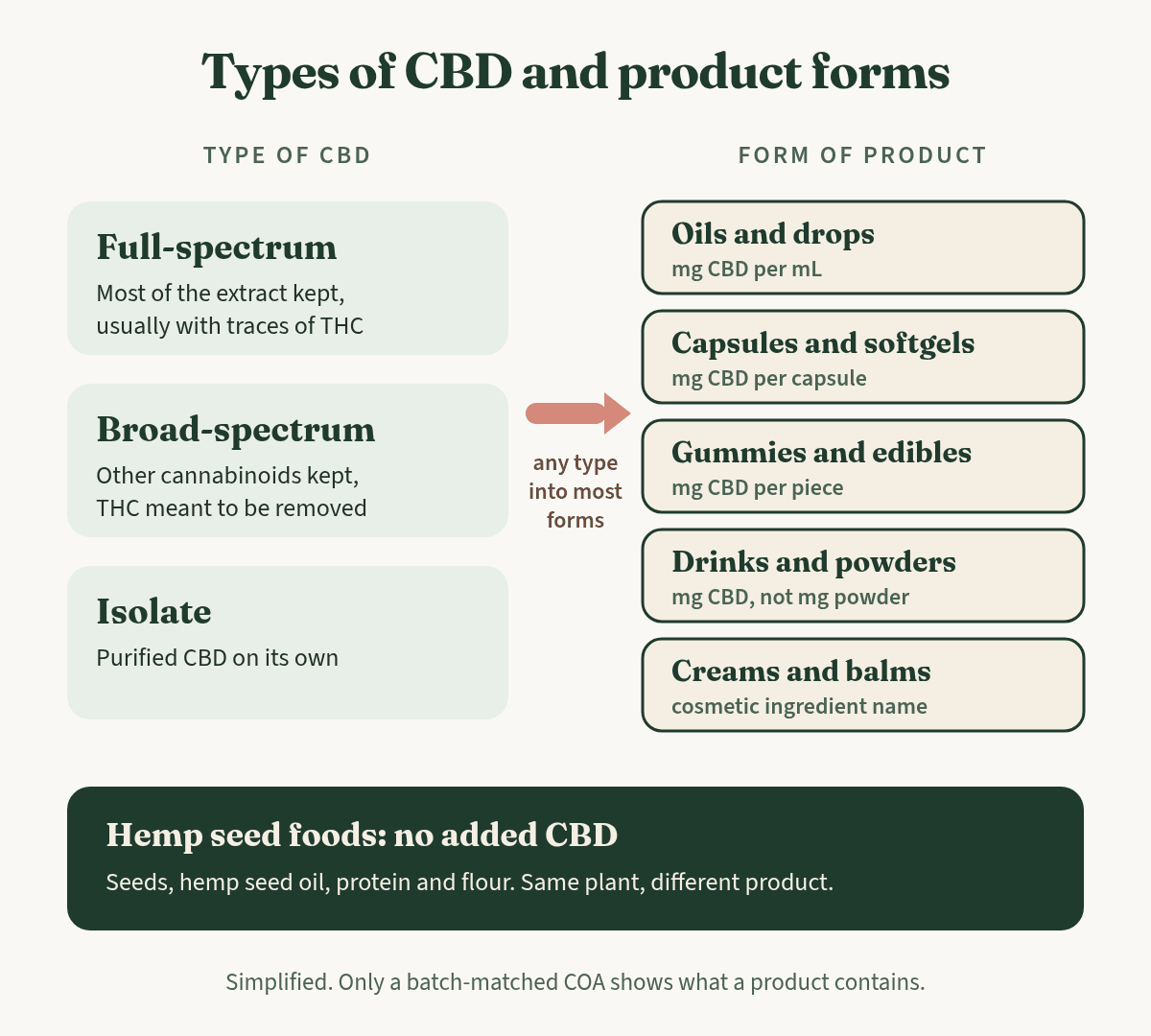
Types of CBD products differ in two separate ways. The first is the type of CBD inside: full-spectrum, broad-spectrum or isolate. The second is the form it comes in, such as an oil, a capsule, a gummy, a drink or a cream.
In principle, any type can go into most forms. A gummy can be made with isolate, and an oil can be full-spectrum. So “what type of CBD is this?” and “what kind of product is this?” are two questions, and a label should answer both. The introduction to CBD covers the compound itself.
There is a third group that often sits on the same shelf: hemp products with no added CBD, such as hemp seed oil and hemp protein. The word “hemp” alone does not say which group a product belongs to.
On this page
- Types of CBD Products at a Glance
- What Are the Three Main Types of CBD?
- What Forms Do CBD Products Come In?
- Hemp Products Without Added CBD
- How to Compare CBD Products Across Forms
- How the Rules Differ by Product Category (2026)
- Frequently Asked Questions
- The Bottom Line
Types of CBD Products at a Glance
| Product | What it is | How it is used | Main check on the label |
|---|---|---|---|
| CBD oil (drops) | CBD extract dissolved in a carrier oil | Drops by mouth | mg of CBD per mL and per bottle |
| Capsules and softgels | CBD oil sealed in a gelatin or plant-based shell | Swallowed | mg of CBD per capsule |
| Gummies and edibles | Sweets or foods with CBD added | Eaten | mg of CBD per piece |
| Drinks and powders | CBD in a water-compatible formulation | Mixed or drunk | mg of CBD, not of powder |
| Creams and balms | Cosmetic products with a CBD ingredient | Applied to the skin | INCI ingredient name |
| Hemp seed foods | Seeds, seed oil, protein, flour | Eaten | No CBD unless added |
The form changes how a product is used. It says nothing about how much CBD or THC is inside.
What Are the Three Main Types of CBD?
The three common labels describe how much of the original hemp extract survives into the CBD ingredient. Hemp extracts contain many cannabinoids, plus aromatic compounds called terpenes. [1]
- Full-spectrum keeps most of the extract, including other cannabinoids and usually small amounts of THC.
- Broad-spectrum keeps other cannabinoids but is meant to have the THC removed.
- CBD isolate is purified CBD on its own.
These are mostly trade terms. One jurisdiction that has defined them in law is New York: since December 2023 its rules have required products sold there that claim to be full-spectrum, broad-spectrum, isolate or distillate to meet the state’s definitions. [2]
Under those rules, full-spectrum means an extract processed “without intentional complete removal of any compound” and containing no more than 0.3% Δ9-THC. Broad-spectrum must have the THC “removed to non-detectable levels”, and isolate must be at least 95% of a single cannabinoid. Distillate, an extract in which cannabinoids have been concentrated by distillation, is a fourth term defined in the same rules. [2]
Elsewhere, the label is usually the brand’s own description. In a 2024 US study of 202 CBD products bought online, 53 of the 149 that named a type did not meet the study’s definition of it. Three broad-spectrum products contained THC. The study was funded by Jazz Pharmaceuticals, which makes a prescription CBD medicine. [3] Those were US products, so the figures do not show how often the same happens in Europe.
What is the difference between a CBD type and a CBD form?
The type is about the ingredient: which compounds the CBD extract contains. The form is about the finished product: how that ingredient is packaged and used.
Two 2026 EFSA opinions show how far apart ingredients can be. One assessed a CBD isolate of at least 98% CBD. [4] The other assessed a hemp extract with 57 to 65% CBD and 9 to 17% other cannabinoids. [5] Either ingredient could, in principle, end up in an oil or a capsule.
The full-spectrum vs broad-spectrum guide compares the three types in detail, including THC and the entourage effect. The guide to how CBD oil is made shows where each ingredient comes from.
Other cannabinoids named on labels
Some products highlight a second cannabinoid. CBG (cannabigerol) comes from CBGA, the acid that the plant converts into the precursors of both CBD and THC. CBN (cannabinol) forms mainly when THC and its acid oxidise, for example as plant material ages. [1]
Products sold for these compounds are covered in CBG vs CBD and the CBN and CBD comparison.
What Forms Do CBD Products Come In?
The forms covered here fall into two groups: products that are swallowed and products applied to the skin. Hemp foods follow in the next section. Vapes, smokable flower and pet products are outside the scope of this guide.
CBD oils and drops
A CBD oil is a CBD ingredient dissolved in a carrier oil such as MCT (medium-chain triglyceride) oil, olive oil or hemp seed oil. It is measured with a dropper, so the strength is given per millilitre. The CBD oil guide covers labels, carrier oils and strengths.
Drops are often held under the tongue. A small randomised crossover trial at Loughborough University, published in 2023, gave eight healthy men the same CBD oil as sublingual drops or in swallowed gelatin capsules. Blood CBD levels did not differ significantly between the two. Peak levels arrived at about four hours in both conditions (Tmax, the time to peak concentration). [6]
The authors suggested the drops were mostly swallowed before much CBD could be absorbed in the mouth. With eight men and one product, the trial cannot show that the two routes are equivalent for everyone. [6]
Capsules and softgels
A capsule or softgel is usually CBD oil sealed inside a shell. Each one holds a fixed amount, so there is no measuring. The shell may be gelatin, which is animal-derived, or a plant-based alternative. [7]
Because the contents are usually an oil, a capsule and a bottle of drops can be closer than they look. The Loughborough trial above used the same oil in both. [6]
Gummies and other edibles
Gummies are sweets made from a gel such as gelatin or pectin, with CBD added to each piece. Gelatin gels soften in warmth, and pectin is the most common plant-based alternative. [7] Chocolates, baked goods and other foods with CBD added also fall in this group.
The guide to CBD gummies covers ingredients, labels and THC. The vegan and sugar-free gummies guide covers gelatin, pectin and polyols. The CBD oil vs gummies comparison sets the two side by side.
Drinks and powders
CBD dissolves poorly in water. Drinks and some powders therefore use water-compatible formulations, such as emulsions, which disperse the oily CBD into tiny droplets. Researchers developing these systems aim to improve how well CBD is absorbed. [8]
The water-soluble CBD guide explains how these work and what “nano” means on a label.
Creams, balms and other skin products
EU cosmetics law covers products applied to the body for cosmetic purposes. It defines a cosmetic product as one intended to be placed on the external parts of the body, or the teeth and mouth, mainly to clean, perfume, protect, change the appearance of, or keep them in good condition, or to correct body odours. [9]
Cosmetics list ingredients by INCI names. The EU’s cosmetic ingredient database, CosIng, has two cannabidiol entries, one for synthetically produced CBD and one for CBD derived from an extract, tincture or resin of cannabis. It lists Cannabis Sativa Seed Oil separately. [10] So a cream naming only the seed oil is a hemp seed product, not a CBD product.
Does the form change how CBD is absorbed?
It can, though the differences are easy to overstate. EFSA’s February 2026 statement concluded that CBD’s bioavailability is variable, influenced by the delivery matrix (what the CBD is formulated in) and by food intake. [11]
Bioavailability is the share of a dose that reaches the bloodstream. Researchers compare forms using peak concentration (Cmax), the time to reach it (Tmax) and total exposure over time (AUC). EFSA noted methodological limitations in many recent human studies, and that the exact composition of the formulations tested was not always known, which makes direct comparisons difficult. [11] A result for one product is no guide to a whole category.
Hemp Products Without Added CBD
Hemp seed oil, hemp hearts, hemp protein and hemp flour are made from the seeds. Hemp seed oil is mostly unsaturated fat, chiefly the omega-6 linoleic acid and the omega-3 alpha-linolenic acid. [12]
Cannabinoids found in hemp seed are a contamination: they come from contact with resin on the bracts around the seed, and the amount depends on the variety and on how well the seed is cleaned. [12] EU maximum levels for THC in hemp seed products have applied since 1 January 2023. [13] They are 3.0 mg/kg for hemp seeds and products made from them, and 7.5 mg/kg for hemp seed oil, both expressed as Δ9-THC equivalents. [14]
The CBD oil vs hemp seed oil guide explains how to tell the two apart on a label.
How to Compare CBD Products Across Forms
The headline number on a pack is rarely comparable between forms. One is per millilitre, another per gummy, another per pack. Converting everything to milligrams of CBD makes products comparable.
- CBD per serving and per pack. For an oil, multiply the concentration (mg/mL) by the volume. For capsules and gummies, multiply the amount per piece by the number of pieces.
- The extract type. Full-spectrum, broad-spectrum or isolate, which affects whether THC may be present.
- THC per serving and per pack. A percentage on its own is hard to compare across forms.
- A batch-matched certificate of analysis (COA). The batch number on the report should match the pack.
- Storage and dates. Oils, capsules and gummies all have a limited shelf life; how CBD products age covers what changes over time.
A fictional example shows the arithmetic. A 10 mL oil at 50 mg/mL holds 10 × 50 = 500 mg of CBD. A pack of 30 capsules at 15 mg each holds 30 × 15 = 450 mg. At €40 for the oil and €36 for the capsules, both work out at 8 cents per mg of CBD. This is a fictional arithmetic example, not a real product, recommended intake or authorised formulation.
What a COA can and cannot show
A COA reports what a laboratory measured in a sample from one batch, using a particular method. It shows composition: how much CBD, THC and other analytes were found, and below which limits others went undetected.
It does not show what the product does in the body, whether it is lawful in a given country or whether other batches are the same. A potency panel also says nothing about pesticides, metals, solvents or microbes unless those were tested separately.
Label accuracy is a real concern. A 2022 US study tested 516 CBD products, edibles and topicals together. Only 42% were within 10% of the labelled CBD content, with more falling short than over. The study was funded by a grant from a subsidiary of Jazz Pharmaceuticals, and the lead author was paid by the Clean Label Project for the work. [15] These were US products tested in one study; they do not show how accurate labels are in Europe.
How the Rules Differ by Product Category (2026)
The same CBD ingredient can fall under different rules depending on the product category. What follows is a dated summary as of 27 October 2026, not legal advice.
Foods and food supplements in the EU. The European Commission’s Novel Food Status Catalogue lists cannabinoid extracts, including CBD, as novel foods. [16] Where an ingredient is a novel food, it needs EU authorisation and a listing on the Union list before it can be sold as food. [17] Whether a particular product falls under these rules, and on what terms, depends on its ingredients and how it is used.
The same catalogue states that hemp seeds, seed oil, hemp seed flour and defatted hemp seed have a history of consumption in the EU, so they are not novel, although national rules may restrict them. [16]
In February 2026 EFSA set a provisional safe intake for CBD that applies only to highly pure CBD (at least 98%) in food supplements under strict conditions, and it found that safety could not be established for some groups, including people under 25. It is not a recommended intake. [11] In September 2026 EFSA published its first positive opinion on a CBD novel food, for synthetic CBD. [18] A safety opinion is a scientific step, not an authorisation.
Cosmetics in the EU. Cosmetic products are covered by their own regulation, Regulation (EC) No 1223/2009, rather than by food law. Whether a skin product is a cosmetic depends on its intended purpose. [9]
Medicines. Epidyolex is a prescription CBD medicine authorised in the EU after assessment by the European Medicines Agency. [19] Its authorisation concerns that specific medicine and says nothing about consumer CBD products.
United Kingdom. The Food Standards Agency regards CBD foods as novel foods, and its June 2026 guidance said no CBD food products had been authorised. [20] In September 2026 its Board considered recommendations to ministers on the first three CBD authorisations; ministers make the final decision. [21]
United States. The FDA’s position is that CBD cannot lawfully be added to food or sold as a dietary supplement. [22] A federal law enacted in 2025 would exclude final hemp-derived products containing more than 0.4 mg of total THC per container from the definition of hemp. [23] That limit is scheduled to apply from 11 December 2026 and was not in force on 27 October 2026. [24] The CBD vs THC guide compares THC limits across countries.
Frequently Asked Questions
How many types of CBD are there?
Three are in common use: full-spectrum, broad-spectrum and isolate. Distillate is a fourth term, used for concentrated extracts. They are mostly trade terms; New York is one jurisdiction that defines them in law. [2]
Which type of CBD has no THC?
Isolate and broad-spectrum are meant to have little or none, but only testing of the batch can show it. “Not detected” on a COA means below the test’s limit, not zero. The UK FSA warns that THC exposure is possible even from products labelled “THC-free”. [20]
Are CBD capsules better absorbed than CBD oil?
One small trial found no significant difference. Eight healthy men took the same oil as drops or in capsules, and blood CBD levels and Tmax were similar. [6] Other formulations may differ, and one trial cannot settle the question. CBD capsules vs CBD oil compares the wider evidence.
Is hemp oil the same as CBD oil?
Not necessarily. “Hemp oil” often means hemp seed oil, which is pressed from the seeds and contains no added CBD. [12] A CBD oil states an amount of CBD in milligrams.
Can a CBD product affect a drug test?
It can’t be ruled out, especially for products containing THC. In a small 2021 US study of a full-spectrum oil with 0.02% THC, 7 of 14 people who completed four weeks of daily use tested positive for a THC metabolite. The study had no comparison group. [25] No CBD product should be assumed to be drug-test safe. The guide to CBD and drug tests covers the wider evidence.
Explore CBD oils · Explore CBD gummies
The Bottom Line
The type of CBD describes the ingredient, and the form describes the product. Full-spectrum, broad-spectrum and isolate can each appear as an oil, capsule, gummy, drink or cream.
The form changes how a product is used and which rules apply. It does not, on its own, say how much CBD or THC is inside, and the small studies comparing forms do not rank one above the others.
Three checks work across every form: milligrams of CBD per serving and per pack, THC per pack, and a COA from the same batch. Our Love CBD review applies them to one brand’s range.
Scientific and Regulatory Sources
Extract types and how they are defined
- Tahir M.N., Raz F.S., Rondeau-Gagné S., Trant J.F. (2021). The biosynthesis of the cannabinoids. Journal of Cannabis Research 3:7. Full study.
- New York State Office of Cannabis Management. 9 NYCRR Part 114, Cannabinoid Hemp: §114.1 Definitions (“broad spectrum”, “distillate”, “full spectrum”, “isolate”) and §114.9(e), as amended effective 13 December 2023. Official text (PDF) · §114.1 (LII).
- Gidal B.E., Vandrey R., Wallin C. et al. (2024). Product labeling accuracy and contamination analysis of commercially available cannabidiol product samples. Frontiers in Pharmacology 15:1335441. Funded by Jazz Pharmaceuticals. Full study.
- EFSA Panel on Nutrition, Novel Foods and Food Allergens (2026). Safety of cannabidiol isolated from Cannabis sativa L. as a novel food pursuant to Regulation (EU) 2015/2283. EFSA Journal (published September 2026). doi.org/10.2903/j.efsa.2026.10318.
- EFSA Panel on Nutrition, Novel Foods and Food Allergens (2026). Safety of Cannabis sativa L. extract as a novel food pursuant to Regulation (EU) 2015/2283. EFSA Journal (published September 2026). doi.org/10.2903/j.efsa.2026.10319.
Product forms, absorption and hemp foods
- Johnson D.A., Funnell M.P., Heaney L.M. et al. (2024; online 2023). Cannabidiol oil ingested as sublingual drops or within gelatin capsules shows similar pharmacokinetic profiles in healthy males. Cannabis and Cannabinoid Research 9(5):e1423–e1432. PubMed · doi.org/10.1089/can.2023.0117.
- Vásquez-Senador M., Pérez-Bermúdez I., Orellana-Palma P., Petzold G. (2026). Gummies: from confectionery to functional hydrogel-based bioactive delivery systems. Gels 12(9):841. Review. Full study.
- Paczkowska-Walendowska M., Trzaskoma P., Dziopa A. et al. (2025). Innovative strategies to enhance the bioavailability of cannabidiol: nanotechnology and advanced delivery systems. Pharmaceuticals 18(11):1637. Review. Full study.
- Regulation (EC) No 1223/2009 of the European Parliament and of the Council of 30 November 2009 on cosmetic products, Article 2(1)(a) (definition of “cosmetic product”). EUR-Lex.
- European Commission. CosIng cosmetic ingredient database: entries Cannabis Sativa Seed Oil (55065), Cannabis Sativa Leaf Extract (97599), Cannabis Sativa Flower/Leaf/Stem Extract (95512), Cannabidiol – Synthetically Produced (93486) and Cannabidiol – Derived from Extract or Tincture or Resin of Cannabis (96287). CosIng.
- EFSA Panel on Nutrition, Novel Foods and Food Allergens (2026). Update of the statement on safety of cannabidiol as a novel food. EFSA Journal 24(2):9862 (published February 2026). Full text (Europe PMC) · EFSA Journal.
- Farinon B., Molinari R., Costantini L., Merendino N. (2020). The seed of industrial hemp (Cannabis sativa L.): nutritional quality and potential functionality for human health and nutrition. Nutrients 12(7):1935. Full study.
- Commission Regulation (EU) 2022/1393 of 11 August 2022 amending Regulation (EC) No 1881/2006 as regards maximum levels of Δ9-THC in hemp seeds and products derived therefrom (recitals 2 to 5, Article 3). EUR-Lex.
- European Commission. Regulation (EU) 2023/915 on maximum levels for certain contaminants in food (Δ9-THC equivalents in hemp seeds and hemp seed products), consolidated text. EUR-Lex.
Label accuracy and testing
- Gardener H., Wallin C., Bowen J. (2022). Heavy metal and phthalate contamination and labeling integrity in a large sample of US commercially available cannabidiol (CBD) products. Science of the Total Environment 851(Pt 1):158110. Funded by Greenwich Biosciences (Jazz Pharmaceuticals). PubMed.
Regulation in the EU, UK and US
- European Commission. Novel Food Status Catalogue (entries “Cannabinoids” and “Cannabis sativa L.”). Official guidance.
- Regulation (EU) 2015/2283 of the European Parliament and of the Council of 25 November 2015 on novel foods, Articles 3, 6 and 10 to 12 (definition, Union list and authorisation procedure). EUR-Lex.
- EFSA Panel on Nutrition, Novel Foods and Food Allergens (2026). Safety of synthetic cannabidiol as a novel food pursuant to Regulation (EU) 2015/2283. EFSA Journal (published September 2026). doi.org/10.2903/j.efsa.2026.10154.
- European Medicines Agency. Epidyolex: European public assessment report. Official EMA information.
- UK Food Standards Agency (22 June 2026). Food Fact Check: CBD safety and health claims. Official FSA blog.
- UK Food Standards Agency (September 2026 Board meeting). CBD novel food applications: recommendations to ministers on first authorisations. Official Board paper.
- US Food and Drug Administration. FDA regulation of cannabis and cannabis-derived products, including cannabidiol (CBD). Official FDA information.
- Public Law 119-37 (enacted 12 November 2025), Division B, section 781 (new definition of hemp). GovInfo.
- Public Law 119-103 (enacted 2 September 2026), section 2019 (phased effective dates). GovInfo.
THC and drug testing
- Dahlgren M.K., Sagar K.A., Lambros A.M., Smith R.T., Gruber S.A. (2021; online November 2020). Urinary tetrahydrocannabinol after 4 weeks of a full-spectrum, high-cannabidiol treatment in an open-label clinical trial. JAMA Psychiatry 78(3):335–337. Full study.
Scientific and regulatory material reviewed: 27 October 2026. This article provides general educational information, not medical advice, legal advice or a product-specific determination of regulatory compliance.