
Last reviewed:
This article is general information, not medical advice. Hemppy does not make CBD products; the shop lists independent brands and links to their own websites. If you buy through one of those links, Hemppy may earn a commission from the brand, and you pay the same price. See our affiliate disclosure. This article does not recommend any specific product.
Reading a CBD oil label comes down to three numbers and one document. Some reports also list terpenes. The numbers are the total CBD in the bottle, the volume of oil and the concentration that follows from them. The document is the batch laboratory report, or certificate of analysis (COA), that should match the bottle.
The large figure on the front, such as “1,000 mg”, is usually the total for the whole bottle. Divide it by the volume in millilitres to get milligrams per millilitre, the number that actually lets two oils be compared. Percentages look simpler but can hide a choice between weight and volume.
Labels are also a starting point, not proof. Independent testing has repeatedly found CBD oils containing more or less CBD than stated, and sometimes THC that was not declared. [1][2][3] The practical skill is checking the label against the lab report, line by line.
The CBD Oil Label at a Glance
| Label line | What it tells you | What to check |
|---|---|---|
| Total CBD (mg) | CBD in the whole bottle | That it is CBD, not “hemp extract” weight |
| Volume (ml) | How much oil there is | Use it to work out mg per ml |
| Percentage | Concentration, by weight or volume | Which basis the brand uses |
| Extract type | Full-spectrum, broad-spectrum or isolate | The cannabinoid list on the COA |
| Ingredients | Extract, carrier oil, flavourings | Allergens and the carrier oil named |
| Batch or lot number | The production run | That it matches the COA |
| Best before date | How long quality holds if stored as stated | Storage instructions |
| Business name and address | Who is responsible for the product | That a real contact is given |
A clean, detailed label is a good sign about the seller’s care. It is not evidence of safety, legality or any effect.
On this page
- The CBD Oil Label at a Glance
- What Is Actually in a CBD Oil?
- How Much CBD Is in the Bottle? mg, ml and %
- Reading the Rest of the Label Line by Line
- How to Check a Label Against the Certificate of Analysis
- How Accurate Are CBD Oil Labels? What Testing Studies Found
- CBD Oil Label Rules in the EU, UK and US (2026)
- Frequently Asked Questions
- The Bottom Line
What Is Actually in a CBD Oil?
A CBD oil is an edible oil to which CBD or a CBD-rich extract has been added. The Belgian food authority describes it in exactly those terms, noting that the base is often hemp seed oil or another edible oil. [4] MCT oil (medium-chain triglycerides) is another carrier: EFSA’s assessment of one synthetic CBD ingredient covered it dissolved in MCT oil. [5] How a hemp seed oil carrier differs from the CBD oil itself is covered in CBD oil vs hemp seed oil.
The extract is where products differ most. Two applications assessed by the European Food Safety Authority in 2026 show the range.
One was a CBD isolate of at least 98% CBD, made by ethanol extraction, winterisation, filtration, decarboxylation and crystallisation. [6] The other was a hemp extract of 57 to 65% CBD plus 9 to 17% other cannabinoids, made by supercritical CO2 extraction followed by further purification and distillation. [7] Both would end up as “CBD oil” once dissolved in a carrier, the last stage of how CBD oil is made. Their cannabinoid profiles would look very different on a lab report.
That is the reality behind three common label words:
- Isolate: highly purified CBD, with little else from the plant.
- Broad-spectrum: CBD with other cannabinoids, from which THC is meant to have been removed.
- Full-spectrum: CBD with other plant cannabinoids, which can include THC.
As of 27 October 2026 we found no definition of these terms in the EU novel food guidance on cannabinoids, so they describe a brand’s claim rather than a regulated category. The COA shows which cannabinoids were measured and at what levels. Our guide to full-spectrum vs broad-spectrum CBD vs isolate compares the three in more depth. For background on the compounds themselves, see What Is CBD?
How Much CBD Is in the Bottle? mg, ml and %
This is where most label confusion starts.
Total CBD vs concentration
The headline milligram figure is the amount of CBD in the whole bottle. On its own it says nothing about strength, because the bottle size can vary.
The concentration is the total divided by the volume:
total CBD (mg) ÷ volume (ml) = CBD per ml
Take two fictional bottles. One holds 500 mg of CBD in 10 ml of oil. The other holds 1,500 mg in 30 ml. The second has three times as much CBD, but both work out at 50 mg per ml. The oil itself is equally concentrated; there is simply more of it.
This is a fictional arithmetic example, not a real product or a suggested amount to take.
If a label gives only “hemp extract” or “cannabinoids” in milligrams, the CBD figure is unknown. An extract can be far from pure CBD, as the 57 to 65% example above shows. [7]
What the percentage means
A label that says “5% CBD” is stating a concentration, but there are two ways to calculate it.
By volume (w/v), 5% means 5 g of CBD per 100 ml of oil, which is 50 mg per ml. By weight (w/w), 5% means 5 g per 100 g of oil, which is 50 mg per gram.
The two only match if a millilitre of the oil weighs exactly one gram. Suppose a carrier oil weighs 0.92 g per ml, an assumed figure for this example. A 5% w/w oil then holds about 46 mg per ml (50 × 0.92), not 50.
This is a fictional arithmetic example. The point is the unit, not the figure: when two brands both say “5%”, compare their mg per ml or their total mg per bottle instead. CBD oil 10% vs 5% works through the same conversions for common strengths.
Laboratory reports can use yet another unit. Published product tests have reported CBD in mg/ml and as a percentage of product weight. [1][3] Convert to one unit before comparing a COA with a label.
Drops are estimates
Many labels describe servings in drops or “a full dropper”. A drop is not a fixed unit of volume, so a milligrams-per-drop figure is only an approximation. A dropper with millilitre markings gives a firmer basis for the arithmetic.
Comparing cost works the same way: divide the price by the total milligrams of CBD. CBD Oil vs CBD Gummies works through that calculation across formats, and the overview of CBD product types applies it to capsules as well.
Reading the Rest of the Label Line by Line
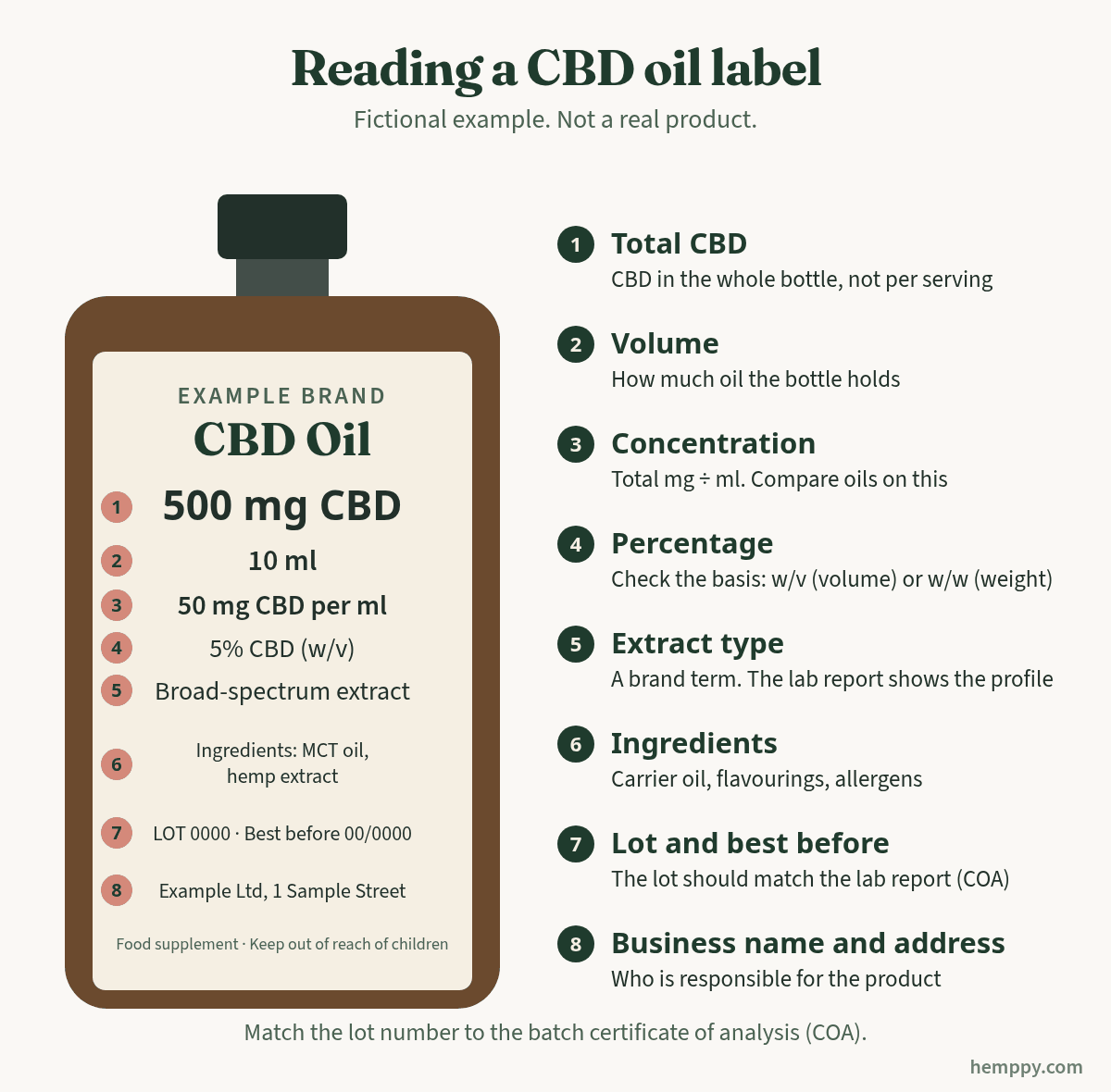
Most of the remaining lines on a CBD oil label are standard food-label information. In the EU and the UK, Regulation (EU) No 1169/2011 lists the mandatory particulars for prepacked food. They include the name of the food, the ingredients list, allergens, net quantity, a date of minimum durability, storage conditions and the name and address of the responsible food business. [8]
Ingredients and allergens
The ingredients list should name the carrier oil and any flavourings, sweeteners or other additions. Ingredients that cause allergies or intolerances must be declared and emphasised. [8] Anyone with an allergy should read this line in full, not just the front panel.
Best before date and storage
The “best before” date is a date of minimum durability: the date until which the food keeps its specific properties when properly stored. [8] The condition matters. If the label says to store the oil away from heat and light, the date assumes that was done. What stability studies found about how long CBD oil keeps is covered in Does CBD Oil Expire?
Batch or lot number
A lot is a batch of sales units produced, manufactured or packaged under practically the same conditions. EU law generally requires food to carry a lot indication. [9] On a CBD oil, that code is the link between the bottle and its lab report.
Business name and address
The label must name the food business responsible and give an address. [8] The UK Food Standards Agency suggests checking for a business name, a contact address, an ingredients list and the CBD content per serving before buying. [10]
Food supplement wording
Many CBD oils are presented as food supplements. In the EU, supplement labels must carry five extra statements. [11]
- the category of nutrients or substances in the product
- the portion recommended for daily consumption
- a warning not to exceed that portion
- a statement that supplements are not a substitute for a varied diet
- a reminder to keep the product out of reach of young children
The recommended portion is the seller’s statement. It is not a safety assessment or an authorisation, and regulators’ own safety positions on CBD intake are summarised in What Is CBD?
Claims that should not be there
EU food law prohibits attributing to a food, including a food supplement, the property of preventing, treating or curing a human disease. [8][11] Health claims also need prior authorisation, and we found no authorised health claim for CBD in the EU Register. [12]
So a CBD oil label promising to ease pain, anxiety or sleep problems is a warning sign, not a selling point. The FSA advises caution about CBD products making medical claims. [10]
How to Check a Label Against the Certificate of Analysis
The COA is the only document that shows what a laboratory measured. It is worth reading slowly. A step-by-step guide to reading a CBD lab report adds an annotated example.
Match the report to the bottle
Start with identity. The batch or lot number on the COA should match the one on the bottle. A report for a different batch, or with no batch number at all, describes some other oil.
Then check four things:
- The laboratory: a named lab, ideally accredited to ISO/IEC 17025, the international standard for the competence of testing laboratories. [13]
- The date: when the sample was tested, compared with the production and best before dates.
- The units: mg/ml, mg/g or %, so the comparison with the label is like for like.
- The scope: which cannabinoids were measured, and whether contaminants were tested at all.
A worked example
Suppose an illustrative label states 50 mg of CBD per ml in a 10 ml bottle, so 500 mg in total. Its COA reports:
| Analyte | Reported result |
|---|---|
| CBD | 47.5 mg/ml |
| CBDA | 1.2 mg/ml |
| Δ9-THC | < LOQ (0.01 mg/ml) |
| THCA | Not detected |
This is a fictional example, not a real product, recommended intake or authorised formulation.
The CBD result is 95% of the labelled 50 mg per ml (47.5 ÷ 50). The US and UK testing studies discussed below both treated a result within 10% of the label as accurate. [1][3] That threshold is a research convention, not a legal tolerance.
The THC line needs more care. “< LOQ” means below the limit of quantification: the lab could not measure an amount reliably below 0.01 mg per ml. It does not mean zero. In a 10 ml bottle, up to 0.1 mg of THC could in principle sit below that line (0.01 × 10).
US rules also count the acid form. USDA rules calculate total THC as Δ9-THC plus 0.877 × THCA. [14] A report that shows only Δ9-THC can understate that total.
What a COA cannot tell you
A potency panel covers cannabinoids. It does not cover pesticides, heavy metals, residual solvents or microbes unless those panels were run too. When researchers tested 29 UK products in 2020, they ran separate analyses for cannabinoids, residual solvents and heavy metals, using different instruments for each. [3]
Results can also differ between laboratories. The US National Institute of Standards and Technology runs a cannabis laboratory quality assurance programme for exactly that reason: to help labs check that their measurements are comparable. [15]
And a COA describes a sample, not every bottle. It says nothing about effects, safety at any intake, or whether a product may legally be sold where it is offered. CBN vs CBD shows how the minor cannabinoid lines on a report can be misread too.
How Accurate Are CBD Oil Labels? What Testing Studies Found
Three independent studies give a sense of the problem.
United States, 2017. Bonn-Miller and colleagues bought 84 CBD products from 31 companies online in 2016 and had them analysed blind. Across all products, 31% were within 10% of the labelled CBD, 43% contained more and 26% less. Oils fared better than the other formats: 18 of 40 (45%) were accurately labelled. THC was detected in 18 of the 84 products. [1]
The study was funded by a nonprofit research institute, and some authors reported fees from cannabis and pharmaceutical companies. [1]
Europe, 2018. Pavlovic and colleagues analysed 14 CBD oils sold in European countries. Nine had CBD concentrations that differed notably from the declared amount; five were within the expected limits. [2] The authors declared no conflicts of interest.
United Kingdom, 2020. Liebling and colleagues tested 29 widely available products blind. The mean advertised CBD content was 4.5%, but the mean measured content was 3.2%. Only 11 products (38%) were within 10% of the label. Over half (55%) contained measurable THC or CBN. [3] The Centre for Medicinal Cannabis funded the testing, and two authors reported advisory roles with cannabinoid companies. [3]
These studies are small and were published between 2017 and 2020. They cannot say how accurate any brand is today. What they do show is consistent: the number on the front of a bottle is a claim that needs checking. That is why the COA, and a batch number that matches it, carry so much weight. The THC side of this is covered in more depth in CBD vs THC.
CBD Oil Label Rules in the EU, UK and US (2026)
A complete label does not mean a product is authorised.
European Union. The European Commission’s Novel Food Status Catalogue lists CBD extracts used in food as novel foods, which need authorisation before sale; whether a particular product is caught, and on what terms, depends on what it contains and how it is used. [16] As of 27 October 2026 we found no authorised CBD novel food on the Union list. [17] EFSA’s September 2026 opinions found one synthetic CBD ingredient safe at up to 2 mg a day under defined conditions, and could not establish safety for two others. Opinions are not authorisations. [5][6][7]
United Kingdom. The FSA classes CBD foods as novel foods that need authorisation. Products linked to applications under assessment appear on the FSA’s public list, which the FSA advises checking before buying. [10] In September 2026 an FSA Board paper recommended that ministers authorise the first three high-purity CBD foods; ministers decide, and as of 27 October 2026 we found no decision. [18]
United States. The FDA’s position is that CBD cannot lawfully be added to food sold across state lines or sold as a dietary supplement. [19] From 11 December 2026, federal law is scheduled to exclude from “hemp” any final product with more than 0.4 mg per container of total THC combined with similar cannabinoids, unless Congress changes the date again. That date had not been reached on 27 October 2026. [20][21]
That container limit turns a label line into arithmetic. A fictional 30 ml oil at 0.02 mg of THC per ml holds 0.6 mg in the bottle (30 × 0.02), which is above 0.4 mg even though the per-ml figure looks tiny.
These summaries are dated and simplified. They are not a legal assessment of any product.
Frequently Asked Questions
What does “1,000 mg” mean on a CBD oil?
Usually the total CBD in the whole bottle. Divide it by the volume to get the concentration: 1,000 mg in 10 ml is 100 mg per ml, while 1,000 mg in 30 ml is about 33 mg per ml. Check that the figure refers to CBD, not to total hemp extract.
What does “10% CBD oil” mean?
It means 10 parts CBD per 100 parts oil, by weight or by volume. By volume that is 100 mg per ml; by weight it is 100 mg per gram, which converts to a different figure per ml. The total milligram figure is the firmer basis for comparison.
Does CBD oil expire?
Labels carry a best before date, which marks how long the oil keeps its specific properties when stored as instructed. [8] After that date, quality is no longer guaranteed by the seller. The label’s storage conditions are part of that promise. Our CBD oil shelf life guide covers storage and what changes in the bottle.
What does “THC-free” mean on a label?
It is a marketing phrase, not a measurement. Check the THC lines on the batch COA, including THCA and the limit of quantification. The UK FSA warns that people may be exposed to THC even from products labelled “THC-free”. [10] No cannabinoid product should be assumed to be drug-test safe.
Is a QR code on the bottle enough?
Only if it leads to a report for the same batch. Scan it, then check that the batch number, product name and date on the report match the bottle in hand.
Whether partner shop links are shown depends on your country.
The Bottom Line
Reading a CBD oil label is mostly arithmetic and matching.
The total milligrams and the volume give the concentration. The percentage needs a basis, weight or volume, before it means anything. Ingredients, best before date, lot number and business address are ordinary food-label lines, and their absence is informative.
The COA is what turns a label into something checkable. Three questions cover most of it: Does the report match this batch? Does the measured CBD match the label? And what do the THC lines actually say?
Asking them is more useful than any adjective on the front of a bottle.
Ready to shortlist brands Hemppy already lists? Open Best CBD oil for Endoca, Love CBD and NuLeaf Naturals compared on labelled milligrams, public lab links and ship-to notes.
Scientific and Regulatory Sources
Product composition and label-accuracy studies
- Bonn-Miller M.O., Loflin M.J.E., Thomas B.F., Marcu J.P., Hyke T., Vandrey R. (2017). Labeling accuracy of cannabidiol extracts sold online. JAMA 318(17):1708–1709. Full study.
- Pavlovic R. et al. (2018). Quality traits of “cannabidiol oils”: cannabinoids content, terpene fingerprint and oxidation stability of European commercially available preparations. Molecules 23(5):1230. Full study.
- Liebling J.P., Clarkson N.J., Gibbs B.W., Yates A.S., O’Sullivan S.E. (2022; online 2020). An analysis of over-the-counter cannabidiol products in the United Kingdom. Cannabis and Cannabinoid Research. Full study.
- Belgian Federal Public Service Health, Food Chain Safety and Environment (August 2026). Questions and answers on the use of hemp (Cannabis sativa L.) and cannabinoids (such as cannabidiol) as or in food, question 11. Official FAQ (PDF).
- EFSA NDA Panel (2026). Safety of synthetic cannabidiol as a novel food pursuant to Regulation (EU) 2015/2283. EFSA Journal 24(9) (published September 2026). doi.org/10.2903/j.efsa.2026.10154.
- EFSA NDA Panel (2026). Safety of cannabidiol isolated from Cannabis sativa L. as a novel food pursuant to Regulation (EU) 2015/2283. EFSA Journal 24(9) (published September 2026). doi.org/10.2903/j.efsa.2026.10318.
- EFSA NDA Panel (2026). Safety of Cannabis sativa L. extract as a novel food pursuant to Regulation (EU) 2015/2283. EFSA Journal 24(9) (published September 2026). doi.org/10.2903/j.efsa.2026.10319.
Food labelling law and guidance
- European Parliament and Council. Regulation (EU) No 1169/2011 on the provision of food information to consumers, Articles 2(2)(r), 7, 9 and 21. EUR-Lex.
- European Parliament and Council. Directive 2011/91/EU on indications or marks identifying the lot to which a foodstuff belongs, Articles 1 and 2. EUR-Lex.
- UK Food Standards Agency (22 June 2026). Food Fact Check: CBD safety and health claims. Official FSA blog.
- European Parliament and Council. Directive 2002/46/EC on food supplements, Article 6. EUR-Lex.
- European Commission. EU Register of Nutrition and Health Claims. Official register.
Laboratory testing and THC calculation
- International Organization for Standardization. ISO/IEC 17025:2017, General requirements for the competence of testing and calibration laboratories. Official ISO page.
- US Department of Agriculture. 7 CFR 990.1, Domestic Hemp Production Program: definitions (“Hemp”, “Total THC”). eCFR.
- Yarberry A. et al. (2024). Cannabis Laboratory Quality Assurance Program: Exercise 2 Cannabinoid Final Report (NIST IR 8519). National Institute of Standards and Technology. Official report.
CBD regulation in the EU, UK and US
- European Commission. Novel Food Status Catalogue (entries “Cannabinoids” and “Cannabis sativa L.”). Official guidance.
- European Commission. Union list of authorised novel foods. Official Union list information.
- UK Food Standards Agency (September 2026 Board meeting). CBD novel food applications: recommendations to ministers on first authorisations. Official Board paper.
- US Food and Drug Administration. FDA regulation of cannabis and cannabis-derived products, including cannabidiol (CBD): questions and answers. Official FDA information.
- Public Law 119-37 (approved 12 November 2025), Division B, section 781 (new definition of hemp). GovInfo.
- Public Law 119-103, Continuing Appropriations and Extensions Act, 2027 (approved 2 September 2026), section 2019. GovInfo.
Scientific and regulatory material reviewed: 22 October 2026; legal and regulatory summary re-checked: 27 October 2026. This article provides general educational information, not medical advice or a product-specific determination of regulatory compliance.