
This article is general information, not medical advice. Hemppy does not sell products. Our shop, opening soon, will link to partner brands’ own websites, where you buy from the brand directly. If you buy through one of those links, Hemppy may earn a commission from the brand. This article does not recommend any specific product.
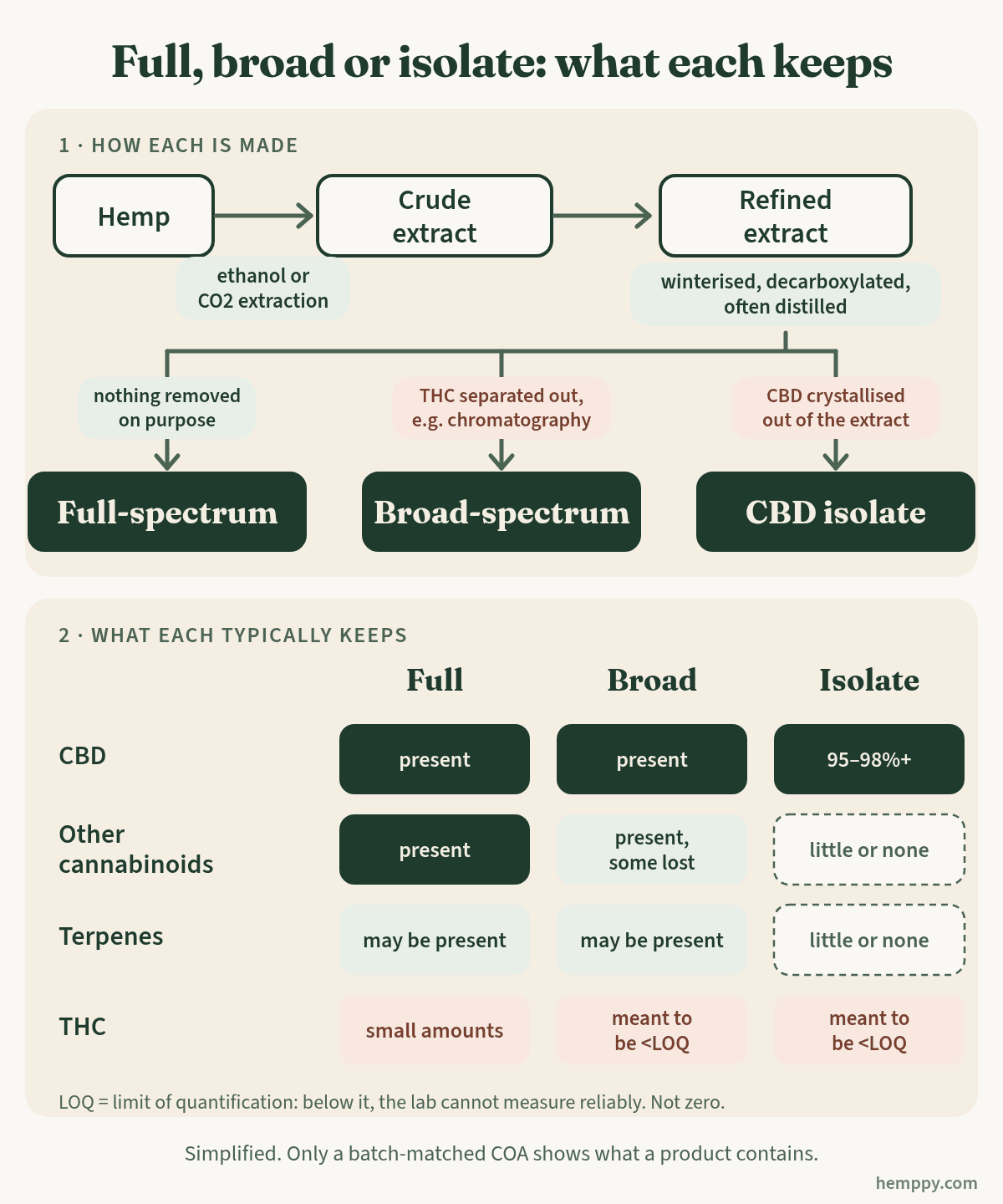
Full-spectrum vs broad-spectrum CBD comes down to what else the extract keeps besides CBD. Full-spectrum keeps most of the hemp extract, including small amounts of THC. Broad-spectrum keeps other cannabinoids but is meant to have the THC removed. CBD isolate is CBD on its own.
The three words are trade labels rather than regulated categories in most of the world. In one US laboratory audit, about a third of products that named a type did not meet the definition of it. [1] In practice the THC question matters most, because it affects drug tests and the legal limits that apply in different countries.
The entourage effect, the idea that the whole extract works better than CBD alone, is the usual selling point for full-spectrum oils. The research behind it is thinner than the marketing suggests. The most reliable guide to any product is the cannabinoid panel on its batch lab report, not the word on the front.
On this page
- Full-Spectrum, Broad-Spectrum and Isolate at a Glance
- What Do the Three Labels Mean?
- How Each Type Is Made
- Does Full-Spectrum CBD Contain THC? The Rules in 2026
- Full-Spectrum vs Broad-Spectrum vs Isolate and Drug Tests
- The Entourage Effect: What Does the Research Show?
- How to Check the Type on a Certificate of Analysis
- Which Type Fits Which Preference?
- Frequently Asked Questions
- The Bottom Line
Full-Spectrum, Broad-Spectrum and Isolate at a Glance
| Full-spectrum | Broad-spectrum | CBD isolate | |
|---|---|---|---|
| What the label signals | Most of the extract kept | Extract kept, THC removed | CBD alone |
| THC | Usually present in small amounts | Meant to be non-detectable | Meant to be absent; traces possible |
| Other cannabinoids (CBG, CBC, CBN) | Present | Present; some can be lost in processing | Little or none |
| Terpenes | May be present | May be present | Little or none |
| Legal definition | None in EU, UK or US federal rules we checked; New York defines it | Same; New York: THC non-detectable | Same; New York: at least 95% one cannabinoid |
| EFSA’s 2026 provisional CBD intake figure | Does not apply | Does not apply | Applies only to CBD of at least 98% purity |
| How to check | Full cannabinoid panel on the COA | THC lines and the test’s limit | Purity and THC lines |
None of the three types has been shown to be more effective than the others.
What Do the Three Labels Mean?
Hemp extracts contain many cannabinoids, plus aromatic compounds called terpenes. The labels describe how much of that mixture survives into the final ingredient. A separate introduction covers cannabinoids and CBD itself.
Full-spectrum
Full-spectrum means the extract has been refined but not stripped of any particular compound. New York’s definition captures the usual industry meaning: an extract with multiple hemp-derived cannabinoids, terpenes and other natural compounds, processed “without intentional complete removal of any compound” and without added isolated cannabinoids. It must contain no more than 0.3% Δ9-THC. [2]
Broad-spectrum
Broad-spectrum keeps several cannabinoids but has the THC taken out. In New York the THC must be “removed to non-detectable levels” using a test with a limit of quantification below 0.01% THC. [2] That detail matters. “Non-detectable” depends on how sensitive the test was.
CBD isolate and distillate
CBD isolate is highly purified CBD, made by crystallisation. New York sets the bar at 95% or more of a single cannabinoid. [2] The isolate assessed by EFSA in 2026 was at least 98% CBD. [3]
Distillate sits between the crude extract and the isolate. It is an extract in which cannabinoids have been concentrated by heating and cooling, a process called distillation. [2]
Is there a legal definition?
Mostly not. As of 22 October 2026, we found no definition of “full-spectrum”, “broad-spectrum” or “isolate” in the EU novel food guidance on cannabinoids, the UK Home Office factsheet on CBD or the US federal definition of hemp. [4][5][6]
The Home Office does use the phrase “full spectrum analysis”, but for an accredited laboratory test of controlled cannabinoids, not for a product type. [5]
The exception we found is New York. Since December 2023, any cannabinoid hemp product sold there that claims to be isolate, full-spectrum, broad-spectrum or distillate must meet the state’s definitions. [2] Elsewhere, the label is usually the brand’s own description.
Audits show why that matters. A 2024 study funded by Jazz Pharmaceuticals, which makes a prescription CBD medicine, tested 202 CBD products bought online in the US in late 2021. [1]
Of the 149 that named a type (84 full-spectrum, 28 broad-spectrum, 37 isolate), 53 did not meet the study’s definition of it. Its definitions were strict, and most failures were products in which no cannabinoids other than CBD and THC were detected. Three of the broad-spectrum products contained THC, two of them above 0.3%. [1]
How Each Type Is Made
All three usually start the same way. Hemp is extracted with a solvent such as ethanol or supercritical carbon dioxide, giving a crude extract. [3][7]
The crude extract carries plant fats and waxes, which a step called winterisation can remove. [8] The acid forms of the cannabinoids, such as CBDA, are converted to their neutral forms, such as CBD, by heat in a reaction called decarboxylation. [9]
From there the routes split, as two 2026 EFSA opinions show. An extract of 57 to 65% CBD with 9 to 17% other cannabinoids was made by CO2 extraction, winterisation, decarboxylation, purification and high-vacuum distillation. [7] A CBD isolate of at least 98% purity was made by ethanol extraction, winterisation, filtration, decarboxylation and crystallisation. [3] EFSA could not establish the safety of either, because the applicants did not supply data it had requested.
Taking the THC out
Broad-spectrum ingredients need an extra step to separate the THC. One method is chromatography, which separates compounds by how they move through a column or between two liquids. [10]
A 2025 study from Colombia shows what that step can and cannot do. Researchers turned 800 g of full-spectrum extract into 613 g of “THC-free” broad-spectrum extract. It contained 85% CBD and 0.02% THC, which met their target of less than 0.05%. [10]
Two details stand out. “THC-free” here meant below a specification, not zero. And 97% of the cannabichromene (CBC) stayed behind in the separated fraction, so removing THC also removed most of another cannabinoid. [10] Broad-spectrum is not necessarily full-spectrum minus the THC alone.
Does Full-Spectrum CBD Contain THC? The Rules in 2026
Usually, yes, in small amounts. How much is allowed depends on the country, and the rules use different units. What follows is a dated summary as of 22 October 2026, not legal advice. The CBD vs THC guide compares the limits side by side.
European Union
Hemp grown under the EU farm payment rules must contain no more than 0.3% THC, a rule about the plant rather than a finished oil. [11] EU food law sets THC limits for hemp seed products; we found no equivalent EU-wide limit for CBD extracts. [12] Hemp seed oil and CBD oil are different products; CBD oil vs hemp seed oil explains how.
The European Commission treats cannabinoid extracts as novel foods that need authorisation before sale. [4] In February 2026 EFSA set a provisional safe intake for CBD of 0.0275 mg per kg of body weight a day, about 2 mg for a 70 kg adult. [13]
It applies only to food supplements with CBD of at least 98% purity, without nanoparticles, made by a process considered safe and with genotoxicity ruled out. Ingredients below 98% total cannabinoids need additional assessment. [13] So the figure cannot be read across to full-spectrum or broad-spectrum extracts, and it is neither a recommended intake nor an authorisation.
In September 2026 EFSA’s first positive opinion went to synthetic CBD, not to a plant extract. [14] An opinion is still not an authorisation, and national drug and food laws differ.
United Kingdom
Pure CBD is not a controlled drug, but THC is. The Home Office considers it highly likely that CBD products contain traces of controlled cannabinoids. A product escapes control only if it meets the “exempt product” conditions, which include no more than 1 mg of any controlled cannabinoid per component part, such as a bottle. [5]
The Food Standards Agency treats CBD foods as novel foods. As a safety figure, it has set an upper limit of 0.07 mg of THC a day for a healthy adult. It also warns that THC exposure is possible even from products labelled “THC-free”. [15] The first three applications recommended to ministers in September 2026 were all high-purity CBD of at least 98%: one synthetic and two isolates. Ministers decide. [16]
United States
Federal law currently defines hemp as cannabis with no more than 0.3% Δ9-THC on a dry-weight basis. [6] A 2025 law replaces that with a total THC test that includes THCA. It also excludes final hemp products containing more than 0.4 mg of total THC and similar cannabinoids per container. [17] A 2026 law set those changes to take effect in stages on 12 November and 11 December 2026, and Congress could still change them. [18]
The container limit turns a percentage into arithmetic. The full-spectrum oil in one US trial contained 0.23 mg of Δ9-THC per ml, or 0.02% by weight. [19] A hypothetical 30 ml bottle would hold about 6.9 mg (30 × 0.23), many times the 0.4 mg figure.
The FDA’s position remains that CBD cannot lawfully be added to food or sold as a dietary supplement, and state laws differ. [20]
Full-Spectrum vs Broad-Spectrum vs Isolate and Drug Tests
Standard workplace drug tests look for a THC metabolite, not for CBD. So the risk depends on how much THC a product contains and how often it is used. This is where the three types differ most.
In a small Johns Hopkins study, six adults took 100 mg of pure CBD. Only 1 of 218 urine samples screened positive at the most sensitive cutoff, and none confirmed positive. After vaporised CBD-dominant cannabis containing 3.7 mg of THC, four samples confirmed positive. [21]
Daily full-spectrum oil gave a different picture. In an open-label study from McLean Hospital, 15 adults took an oil with 0.02% THC three times a day for four weeks, about 0.8 mg of THC a day. Of the 14 who finished, 7 tested positive for the THC metabolite. The study was small, had no comparison group and was funded by private donations. [19]
Broad-spectrum products raise a separate issue in sport. The World Anti-Doping Agency’s 2026 list exempts cannabidiol but prohibits other cannabinoids in competition. [22]
In a 2026 UK study, 31 adults took a broad-spectrum CBD product daily for ten weeks and 5 took a placebo. No THC was found. But CBG appeared in 42% and cannabidivarin (CBDV) in 68% of urine samples before exercise, and more often afterwards. The authors advised athletes to avoid broad-spectrum products. [23]
| Study | Product | People | What was observed | What remains uncertain |
|---|---|---|---|---|
| Spindle et al., 2020 | Pure CBD, single 100 mg doses | 6 | No confirmed THC positives | Single doses; not daily use |
| Dahlgren et al., 2021 | Full-spectrum oil, 0.02% THC, 4 weeks | 14 completers | 7 positive for THC metabolite | No control group; one product |
| Gillham et al., 2026 | Broad-spectrum, 10 weeks | 31 (+5 placebo) | No THC; CBG and CBDV in urine | One product; sport-testing focus |
Label accuracy adds uncertainty to all three. A 2017 analysis of 84 CBD products bought online found THC in 18 of them. [24] A 2025 analysis found Δ9-THC in 39% of 56 CBD gummy products. [25]
The most defensible conclusion is that pure CBD appears unlikely to cause a positive THC test on its own, while daily full-spectrum use can. But the label is not a reliable guide to which one a product is. No cannabinoid product should be assumed to be drug-test safe.
The Entourage Effect: What Does the Research Show?
The entourage effect is the claim that CBD works better alongside the plant’s other compounds than on its own. It is the main argument made for full-spectrum products. The evidence is more limited, and more interesting, than the claim.
Where the idea comes from
The term was coined in 1998, and not about cannabis products. Researchers in Raphael Mechoulam’s group found that two compounds made by the body, inactive on their own, increased the activity of the body’s own cannabinoid 2-AG in cell and mouse experiments. [26] The idea was later extended to plant extracts and full-spectrum products. [27]
What laboratory and animal studies have found
The most popular version holds that terpenes strengthen cannabinoids at their receptors. Two laboratory groups tested this directly.
A 2020 New Zealand study found that five common cannabis terpenes, alone or mixed, did not change how THC or CBD acted at the CB1 and CB2 receptors. The one possible exception was a weak interaction of one terpene with CB2. [28] An Australian study the same year found that seven terpenes neither activated two other receptor channels, TRPA1 and TRPV1, nor changed how cannabinoids acted on them. [29]
A 2023 study in rats compared commercial isolate, broad-spectrum and full-spectrum oils at the same CBD dose. CBD’s oral bioavailability was somewhat higher with the full-spectrum oil. The same increase appeared when the researchers simply added 0.2% THC to an isolate, which points to THC rather than terpenes or minor cannabinoids. [30] Rat data do not predict how a person will respond.
What human studies have found
Human evidence is sparse. In a 2024 Johns Hopkins trial, 20 healthy adults inhaled THC with and without the terpene d-limonene. Adding limonene to the higher THC dose lowered ratings of feeling anxious and paranoid, while other effects were unchanged. The US National Institute on Drug Abuse funded the trial, and Johns Hopkins later filed a patent application naming three of the authors. [31] It concerned THC, not CBD products.
A 2018 meta-analysis pooled 11 observational studies of 670 people with treatment-resistant epilepsy who used CBD-rich extracts or purified CBD. Improvement was reported more often with extracts (71% vs 46%). On the standard clinical measure, at least a 50% fall in seizures, there was no significant difference (37% vs 42%). [32]
The extract groups also reported much lower doses, and two of the three authors worked for cannabis companies. They wrote that an entourage explanation remained “to be confirmed in controlled clinical studies”. [32] These were studies of a serious medical condition, not of consumer oils.
We found one small randomised trial that compared full-spectrum and broad-spectrum CBD directly. In 2025, 44 adults with alcohol use disorder took full-spectrum CBD, broad-spectrum CBD or placebo for eight weeks. Its main aim was to test feasibility and tolerability, and side effects and drop-out did not differ between groups. [33]
The full-spectrum group reported larger falls in craving but not fewer drinks per drinking day, and the authors called for larger studies. The products came from a hemp company; the authors declared no conflicts. [33]
The two CBD products differed mainly in THC, 0.41 mg per capsule against none, while CBC, CBG and terpenes were barely present. [33] A comparison labelled “full vs broad” can in practice be one of THC vs no THC.
What the reviews conclude
Four recent reviews reach similar verdicts. A 2023 scoping review called the research “in its infancy”, with simplistic methods, contradictory findings and clinical support resting mostly on anecdotal and real-world data. [27] A 2024 review found limited evidence of a “stable and predictable” effect and warned against promoting it as proven. [34]
Another 2024 review found no clinical trials designed to validate the effect and called it “unproven”. [35] A 2026 review described the human evidence as “exceptionally limited”. [36] Authors of three of the four reviews are employed by, or declared links to, private companies.
That does not mean researchers have found nothing. Some combinations do change effects, at least for THC. [36] But the most defensible conclusion is that no full-spectrum, broad-spectrum or isolate product has been shown in controlled human trials to work better than another.
How to Check the Type on a Certificate of Analysis
A certificate of analysis (COA) is the batch lab report. Its cannabinoid panel is where the three types become visible, so start there. The CBD oil label guide explains the rest of a COA, from batch numbers to contaminant tests.
Check these lines:
- Which cannabinoids were tested. A panel with only CBD and THC cannot show full or broad spectrum.
- Δ9-THC and THCA. US rules count total THC as Δ9-THC plus 0.877 × THCA. [37]
- “ND” and “<LOQ”. Not detected, or below the limit of quantification, under that test. Neither means zero.
- Units and batch number. mg/g, mg/ml and % differ, and the batch must match the product.
Minor cannabinoids such as CBG and CBN often appear on full panels. Their presence alone says little about quality or effect. A batch can also change with age and storage, which Does CBD Oil Expire? covers.
A worked example: three panels side by side
Suppose an illustrative lab reports these results for three oils, each with 50 mg of CBD per gram:
| Analyte (mg/g) | Oil A | Oil B | Oil C |
|---|---|---|---|
| CBD | 50.0 | 50.0 | 50.0 |
| CBG | 1.1 | 1.0 | ND |
| CBC | 0.6 | <LOQ | ND |
| CBN | 0.2 | 0.2 | ND |
| Δ9-THC | 0.6 | <LOQ | <LOQ |
| THCA | 0.3 | ND | ND |
| LOQ for THC | 0.05 | 0.05 | 0.05 |
This is a fictional example, not a real product, recommended intake or authorised formulation.
Oil A reads as full-spectrum. Its total THC is 0.6 + (0.877 × 0.3) = 0.86 mg/g. In a 30 g bottle that is about 26 mg. Oil B reads as broad-spectrum: other cannabinoids, THC below the limit, CBC reduced. Oil C reads as an isolate in a carrier oil.
Now look again at Oil B. “<LOQ” at 0.05 mg/g means up to 0.05 mg in every gram could be present unmeasured. Across 30 g, that is up to 1.5 mg. A low limit of quantification tells you more than the word “broad”.
“THC-free” on a label
“THC-free” is a marketing phrase, not a measurement. The UK FSA warns that people may be exposed to THC even from products labelled that way. [15] A batch-matched result below a sensitive limit is the closest a lab can come to showing it.
Which Type Fits Which Preference?
None of the three has been shown to work better. They differ in composition, and that matters to different people for different reasons.
| If the priority is… | Look for | Keep in mind |
|---|---|---|
| No measurable THC | Isolate or broad-spectrum with a low LOQ | Traces remain possible; check the batch COA |
| Other cannabinoids as well as CBD | Full or broad, with a full panel | No proven advantage in human trials |
| A plant-like taste or smell | Full or broad with terpenes listed | A cannabinoid panel does not measure terpenes |
| Workplace or sport testing | Ask the employer or sport body first | No product is guaranteed test-safe |
| Comparing prices | Price per mg of CBD | Compare within the same type |
All three types come in oils and gummies, so the extract type is a separate decision from the format. That article also works through price per milligram.
Frequently Asked Questions
Does full-spectrum CBD get you high?
Not in the one study we found that asked. In the four-week McLean study, no participant reported intoxication at about 0.8 mg of THC a day, although half tested positive for THC. [19] That was one product at one THC level, and higher-THC products are a different matter.
Is broad-spectrum CBD THC-free?
Not necessarily. Broad-spectrum is meant to have THC removed to non-detectable levels, but a 2024 audit found THC in 3 of 28 products labelled broad-spectrum. [1] The batch COA and its limit of quantification are the only way to check.
Is CBD isolate stronger than full-spectrum CBD?
Stronger in which sense? An isolate is purer CBD per gram of ingredient, but strength on a label depends on milligrams of CBD per ml or per serving. Full-spectrum extracts contain more compounds, which is not the same as a stronger effect. No controlled human trial has shown either to work better. [35]
Are full-spectrum gummies different from full-spectrum oil?
The extract type can be the same, but the format changes the dose per unit, the ingredients and how consistent each piece is. In one analysis, Δ9-THC content varied from gummy to gummy within the same bottle. [25] Check the COA for the specific product.
Can I travel with full-spectrum CBD?
There is no single answer. THC limits, drug laws and food rules differ by country, and a product that is legal to buy in one place may not be in another. Check the rules of the destination and any transit country before travelling. The rules summarised above are a starting point, not a legal opinion.
The Bottom Line
The three labels describe how much of the hemp extract is kept. Full-spectrum keeps most of it, including some THC. Broad-spectrum aims to remove the THC, and isolate keeps only CBD.
The THC difference is real and shows up in drug tests. The entourage effect remains a hypothesis: laboratory results are mixed and controlled human comparisons are scarce.
Three questions cut through most of the marketing. What does the batch’s cannabinoid panel show? How much THC is there per serving and per container? And which laws and testing rules apply to the person using it?
Answering them is more useful than choosing a product by the word on the front of the bottle.
Scientific and Regulatory Sources
Definitions, processing and composition
- Gidal B.E., Vandrey R., Wallin C. et al. (2024). Product labeling accuracy and contamination analysis of commercially available cannabidiol product samples. Frontiers in Pharmacology 15:1335441. Funded by Jazz Pharmaceuticals. Full study.
- New York State Office of Cannabis Management. 9 NYCRR Part 114, Cannabinoid Hemp: §114.1 Definitions (“broad spectrum”, “distillate”, “full spectrum”, “isolate”) and §114.9(e), as amended effective 13 December 2023. Official text (PDF) · §114.1 (LII).
- EFSA Panel on Nutrition, Novel Foods and Food Allergens (2026). Safety of cannabidiol isolated from Cannabis sativa L. as a novel food pursuant to Regulation (EU) 2015/2283. EFSA Journal (published September 2026). doi.org/10.2903/j.efsa.2026.10318.
- European Commission. Novel Food Status Catalogue (entries “Cannabinoids” and “Cannabis sativa L.”). Official guidance.
- UK Home Office. Drug licensing factsheet: cannabis, CBD and other cannabinoids (updated 3 October 2024), paragraphs 20 to 32. Official guidance.
- United States Code, 7 U.S.C. §1639o (definition of hemp, as in force on 22 October 2026). GovInfo.
- EFSA Panel on Nutrition, Novel Foods and Food Allergens (2026). Safety of Cannabis sativa L. extract as a novel food pursuant to Regulation (EU) 2015/2283. EFSA Journal (published September 2026). doi.org/10.2903/j.efsa.2026.10319.
- Sosa M.E. et al. (2026). Temperature control minimizes wax-derived alkane carryover in hydrocarbon cannabis extraction. ACS Omega 11(27):39743–39752. Full study.
- Tahir M.N., Raz F.S., Rondeau-Gagné S., Trant J.F. (2021). The biosynthesis of the cannabinoids. Journal of Cannabis Research 3:7. Full study.
- Gallo-Molina A.C., Sánchez-Correa C.A., Gil-Chaves I.D. (2025). Tetrahydrocannabinol separation from cannabis extracts using centrifugal partition chromatography. Journal of Chromatography A 1757:466173. PubMed.
THC rules in the EU, UK and US
- European Commission. Hemp: rules for cultivation and EU support (Regulation (EU) 2021/2115). Official information.
- European Commission. Regulation (EU) 2023/915 on maximum levels for certain contaminants in food (Δ9-THC equivalents in hemp seeds and hemp seed products), consolidated text. EUR-Lex.
- EFSA Panel on Nutrition, Novel Foods and Food Allergens (2026). Update of the statement on safety of cannabidiol as a novel food. EFSA Journal 24(2):9862 (published February 2026). Full text (Europe PMC) · EFSA Journal.
- EFSA Panel on Nutrition, Novel Foods and Food Allergens (2026). Safety of synthetic cannabidiol as a novel food pursuant to Regulation (EU) 2015/2283. EFSA Journal (published September 2026). doi.org/10.2903/j.efsa.2026.10154.
- UK Food Standards Agency (22 June 2026). Food Fact Check: CBD safety and health claims. Official FSA blog.
- UK Food Standards Agency (September 2026 Board meeting). CBD novel food applications: recommendations to ministers on first authorisations. Official Board paper.
- Public Law 119-37 (enacted 12 November 2025), Division B, section 781 (new definition of hemp). GovInfo.
- Public Law 119-103 (enacted 2 September 2026), section 2019 (phased effective dates). GovInfo.
- Dahlgren M.K., Sagar K.A., Lambros A.M., Smith R.T., Gruber S.A. (2021; online November 2020). Urinary tetrahydrocannabinol after 4 weeks of a full-spectrum, high-cannabidiol treatment in an open-label clinical trial. JAMA Psychiatry 78(3):335–337. Full study.
- US Food and Drug Administration. FDA regulation of cannabis and cannabis-derived products, including cannabidiol (CBD). Official FDA information.
Drug-test and label-accuracy studies
- Spindle T.R., Cone E.J., Kuntz D. et al. (2020). Urinary pharmacokinetic profile of cannabinoids following administration of vaporized and oral cannabidiol and vaporized CBD-dominant cannabis. Journal of Analytical Toxicology 44(2):109–125. Full study.
- World Anti-Doping Agency. The 2026 Prohibited List, section S8 Cannabinoids. Official list.
- Gillham S.H., Cole P.L., Owens D.J. et al. (2026). Daily use of a broad-spectrum cannabidiol supplement produces detectable concentrations of cannabinoids in urine prohibited by the World Anti-Doping Agency: an effect amplified by exercise. Medicine & Science in Sports & Exercise 58(1):121–131. PubMed.
- Bonn-Miller M.O., Loflin M.J.E., Thomas B.F., Marcu J.P., Hyke T., Vandrey R. (2017). Labeling accuracy of cannabidiol extracts sold online. JAMA 318(17):1708–1709. Full study.
- Johnson E.D., Kilgore M.W., Stafford M. et al. (2025). Cannabidiol gummy products: LC-MS/MS assessment of cannabinoid concentrations. Cannabis and Cannabinoid Research 10(6):710–718. PubMed.
Entourage effect research
- Ben-Shabat S., Fride E., Sheskin T. et al. (1998). An entourage effect: inactive endogenous fatty acid glycerol esters enhance 2-arachidonoyl-glycerol cannabinoid activity. European Journal of Pharmacology 353(1):23–31. PubMed.
- Christensen C., Rose M., Cornett C., Allesø M. (2023). Decoding the postulated entourage effect of medicinal cannabis: what it is and what it isn’t. Biomedicines 11(8):2323. Full study.
- Finlay D.B., Sircombe K.J., Nimick M., Jones C., Glass M. (2020). Terpenoids from cannabis do not mediate an entourage effect by acting at cannabinoid receptors. Frontiers in Pharmacology 11:359. Full study.
- Heblinski M., Santiago M., Fletcher C. et al. (2020). Terpenoids commonly found in Cannabis sativa do not modulate the actions of phytocannabinoids or endocannabinoids on TRPA1 and TRPV1 channels. Cannabis and Cannabinoid Research 5(4):305–317. Full study.
- Berthold E.C., Kamble S.H., Kanumuri S.R.R. et al. (2023). Comparative pharmacokinetics of commercially available cannabidiol isolate, broad-spectrum, and full-spectrum products. European Journal of Drug Metabolism and Pharmacokinetics 48(4):427–435. PubMed.
- Spindle T.R., Zamarripa C.A., Russo E. et al. (2024). Vaporized D-limonene selectively mitigates the acute anxiogenic effects of Δ9-tetrahydrocannabinol in healthy adults who intermittently use cannabis. Drug and Alcohol Dependence 257:111267. Full study.
- Pamplona F.A., da Silva L.R., Coan A.C. (2018; corrected 2019). Potential clinical benefits of CBD-rich cannabis extracts over purified CBD in treatment-resistant epilepsy: observational data meta-analysis. Frontiers in Neurology 9:759. Full study.
- Mueller R.L., Hooper J.F., Ellingson J.M. et al. (2025). A preliminary randomized trial of the safety, tolerability, and clinical effects of hemp-derived cannabidiol in alcohol use disorder. Frontiers in Psychiatry 16:1516351. Full study.
- Simei J.L.Q., Souza J.D.R., Lisboa J.R. et al. (2024; online 2023). Does the “entourage effect” in cannabinoids exist? A narrative scoping review. Cannabis and Cannabinoid Research 9(5):1202–1216. PubMed.
- André R., Gomes A.P., Pereira-Leite C. et al. (2024). The entourage effect in cannabis medicinal products: a comprehensive review. Pharmaceuticals 17(11):1543. Full study.
- Elder H.J., Jenkins B.W., Zamarripa C.A., Spindle T.R., Vandrey R. (2026). A critical review of the interactions between Δ9-THC and other naturally occurring phytochemical constituents of Cannabis sativa. Current Neuropharmacology (online 31 August 2026). PubMed.
Laboratory reports
- US Department of Agriculture. 7 CFR 990.1, Domestic hemp production program: definitions (“Total THC”). eCFR.
Scientific and regulatory material reviewed: 22 October 2026. This article provides general educational information, not medical advice, legal advice or a product-specific determination of regulatory compliance.