
Last reviewed:
This article is general information, not medical advice. Hemppy does not make CBD products; the shop lists independent brands and links to their own websites. If you buy through one of those links, Hemppy may earn a commission from the brand, and you pay the same price. See our affiliate disclosure.
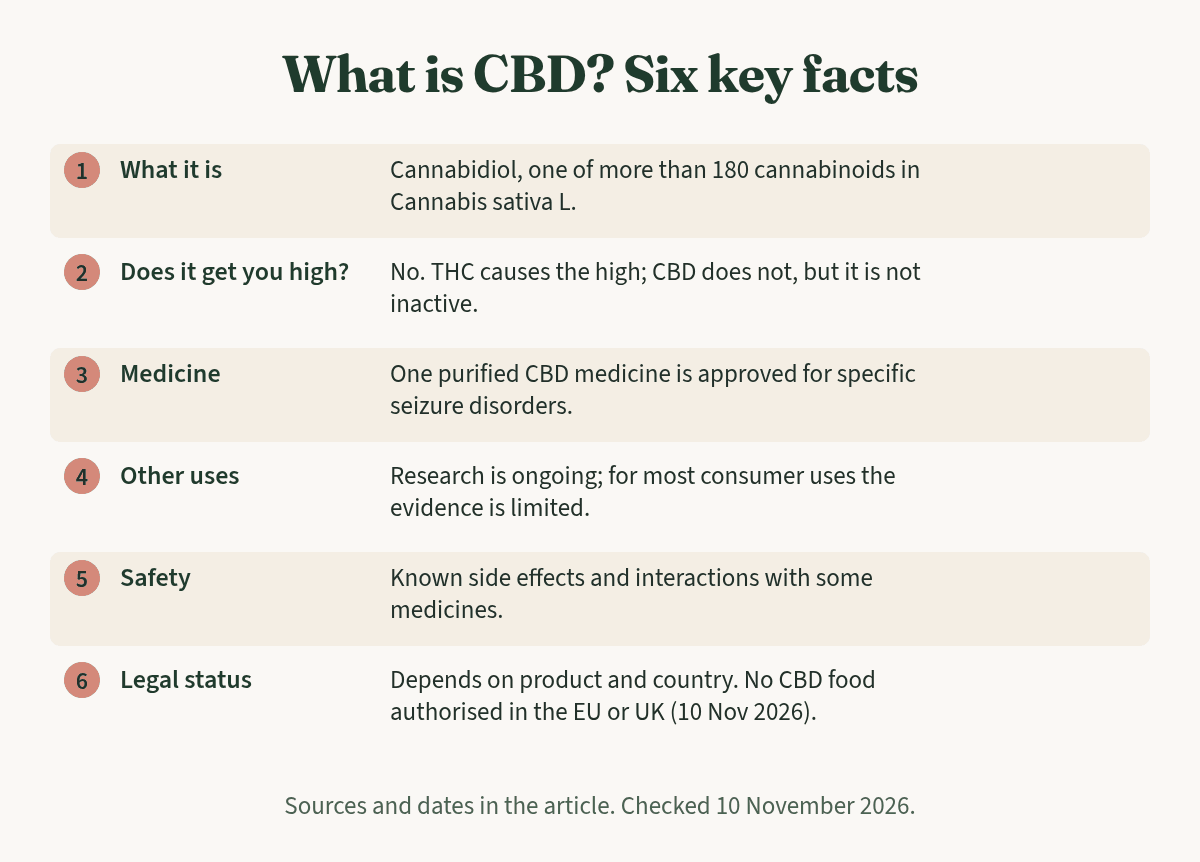
CBD is short for cannabidiol, one of more than 180 cannabinoids identified in the cannabis plant, Cannabis sativa L. [1] It is known mainly for two things: it does not cause the high associated with THC, and it is sold in oils, gummies and many other consumer products.
In the plant, CBD starts life as an acid called CBDA. It is now made both from hemp and by chemical synthesis. One highly purified CBD medicine is authorised for specific seizure disorders, while the evidence behind most consumer uses remains limited.
The legal picture is just as important as the chemistry. In the European Union and the United Kingdom, CBD in food is handled under novel food rules, and on 10 November 2026 we found no CBD food authorised in either. The United States treats it differently again. So the useful questions are simple ones: what CBD is, what research actually shows, and which rules apply where a product is sold.
Short answer. CBD (cannabidiol) is a non-intoxicating cannabinoid from the cannabis plant, sold mainly as oils, gummies and capsules. One purified CBD medicine is approved for specific seizure disorders; for other uses the human evidence is limited. CBD can cause side effects and interact with medicines. Its legal status depends on the product and the country: in the EU and the UK, CBD foods need novel food authorisation, and on 10 November 2026 we found none authorised.
CBD at a Glance
| Question | Short answer |
|---|---|
| Full name | Cannabidiol |
| What it is | A cannabinoid produced by the cannabis plant, also made synthetically |
| Where it forms | From CBDA, made in the plant from the precursor CBGA |
| Intoxicating? | Generally regarded as non-intoxicating, unlike THC |
| Medical use | One prescription medicine, authorised for specific rare seizure disorders |
| Consumer products | Oils, gummies, capsules, topicals and others; quality varies |
| Known safety issues | Medicine interactions, liver enzyme changes, drowsiness |
| EU and UK food status | Novel food; we found no authorised CBD food as of 10 November 2026 |
| US status | FDA: not lawful in food or dietary supplements sold across state lines |
Being non-intoxicating does not make CBD inactive, risk-free or proven to do what a label implies. Each of those is a separate question.
On this page
- CBD at a Glance
- What Does CBD Stand For, and Where Does It Come From?
- Does CBD Get You High?
- How Does CBD Work in the Body?
- What Is CBD Used For? What the Evidence Shows
- Side Effects and Safety: What Is Known?
- What Kinds of CBD Products Exist?
- Is CBD Legal? The Rules in the EU, UK and US (2026)
- Comparing CBD Products on Hemppy
- Frequently Asked Questions
- The Bottom Line
What Does CBD Stand For, and Where Does It Come From?
CBD stands for cannabidiol. The word describes a single molecule, not a plant or a product. A bottle labelled “CBD oil” holds cannabidiol plus other ingredients, sometimes including other cannabinoids.
How the plant makes CBD
The living plant does not make much CBD directly. It makes cannabidiolic acid, or CBDA.
The chain starts with cannabigerolic acid (CBGA), which acts as a shared precursor. An enzyme called CBDA synthase converts CBGA into CBDA; a related enzyme turns the same precursor into THCA, the acid form of THC. [2][1]
CBGA is also the acid form of cannabigerol, a cannabinoid compared with CBD in CBG vs CBD. [1]
CBDA becomes CBD when it loses a carboxyl group, a reaction called decarboxylation. Heat drives it. That is why extracts are often heated during processing, and why a lab report may list both CBDA and CBD. [1]
Not all CBD comes from plants. Some ingredients are made by chemical synthesis. The European Food Safety Authority’s September 2026 opinions cover both kinds: one CBD crystallised from a hemp extract, another made entirely in a lab. [3][4]
A short history
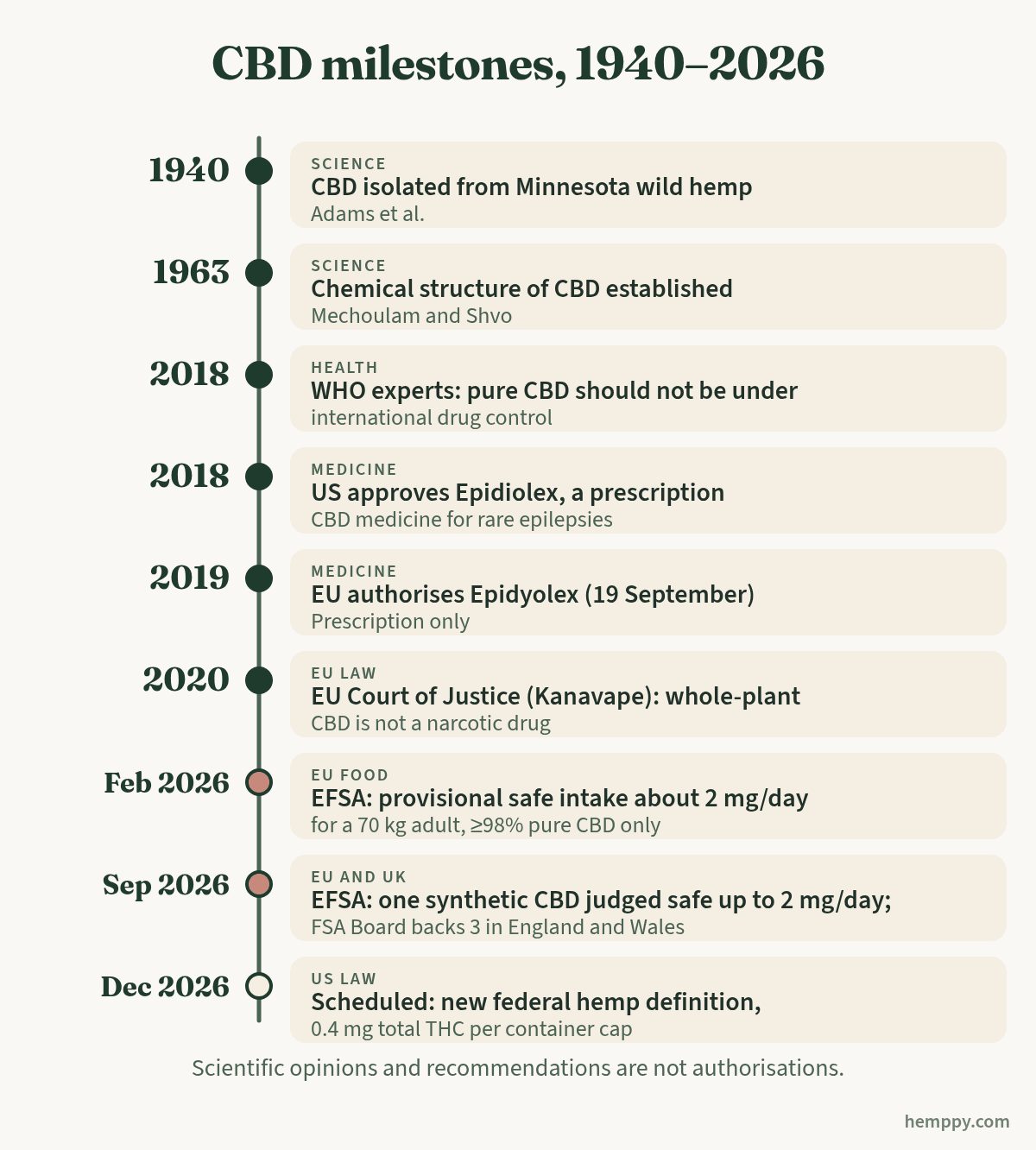
CBD is not a new discovery. Roger Adams and colleagues isolated it from Minnesota wild hemp and reported it in 1940. [5] Its full chemical structure was established in 1963 by Raphael Mechoulam and Yuval Shvo. [6]
THC, the main psychoactive cannabinoid, was described by Yechiel Gaoni and Mechoulam a year later. [7] Chemists have known both compounds for decades. The consumer market is the recent part.
Hemp, cannabis and marijuana
Hemp and marijuana are both Cannabis sativa. The difference is legal rather than botanical: hemp is cannabis kept under a THC limit set by law, and that limit varies by jurisdiction. “Hemp oil” is another trap, covered in the FAQ.
Does CBD Get You High?
No, not in the way THC does. On this point the evidence is fairly consistent.
In 2018 the World Health Organization’s Expert Committee on Drug Dependence reviewed CBD. It recommended that preparations considered to be pure CBD should not be placed under international drug control. It found no potential for abuse or dependence. [8]
A controlled trial led by Schoedel tested this directly. Healthy recreational drug users took single oral doses of a purified CBD medicine (750, 1,500 or 4,500 mg), placebo, the sedative alprazolam or dronabinol, a synthetic THC. Of 43 participants dosed, 35 entered the main analysis. [9]
At 750 mg, “drug liking” did not differ from placebo. At the two higher doses it was statistically higher, but by less than 10 points on the rating scale. Alprazolam and dronabinol scored more than 18 points above placebo. CBD had no observable effect on the cognitive and psychomotor tests. [9]
Two limits matter. The doses were single and far above typical consumer amounts. And two authors worked for GW Research and Greenwich Biosciences, companies involved with the medicine being tested. [9]
“Not intoxicating” is also different from “no effect”. The CBD medicine’s prescribing information lists sleepiness among its most common adverse reactions. It advises patients not to drive until they know how it affects them. [10] A product sold as CBD can also contain THC, a separate risk covered in CBD vs THC.
How Does CBD Work in the Body?
The honest answer is that nobody fully knows.
THC is a partial agonist at the body’s two main cannabinoid receptors, CB1 and CB2. In other words, it switches them on, at least partly. CBD behaves differently. In laboratory work reviewed by Roger Pertwee in 2008, CBD blocked compounds that activate those receptors rather than activating them itself. [11]
Lab findings like these do not translate directly into human effects. According to the US prescribing information, the precise mechanism behind the medicine’s anti-seizure effect is unknown. CBD does not appear to produce it through cannabinoid receptors. [10] The European Medicines Agency says it is thought to act on targets involved in moving calcium in cells. [12]
What is better understood is how the body handles CBD.
Swallowed CBD is poorly absorbed. A 2020 review estimated its oral bioavailability at about 6% on an empty stomach, so only a small share of a swallowed dose reaches the bloodstream. A high-fat meal raised that about fourfold. [13] The liver then breaks CBD down, mainly through the enzymes CYP2C19 and CYP3A4. Many medicines use the same enzymes. [10]
That overlap is the root of the interaction concerns described below. For how absorption plays out between formats, see CBD Oil vs CBD Gummies.
What Is CBD Used For? What the Evidence Shows
The evidence falls into two very different categories.
The one authorised medical use
A highly purified CBD oral solution is approved in the United States as Epidiolex (initial approval 2018). In the EU, as Epidyolex, it received marketing authorisation on 19 September 2019. [10][12]
It is authorised for seizures in Lennox-Gastaut syndrome, Dravet syndrome and tuberous sclerosis complex, rare epilepsies that begin in childhood. A doctor experienced in epilepsy starts and supervises treatment, and the US label calls for liver tests first. [12][10]
That authorisation shows an established medical use for one pharmaceutical product at prescribed doses. It says nothing about whether ordinary CBD consumer products are effective or safe for that or any other purpose.
Consumer CBD products
Outside that medicine, research is plentiful but conclusions are thin.
The US Food and Drug Administration says it has seen only limited data about CBD safety. It adds that some CBD products are marketed with unproven medical claims and are of unknown quality. [14] We found no authorised health claim for CBD in the EU Register. The UK Food Standards Agency advises caution about CBD products that make medical claims, such as treating pain, anxiety or sleep problems. [15][16]
Some topics, sleep in particular, now have controlled trials. Their results are mixed: positive secondary findings sit beside primary outcomes that failed. CBN vs CBD goes through those sleep trials one by one.
A trial result also describes the product that was tested. It cannot be carried over to a different formulation, dose or brand.
Why product content matters as much as the research
Even where research exists, a consumer product may not contain what its label says.
A 2017 study in JAMA bought 84 CBD extracts from 31 companies online in 2016 and had them analysed blind. Only 31% matched their label to within 10%. Another 43% contained more CBD than stated, and 26% less. THC turned up in 18 of the 84. [17] A nonprofit research institute funded the work; some authors reported fees from cannabis and pharmaceutical companies. [17]
A UK study published in 2020 tested 29 widely available products. Only 11 were within 10% of the advertised CBD content, and 55% contained measurable THC or CBN. [18] The Centre for Medicinal Cannabis funded the purchases and testing, and two authors reported advisory roles with cannabinoid companies. [18]
Both studies describe products bought years ago, not every brand today. They do show why a label alone settles little. How to read a CBD oil label explains how to check one against a batch lab report.
Side Effects and Safety: What Is Known?
The most detailed safety data come from the prescription medicine, used at doses far higher than most consumer products.
Its US label lists the most common adverse reactions in trials: sleepiness, decreased appetite, diarrhoea, raised liver enzymes, fatigue, rash, poor sleep and infections. It carries warnings on liver injury and sedation. [10]
Liver enzymes at consumer-range doses
A 2025 randomised trial, funded and overseen by the FDA, tested a lower exposure. It gave 201 healthy adults CBD at 5 mg per kilogram of body weight per day, or placebo, for 28 days. [19]
Eight of the 151 people taking CBD had liver enzyme rises above three times the upper limit of normal. None of the 50 on placebo did. [19]
A raised lab value is not the same as liver damage, and the trial was short. Still, the signal came from healthy adults, not from patients on other anti-seizure drugs.
Interactions with medicines
Because CBD shares liver enzymes with many drugs, it can change the levels of other medicines, and they can change CBD levels. [10] In January 2023 the FDA cited potential harm to the liver, interactions with certain medications and possible harm to the male reproductive system. It concluded that existing food and supplement rules were not appropriate for CBD. [20]
Who regulators say should avoid CBD
The UK Food Standards Agency advises healthy adults to limit CBD to 10 mg a day. It advises children under 18 and people who are pregnant, breastfeeding or trying to conceive to avoid CBD, and does not recommend it for anyone taking medication unless under medical direction. [16]
EFSA’s February 2026 statement could not establish safety for people under 25, during pregnancy or breastfeeding, or for people taking medicines. [21]
These are safety positions, not recommended intakes. Anyone considering cannabinoid exposure alongside prescribed medicines should obtain advice from an appropriately qualified healthcare professional.
What Kinds of CBD Products Exist?
CBD is sold as oils, gummies, capsules, drinks, creams and vaping liquids. Each format raises its own questions about absorption, ingredients and legal category, as the guide to types of CBD products sets out.
Labels also use three industry terms for the extract:
- Full-spectrum: contains CBD with other cannabinoids from the plant, which can include THC.
- Broad-spectrum: contains other cannabinoids but aims to remove THC.
- Isolate: highly purified CBD, often 98% or more.
As of 27 October 2026 we found no definition of these terms in the EU novel food guidance on cannabinoids. The batch lab report, not the word on the front, shows what a product contains. Full-spectrum vs broad-spectrum CBD vs isolate looks at each type in detail. The two most common oral formats are compared in CBD Oil vs CBD Gummies.
Is CBD Legal? The Rules in the EU, UK and US (2026)
There is no single answer. “CBD” covers medicines, foods, cosmetics and vaping products, each under different law. What follows is a dated summary of what authorities say, not a legal opinion on any product.
The international position
The WHO’s 2018 recommendation concerned international drug control, not food safety. [8]
In November 2020 the Court of Justice of the European Union ruled in the Kanavape case that CBD extracted from the whole plant could not be regarded as a narcotic drug. A Member State could not ban CBD lawfully produced in another Member State unless public health justified it. [22] The case was about free movement of goods. It did not authorise CBD as a food.
European Union
The European Commission treats extracts of Cannabis sativa and products containing cannabinoids, including CBD, as novel foods because a history of consumption has not been demonstrated. [26] A novel food needs a safety assessment and inclusion in the Union list before it can be placed on the market; whether a particular product is caught, and on what terms, depends on what it contains and how it is used. [27]
| Stage | Where CBD stood on 27 October 2026 |
|---|---|
| Novel food classification | Treated as novel by the European Commission |
| EFSA safety assessment | One positive opinion, two “safety cannot be established” |
| EU authorisation | We found none on the Union list |
In February 2026 EFSA set a provisional safe intake of 0.0275 mg per kg of body weight per day, about 2 mg a day for a 70 kg adult. It covers only CBD of at least 98% purity, made by a process considered safe, without nanoparticles and with genotoxicity ruled out. It is neither a recommended dose nor an authorisation. [21]
In September 2026 EFSA published three opinions on specific applications. One synthetic CBD was found safe in food supplements at up to 2 mg a day for adults over 25, excluding pregnant and breastfeeding women. Safety was not established for people taking medicines. [4]
The other two went the other way. For a CBD isolate proposed at up to 60 mg a day and a hemp extract proposed at up to 30 mg a day, EFSA concluded that safety could not be established. The applicant had not answered its requests for more data. [3][28]
An EFSA opinion is scientific advice; authorisation decisions rest with the Commission and Member States. As of 10 November 2026 we found no CBD novel food on the Union list. The Commission has closed dozens of CBD applications without authorisation, several in 2026. [29][30]
That missing authorisation now has a knock-on effect. On 5 November 2026 the EU Court of Justice ruled that a CBD food product cannot be certified as organic while it has not been authorised for the EU market, even if it is meant for sale outside the EU. [36]
Hemp farming is a separate layer. EU farm support applies to hemp varieties with no more than 0.3% THC, a farming rule, not a limit for finished CBD products. [31] Health claims are another layer: they need prior authorisation under Regulation (EC) No 1924/2006. [32] National rules also differ.
United Kingdom
The FSA also classes CBD as a novel food. Products linked to applications under assessment are tolerated on the market and listed publicly. As of 10 November 2026 we found no authorised CBD food. [16]
In September 2026 an FSA Board paper recommended that ministers in England and Wales authorise the first three high-purity CBD novel foods. The final decision rests with ministers, and as of 10 November 2026 we found no decision. [23]
United States
The FDA’s position is that CBD cannot lawfully be added to food sold across state lines or sold as a dietary supplement. Its reasoning: CBD is the active ingredient of an approved drug and was the subject of substantial clinical investigations first. [33]
Since the 2018 Farm Bill, federal law has defined hemp as cannabis with no more than 0.3% delta-9 THC on a dry weight basis. USDA testing rules count THCA towards that total. [34]
A law enacted on 12 November 2025 rewrites the definition in two scheduled steps. From 12 November 2026 it reaches only products with cannabinoids the plant cannot produce naturally. From 11 December 2026 the rest is due to apply, including a total THC test that counts THCA and a cap of 0.4 mg total THC per container for final products. Congress could still change that date, and state laws vary. [24][25]
Elsewhere
Rules differ widely. The FSA notes, for example, that Australia regulates CBD as a medicine. [16] Coming from hemp does not, on its own, make a product legal to sell as food anywhere in particular.
Comparing CBD Products on Hemppy
Hemppy does not make or test CBD products. We compare what independent brands publish: label strength, extract type, price per 100 mg of CBD and links to batch lab reports. If you want to see those facts side by side, these pages are the place to start:
- CBD oils, CBD gummies and CBD capsules: every listed product with label facts and per-country availability.
- Best CBD oil and best CBD gummies: documents-based shortlists, with no personal testing or star scores.
- CBD price per 100 mg: our study of what the same amount of CBD costs across brands and formats.
- How to read a CBD lab report: checking CBD, THC and contaminant lines against the label.
- Other cannabinoids on labels: CBG vs CBD, CBN vs CBD and CBC and THCV.
How each figure is gathered is set out in how we compare CBD products, and unfamiliar terms are defined in the CBD glossary.
Frequently Asked Questions
Is CBD a drug?
It depends on the product and the law. Purified CBD is the active substance of an authorised prescription medicine. [12] Consumer CBD products are not medicines, and the WHO recommended in 2018 that pure CBD stay outside international drug control. [8]
Is CBD the same as hemp seed oil?
No. Hemp seed oil is pressed from the seeds and is a traditional food: the Finnish Food Authority lists hemp seeds and seed oil among the hemp parts that are not novel. [35] A CBD oil carries a cannabinoid extract, which the Commission’s catalogue lists as novel. [35][26] On a label, look for CBD stated in milligrams. The full comparison is in CBD oil vs hemp seed oil.
Is CBD addictive?
The available evidence suggests a low potential. The WHO found no potential for abuse or dependence for pure CBD, and a controlled study found only small “drug liking” effects at very high single doses. [8][9] That evidence does not cover products that also contain THC.
Can CBD show up on a drug test?
It can, indirectly. Drug tests usually look for THC, and CBD products can contain it. The FSA warns of possible THC exposure even from products labelled “THC-free”, and one testing study found THC in 21% of products. [16][17] No cannabinoid product should be assumed to be drug-test safe.
Can CBD be taken with other medicines?
Ask a doctor or pharmacist first. CBD is processed by liver enzymes that also handle many medicines, and the FSA advises people taking medication to avoid CBD unless under medical direction. [10][16]
Explore CBD oils · Explore CBD gummies
Whether partner shop links are shown depends on your country.
The Bottom Line
CBD is a single cannabinoid that the cannabis plant makes from CBGA by way of CBDA, and that industry can also make synthetically.
It does not cause a THC-like high. One purified form is an authorised medicine for rare childhood-onset epilepsies; the evidence for consumer uses is limited and mixed. Documented safety concerns include liver enzyme changes and interactions with medicines.
For any CBD product, three questions do more work than marketing: What does the batch report show it contains? What evidence supports what is said about it? And which rules apply where it is sold?
Answering those questions is a better starting point than the reputation CBD has acquired.
Scientific and Regulatory Sources
Science, medicines and safety
- Tahir M.N., Shahbazi F., Rondeau-Gagné S., Trant J.F. (2021). The biosynthesis of the cannabinoids. Journal of Cannabis Research. Full study.
- Taura F., Morimoto S., Shoyama Y. (1996). Purification and characterization of cannabidiolic-acid synthase from Cannabis sativa L. Journal of Biological Chemistry. PubMed.
- EFSA NDA Panel (2026). Safety of cannabidiol isolated from Cannabis sativa L. as a novel food pursuant to Regulation (EU) 2015/2283. EFSA Journal 24(9) (published September 2026). doi.org/10.2903/j.efsa.2026.10318.
- EFSA NDA Panel (2026). Safety of synthetic cannabidiol as a novel food pursuant to Regulation (EU) 2015/2283. EFSA Journal 24(9) (published September 2026). doi.org/10.2903/j.efsa.2026.10154.
- Adams R., Hunt M., Clark J.H. (1940). Structure of cannabidiol, a product isolated from the marihuana extract of Minnesota wild hemp. I. Journal of the American Chemical Society 62:196–200. doi.org/10.1021/ja01858a058.
- Mechoulam R., Shvo Y. (1963). Hashish. I. The structure of cannabidiol. Tetrahedron 19:2073–2078. doi.org/10.1016/0040-4020(63)85022-X.
- Gaoni Y., Mechoulam R. (1964). Isolation, structure, and partial synthesis of an active constituent of hashish. Journal of the American Chemical Society 86:1646–1647. doi.org/10.1021/ja01062a046.
- World Health Organization (2018). 40th Expert Committee on Drug Dependence: news briefing, 13 September 2018. WHO.
- Schoedel K.A. et al. (2018). Abuse potential assessment of cannabidiol (CBD) in recreational polydrug users: a randomized, double-blind, controlled trial. Epilepsy & Behavior. PubMed.
- US Food and Drug Administration. EPIDIOLEX (cannabidiol) oral solution: prescribing information (sections 5, 6, 12.1 and 12.3). Official label (PDF).
- Pertwee R.G. (2008). The diverse CB1 and CB2 receptor pharmacology of three plant cannabinoids: Δ9-tetrahydrocannabinol, cannabidiol and Δ9-tetrahydrocannabivarin. British Journal of Pharmacology. Full study.
- European Medicines Agency. Epidyolex: EPAR, medicine overview (marketing authorisation 19 September 2019). Official EMA information.
- Perucca E., Bialer M. (2020). Critical aspects affecting cannabidiol oral bioavailability and metabolic elimination, and related clinical implications. CNS Drugs. PubMed.
- US Food and Drug Administration. What you need to know (and what we’re working to find out) about products containing cannabis or cannabis-derived compounds, including CBD. Consumer update. Official FDA information.
- European Commission. EU Register of Nutrition and Health Claims. Official register.
- UK Food Standards Agency (22 June 2026). Food Fact Check: CBD safety and health claims. Official FSA blog.
- Bonn-Miller M.O., Loflin M.J.E., Thomas B.F., Marcu J.P., Hyke T., Vandrey R. (2017). Labeling accuracy of cannabidiol extracts sold online. JAMA 318(17):1708–1709. Full study.
- Liebling J.P., Clarkson N.J., Gibbs B.W., Yates A.S., O’Sullivan S.E. (2022; online 2020). An analysis of over-the-counter cannabidiol products in the United Kingdom. Cannabis and Cannabinoid Research. Full study.
- Florian J. et al. (2025). Cannabidiol and liver enzyme level elevations in healthy adults: a randomized clinical trial. JAMA Internal Medicine. Full study.
- US Food and Drug Administration (26 January 2023). FDA concludes that existing regulatory frameworks for foods and supplements are not appropriate for cannabidiol, will work with Congress on a new way forward. Official FDA statement.
- EFSA Panel on Nutrition, Novel Foods and Food Allergens (2026). Update of the statement on safety of cannabidiol as a novel food. EFSA Journal 24:9862 (EFSA news release 9 February 2026). doi.org/10.2903/j.efsa.2026.9862.
Law and regulation
- Court of Justice of the European Union (19 November 2020). Judgment in Case C-663/18, BS and CA (“Kanavape”), press release No 141/20. Official press release (PDF).
- UK Food Standards Agency (September 2026 Board meeting). CBD novel food applications: recommendations to ministers on first authorisations. Official Board paper.
- Public Law 119-37 (approved 12 November 2025), Division B, section 781 (new definition of hemp). GovInfo.
- Public Law 119-103, Continuing Appropriations and Extensions Act, 2027 (approved 2 September 2026), section 2019. GovInfo.
- European Commission. Novel Food Status Catalogue (entries “Cannabinoids” and “Cannabis sativa L.”). Official guidance.
- European Parliament and Council. Regulation (EU) 2015/2283 on novel foods. EUR-Lex.
- EFSA NDA Panel (2026). Safety of Cannabis sativa L. extract as a novel food pursuant to Regulation (EU) 2015/2283. EFSA Journal 24(9) (published September 2026). doi.org/10.2903/j.efsa.2026.10319.
- European Commission. Union list of authorised novel foods. Official Union list information.
- European Commission. Decisions terminating the novel food procedure. Official list of decisions.
- European Commission. Hemp (crop production and plant-based products); Regulation (EU) 2021/2115, hemp eligibility for CAP support. Official EC information.
- European Parliament and Council. Regulation (EC) No 1924/2006 on nutrition and health claims made on foods. EUR-Lex.
- US Food and Drug Administration. FDA regulation of cannabis and cannabis-derived products, including cannabidiol (CBD): questions and answers. Official FDA information.
- US Department of Agriculture. 7 CFR 990.1, Domestic Hemp Production Program: definitions (“Hemp”, “Total THC”). eCFR.
- Finnish Food Authority (Ruokavirasto). Hemp as food. Official guidance.
Updates checked 10 November 2026
- Court of Justice of the European Union (5 November 2026). Judgment in Case C-495/25, Syndicat professionnel du chanvre, press release No 159/26. Official press release (PDF).
Scientific and regulatory material reviewed: 22 October 2026; legal and regulatory summary re-checked: 10 November 2026. This article provides general educational information, not medical advice or a product-specific determination of regulatory compliance.