
This article is general information, not medical advice. Hemppy does not sell products. Our shop, opening soon, will link to partner brands’ own websites, where you buy from the brand directly. If you buy through one of those links, Hemppy may earn a commission from the brand. This article does not recommend any specific product.
In any CBD vs THC comparison, the difference people notice first is intoxication. Both are compounds from the cannabis plant. THC causes the “high” linked with cannabis. CBD does not, but that does not make it inactive or free of side effects.
The two molecules come from the same starting material in the plant and even share a chemical formula. A small difference in shape changes how each acts on the body’s cannabinoid receptors, and that difference carries through to safety, drug tests and the law.
It matters in practice. Many CBD products contain some THC, a “THC-free” label is not a guarantee, and THC limits differ between the EU, the UK and the US. This guide covers what the research shows, what it does not, and how to read the numbers.
On this page
- CBD and THC at a Glance
- What Are CBD and THC?
- Why Does THC Cause a High but CBD Does Not?
- CBD vs THC in Human Trials: Driving and Mixing
- Side Effects and Safety: What Is Known?
- Are CBD and THC Used in Medicines?
- Can CBD Make You Fail a Drug Test?
- How to Read THC on a Lab Report
- CBD and THC Under the Law: EU, UK and US
- Frequently Asked Questions About CBD and THC
- The Bottom Line
CBD and THC at a Glance
| CBD (cannabidiol) | THC (Δ9-tetrahydrocannabinol) | |
|---|---|---|
| How the plant makes it | CBGA → CBDA, then heat → CBD | CBGA → THCA, then heat → THC |
| Chemical formula | C21H30O2 | C21H30O2 |
| Action at the CB1 receptor (lab studies) | Does not switch it on; reduces responses to THC in cell models | Partial agonist: switches it on |
| Intoxicating? | No “high” in controlled studies; drowsiness is a known side effect at medicine doses | Yes |
| Driving (one controlled trial) | No significant effect on lane weaving | Increased lane weaving 40 to 100 minutes after use |
| Prescription medicines | Epidiolex / Epidyolex (purified CBD) | Dronabinol (synthetic THC); nabilone (THC-like) |
| Standard drug tests | Do not target CBD; THC in a product can cause a positive | Detected through its metabolite |
| International drug treaties | Pure CBD not listed | Listed under the 1971 Convention |
Neither compound is simply the “good” or the “bad” cannabinoid. Each has known effects, known risks and questions that research has not yet answered.
What Are CBD and THC?
Both belong to a family of plant compounds called cannabinoids. Neither is made directly. Each is the end point of a short chemical pathway, and the two pathways split at a single step.
One precursor, two enzymes
The plant starts with a shared building block, cannabigerolic acid (CBGA). One enzyme, CBDA synthase, turns CBGA into cannabidiolic acid (CBDA). [1] A different enzyme, THCA synthase, turns the same molecule into tetrahydrocannabinolic acid (THCA). [2] Genetic studies show that a single locus with different versions of these enzymes largely decides whether a plant leans towards THC, CBD or neither. [3]
The acids then lose a molecule of carbon dioxide, a reaction called decarboxylation, which heat speeds up. CBDA becomes CBD and THCA becomes THC. [4] This is why heating, smoking, vaping or baking cannabis matters so much for its THC content, a point that returns in the section on lab reports.
Same atoms, different shape
CBD and THC have the same molecular formula, C21H30O2, and the same molecular weight of about 314.5. [5] Molecules like this are called isomers: same atoms, different arrangement.
The difference is one ring. In THC, part of the molecule is closed into an extra ring that contains an oxygen atom, leaving one hydroxyl (OH) group. In CBD that ring is open, so the molecule carries two hydroxyl groups instead. [5] On paper it is a minor change, but receptors respond to shape.
Why Does THC Cause a High but CBD Does Not?
THC, the main psychotropic constituent of cannabis, is a partial agonist at the CB1 and CB2 cannabinoid receptors. In plain terms, it binds to them and switches them on, though not to the full extent possible. [6]
CBD behaves very differently. In cell and tissue studies it showed unexpectedly high potency as an antagonist of compounds that activate CB1 and CB2, which means it blocked or reduced their action rather than mimicking it. [6] Experiments published in 2015 suggested how: CBD appears to bind at a separate site on the CB1 receptor and dampen its response to THC, a behaviour called negative allosteric modulation. [7]
These are cell findings. They help explain why the two compounds differ, but they cannot predict how a person will respond to a given product or dose.
What “non-intoxicating” does and does not mean
The most direct human test of whether a substance feels rewarding is an abuse-potential study. In a 2018 trial, Schoedel and colleagues gave single doses of purified CBD (750, 1,500 and 4,500 mg), the sedative alprazolam, the synthetic THC dronabinol and placebo to experienced recreational drug users, in random order. Of 43 people who received at least one dose, 35 formed the main analysis.
At 750 mg, “drug liking” for CBD did not differ significantly from placebo. The two higher doses produced small but statistically significant differences, under 10 points on the study’s rating scale. Alprazolam and dronabinol produced differences of more than 18 points and were liked significantly more than every CBD dose. CBD showed no effect on cognitive or motor performance. Two authors were affiliated with GW Research Ltd and Greenwich Biosciences. [8]
So CBD is not intoxicating in the way THC is. That is different from saying it does nothing in the brain: the prescription CBD medicine lists sleepiness and sedation among its warnings. [9]
CBD vs THC in Human Trials: Driving and Mixing
Controlled human trials give a more direct picture than cell studies. Three are especially useful here.
Driving
In a 2020 trial, Arkell and colleagues gave 26 healthy occasional cannabis users four types of vaporised cannabis on separate days: THC-dominant, CBD-dominant, an equal THC and CBD mix, and placebo. The THC and CBD doses were 13.75 mg each, and 22 people completed all four sessions. Participants then completed 100 km on-road driving tests, starting 40 minutes and again 240 minutes after use.
The main measure was lane weaving, technically the standard deviation of lateral position. In the first drive, THC-dominant and mixed cannabis increased lane weaving compared with placebo, while CBD-dominant cannabis did not. By the four-hour drive, none of the conditions differed significantly from placebo.
The authors noted that the CBD result could not rule out clinically important impairment, and that the doses may not match what people commonly use. The Lambert Initiative for Cannabinoid Therapeutics at the University of Sydney funded the trial and took part in its design. [10]
Does CBD cancel out THC?
A popular idea holds that CBD “balances” THC, so products containing both are gentler. Two randomised trials published in 2023 tested this directly, and neither supported it.
Englund and colleagues gave 46 healthy, infrequent cannabis users vaporised cannabis containing 10 mg of THC with 0, 10, 20 or 30 mg of CBD. The primary outcome was delayed verbal recall, a memory test. THC impaired recall and produced psychotic symptoms on a standard rating scale, and no CBD dose significantly changed either effect or the amount of THC in the blood. The UK Medical Research Council funded the study. [11]
Zamarripa and colleagues looked at edibles. Eighteen healthy adults ate brownies containing 20 mg of THC alone, 20 mg of THC with 640 mg of CBD, or no cannabis extract. With CBD added, blood levels of THC rose, and participants reported stronger effects, including more anxiety, sedation and memory difficulty, with greater impairment on performance tasks. The likely explanation is that CBD slowed the body’s breakdown of THC. The work was funded by the US National Institutes of Health. [12]
What the trials do and do not show
| Question | What the trials found | Main limits |
|---|---|---|
| Does CBD feel rewarding like THC? | Much weaker “drug liking” than dronabinol; 750 mg not different from placebo | Single doses; industry-affiliated authors |
| Does CBD impair driving? | No significant effect at 13.75 mg vaporised | One trial, 26 people; cannot exclude small effects |
| Does CBD reduce THC’s effects? | No (vaporised); effects increased when eaten together | Short studies; small samples; specific doses |
None of these trials studied daily use over months, and none tested the wide range of commercial products sold as CBD.
Side Effects and Safety: What Is Known?
The safety profiles are known in different ways. For high-THC cannabis, a 2025 review links use with cannabis use disorder, acute mental and cardiovascular problems, and road accidents. It also describes an association with psychosis, although how far that link is causal is still debated. [13]
For CBD, the strongest data come from the prescription medicine. Its label lists the most common adverse reactions in trials as sleepiness, decreased appetite, diarrhoea, raised liver enzymes, fatigue, rash, sleep problems and infections. It warns about liver injury and about interactions with other medicines processed by the same liver enzymes. [9]
Those trials involved patients at medicine doses. A 2025 randomised trial funded by the FDA tested 201 healthy adults instead, giving 5 mg/kg of CBD a day or placebo for 28 days. Liver enzymes rose above three times the upper limit of normal in 8 of 151 people on CBD and none of 50 on placebo. [14]
The authors described that dose as representative of consumer use; for a 70 kg adult it works out at 350 mg a day. The finding is a reminder that “natural” and “harmless” are not the same thing.
Are CBD and THC Used in Medicines?
Yes, both are, under prescription and medicines law. In the US, the FDA has approved one cannabis-derived medicine, Epidiolex (purified CBD), and three synthetic cannabis-related medicines: Marinol and Syndros, which contain dronabinol, a synthetic form of THC, and Cesamet, which contains nabilone. The FDA has not approved any other cannabis or CBD product on the market. [15]
According to its label, Epidiolex is indicated for seizures linked with Lennox-Gastaut syndrome, Dravet syndrome or tuberous sclerosis complex in patients aged one year and older. [9] In the EU it is authorised as Epidyolex. [16] A medicine’s approval applies to that product, at its tested dose and quality. It says nothing about the effects of a consumer CBD oil, gummy or vape.
Can CBD Make You Fail a Drug Test?
Pure CBD is unlikely to, because standard tests look for a THC metabolite, not CBD.
In a small Johns Hopkins study with six adults, 1 of 218 urine samples collected after 100 mg of pure CBD screened positive at the most sensitive cutoff, and none passed the confirmation test. After vaporised CBD-dominant cannabis containing 3.7 mg of THC, four samples confirmed positive. [17] An Australian trial found no positive roadside saliva tests for THC after oral CBD doses of up to 1,500 mg. [18]
The practical risk is THC in the product itself. A 2025 analysis of 56 CBD gummy products found Δ9-THC in 39%, at 0.019 to 0.88 mg per gummy. [19] The UK Food Standards Agency has warned that even products marketed as “THC-free” may contain THC. [20]
Sport adds a further layer. The World Anti-Doping Agency prohibits all natural and synthetic cannabinoids in competition except cannabidiol itself. [21] In a 2026 study, adults who took a broad-spectrum CBD product for ten weeks had other prohibited cannabinoids, such as CBG, in their urine, though no THC was detected. [22]
If your job, sport or travel involves drug testing, small amounts of THC from regular use can add up. A low or absent THC result on the batch’s certificate of analysis is the most practical check, although no CBD product can guarantee a negative test. Our guide to full-spectrum vs broad-spectrum CBD vs isolate explains what each label means for THC and what drug-test studies found.
How to Read THC on a Lab Report
A certificate of analysis (COA) usually lists THC and THCA separately. Because THCA turns into THC when heated, US hemp rules use a “total THC” figure: Δ9-THC plus 0.877 × THCA. The factor reflects the weight THCA loses as carbon dioxide when it decarboxylates. [23]
Here is a fictional worked example. A COA for a 10 ml oil reports 0.02% Δ9-THC and 0.03% THCA by weight.
- Total THC = 0.02% + (0.877 × 0.03%) = 0.046% (rounded).
- Treating 10 ml as roughly 10 g, which is an approximation since oil density varies, that is about 4.6 mg of total THC in the bottle.
- 0.046% sounds tiny. Yet the Δ9-THC alone, about 2 mg, is above the UK’s 1 mg per-container threshold. The 4.6 mg of total THC is far above the 0.4 mg per-container limit due for US final hemp products. Both rules are described below.
Percentages, milligrams per serving and milligrams per container answer different questions, so check which unit a rule uses before deciding what a number means. Check also that the COA’s batch number matches the product, that the lab is independent and accredited, and whether the report lists other controlled cannabinoids. A lab report may also list CBN, covered in CBN vs CBD. The CBD oil guide explains the rest of a COA in more detail.
CBD and THC Under the Law: EU, UK and US
The legal treatment of the two compounds is very different, and the details change often. What follows describes the position as of 22 October 2026. It is general information, not legal advice for any product or country.
International drug treaties
THC is controlled under the 1971 UN Convention on Psychotropic Substances. Cannabis and cannabis resin remain in Schedule I of the 1961 Single Convention, although in December 2020 the UN Commission on Narcotic Drugs voted to remove them from Schedule IV, the most restrictive category.
The Commission rejected a proposed footnote that would have exempted CBD preparations containing no more than 0.2% THC. [24] Earlier, the WHO had recommended that preparations considered to be pure CBD should not be placed under international control. [25]
European Union
In 2020, the EU Court of Justice ruled that CBD extracted from the whole hemp plant is not a narcotic drug under the 1961 Single Convention. A Member State may not ban the marketing of CBD lawfully produced in another Member State, unless the restriction is justified on public health grounds and proportionate. [26]
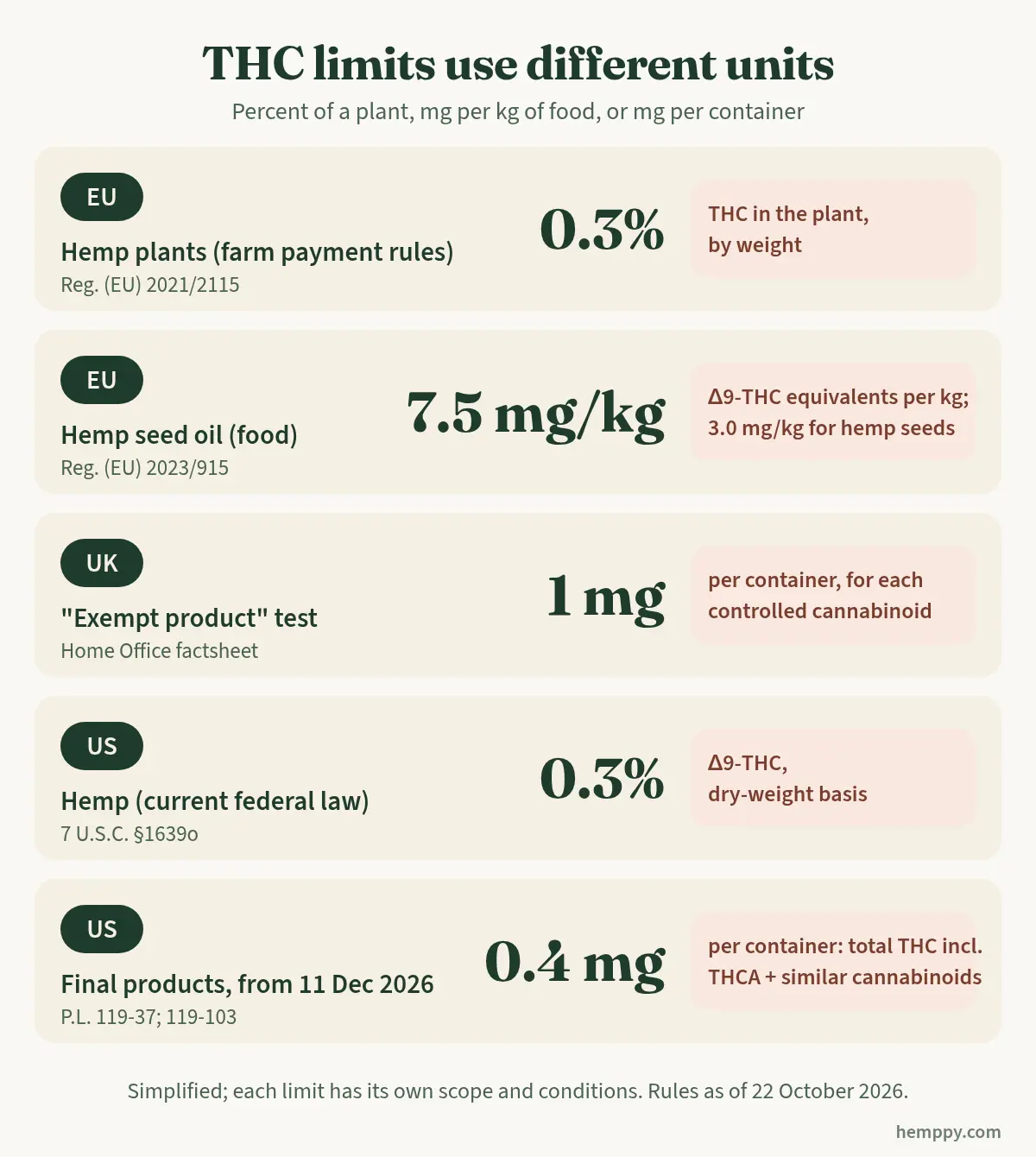
Hemp grown under the EU farm payment rules must contain no more than 0.3% THC. [27] Separately, EU food law sets maximum levels for THC in hemp seeds and hemp seed oil, expressed as Δ9-THC equivalents. [28]
CBD extracts in food are treated as novel foods that need authorisation before sale, and we found no authorised CBD novel food as of the review date. [29] In 2026 EFSA set a provisional safe intake of 0.0275 mg of CBD per kg of body weight a day, with conditions, while its assessment continues. [30] Individual countries also apply their own drug and food laws, which differ widely. The CBD oil vs gummies guide covers the food rules in more detail.
United Kingdom
Under the Misuse of Drugs Act 1971, THC is a Class B controlled drug, while pure CBD is not controlled. The Home Office considers it nearly impossible to isolate CBD without traces of controlled cannabinoids such as THC, so a CBD product usually counts as controlled unless it meets the “exempt product” conditions.
One of those conditions is that no component part contains more than 1 mg of any controlled cannabinoid. The Home Office views that unit as the container, such as a bottle of oil, not a serving. Licensed medicines such as Sativex and Epidyolex are regulated separately. [31] CBD food products are also subject to the FSA’s novel food process. [20]
United States
Federal law currently defines hemp as cannabis with no more than 0.3% Δ9-THC on a dry-weight basis. [32] A 2025 law replaces that with a total THC test that includes THCA, and excludes final hemp products containing more than 0.4 mg of total THC and similar cannabinoids per container. [33] A 2026 law set those changes to take effect in stages on 12 November and 11 December 2026, and Congress could still change them. [34]
Marijuana itself remains a Schedule I controlled substance under federal law. Since April 2026, FDA-approved medicines containing marijuana, and marijuana held under a state medical licence, sit in Schedule III instead. [35] A broader rescheduling proceeding had not concluded at the review date. The FDA’s position remains that CBD cannot lawfully be added to food or sold as a dietary supplement, and state laws differ widely. [36]
Frequently Asked Questions About CBD and THC
Is CBD a type of THC?
No. CBD and THC are separate cannabinoids with the same chemical formula but a different structure. The plant makes them from a shared precursor using different enzymes, and they act differently at the CB1 receptor. Learn more about CBD itself.
Does CBD oil contain THC?
It can. Whole-plant hemp extracts often carry traces of THC, and retail tests have found it even where labels suggest otherwise. Check the batch’s certificate of analysis.
Is THCA the same as THC?
No, but it becomes THC when heated. THCA is the acid form the plant makes, and it is not counted as THC under every rule. US federal law will count it under changes due in late 2026, and the UK Home Office notes that THCA readily breaks down into THC. [31]
Is CBD stronger than THC?
They cannot be compared on strength because they do different things. In the abuse-potential trial described above, 10 mg and 30 mg doses of dronabinol were liked significantly more than any CBD dose, up to 4,500 mg. [8] Medicine doses of CBD are set by body weight, often reach hundreds of milligrams a day for an adult, and carry their own side effects. [9]
Is CBD banned in sport?
Cannabidiol itself is exempt from the 2026 World Anti-Doping Agency list, but other cannabinoids are prohibited in competition and THC is classed as a “substance of abuse”. [21] Products can contain listed cannabinoids besides CBD. [22] Athletes should check their sport’s own rules.
The Bottom Line
CBD and THC are built from the same atoms and made from the same precursor, but a single ring changes their behaviour. THC switches on the brain’s CB1 receptor and causes a high. CBD does not.
In controlled trials, CBD did not impair driving or feel rewarding in the way THC did. It also did not soften THC’s effects, and when eaten together it raised THC exposure.
Neither is risk-free. THC carries well-documented risks, and CBD at medicine doses can cause drowsiness, raised liver enzymes and drug interactions.
For anyone choosing a CBD product, the THC figures on the batch lab report, and the unit a rule uses, matter more than marketing terms such as “THC-free”.
Scientific and Regulatory Sources
Plant chemistry and pharmacology
- Taura F., Morimoto S., Shoyama Y. (1996). Purification and characterization of cannabidiolic-acid synthase from Cannabis sativa L. Journal of Biological Chemistry. PubMed.
- Sirikantaramas S. et al. (2004). The gene controlling marijuana psychoactivity: molecular cloning and heterologous expression of Δ1-tetrahydrocannabinolic acid synthase from Cannabis sativa L. Journal of Biological Chemistry. PubMed.
- de Meijer E.P.M., Hammond K.M. (2005). The inheritance of chemical phenotype in Cannabis sativa L. (II): cannabigerol predominant plants. Euphytica. Publisher abstract.
- Tahir M.N. et al. (2021). The biosynthesis of the cannabinoids. Journal of Cannabis Research. Full study.
- National Library of Medicine. PubChem compound records: cannabidiol (CID 644019) and dronabinol, Δ9-THC (CID 16078). PubChem CBD · PubChem THC.
- Pertwee R.G. (2008). The diverse CB1 and CB2 receptor pharmacology of three plant cannabinoids: Δ9-tetrahydrocannabinol, cannabidiol and Δ9-tetrahydrocannabivarin. British Journal of Pharmacology. Full study.
- Laprairie R.B. et al. (2015). Cannabidiol is a negative allosteric modulator of the cannabinoid CB1 receptor. British Journal of Pharmacology. Full study.
Human studies, medicines and testing
- Schoedel K.A. et al. (2018). Abuse potential assessment of cannabidiol (CBD) in recreational polydrug users: a randomized, double-blind, controlled trial. Epilepsy & Behavior. PubMed.
- US Food and Drug Administration. EPIDIOLEX (cannabidiol) oral solution, prescribing information (revised May 2026), sections 1, 5, 6 and 7. Official label.
- Arkell T.R. et al. (2020). Effect of cannabidiol and Δ9-tetrahydrocannabinol on driving performance: a randomized clinical trial. JAMA. Full study.
- Englund A. et al. (2023). Does cannabidiol make cannabis safer? A randomised, double-blind, cross-over trial of cannabis with four different CBD:THC ratios. Neuropsychopharmacology. Full study.
- Zamarripa C.A. et al. (2023). Assessment of orally administered Δ9-tetrahydrocannabinol when coadministered with cannabidiol on Δ9-tetrahydrocannabinol pharmacokinetics and pharmacodynamics in healthy adults: a randomized clinical trial. JAMA Network Open. Full study.
- Hoch E. et al. (2025). Cannabis, cannabinoids and health: a review of evidence on risks and medical benefits. European Archives of Psychiatry and Clinical Neuroscience. Full study.
- Florian J. et al. (2025). Cannabidiol and liver enzyme level elevations in healthy adults: a randomized clinical trial. JAMA Internal Medicine. Full study.
- US Food and Drug Administration. FDA and cannabis: research and drug approval process. Official FDA information.
- European Medicines Agency. Epidyolex: European public assessment report. Official EMA information.
- Spindle T.R. et al. (2020). Urinary pharmacokinetic profile of cannabinoids following administration of vaporized and oral cannabidiol and vaporized CBD-dominant cannabis. Journal of Analytical Toxicology. PubMed.
- McCartney D. et al. (2022). Orally administered cannabidiol does not produce false-positive tests for Δ9-tetrahydrocannabinol on the Securetec DrugWipe 5S or Dräger DrugTest 5000. Drug Testing and Analysis. Full study.
- Johnson E.D. et al. (2025). Cannabidiol gummy products: LC-MS/MS assessment of cannabinoid concentrations. Cannabis and Cannabinoid Research. PubMed.
- UK Food Standards Agency. Food Fact Check: CBD safety and health claims (22 June 2026). Official guidance.
- World Anti-Doping Agency. The 2026 Prohibited List, section S8 Cannabinoids. Official list.
- Gillham S.H. et al. (2026). Daily use of a broad-spectrum cannabidiol supplement produces detectable concentrations of cannabinoids in urine prohibited by the World Anti-Doping Agency: an effect amplified by exercise. Medicine & Science in Sports & Exercise. PubMed.
- US Department of Agriculture. 7 CFR 990.1, Domestic hemp production program: definitions (“Decarboxylated”, “Total THC”). eCFR.
Laws and international drug control
- United Nations Commission on Narcotic Drugs. Press statement: CND votes on recommendations for cannabis and cannabis-related substances (2 December 2020). Official statement.
- World Health Organization. 40th Expert Committee on Drug Dependence: news briefing (13 September 2018). Official WHO information.
- Court of Justice of the European Union. Judgment in Case C-663/18, B S and C A (Kanavape), press release No 141/20 (19 November 2020). Official press release.
- European Commission. Hemp: rules for cultivation and EU support (Regulation (EU) 2021/2115). Official information.
- European Commission. Regulation (EU) 2023/915 on maximum levels for certain contaminants in food (Δ9-THC equivalents), consolidated text. EUR-Lex.
- European Commission. Novel Food Status Catalogue (entries for cannabinoids and Cannabis sativa L.). Official guidance.
- EFSA Panel on Nutrition, Novel Foods and Food Allergens (2026). Update of the statement on safety of cannabidiol as a novel food. EFSA Journal. Scientific statement.
- UK Home Office. Drug licensing factsheet: cannabis, CBD and other cannabinoids (updated 3 October 2024). Official guidance.
- United States Code, 7 U.S.C. §1639o (definition of hemp, as in force on 22 October 2026). GovInfo.
- Public Law 119-37 (enacted 12 November 2025), Division B, section 781 (new definition of hemp). GovInfo.
- Public Law 119-103 (enacted 2 September 2026), section 2019 (phased effective dates). GovInfo.
- US Department of Justice, Drug Enforcement Administration. Final rule: rescheduling of FDA-approved products containing marijuana from Schedule I to Schedule III, 91 FR 22714 (28 April 2026). Federal Register.
- US Food and Drug Administration. FDA regulation of cannabis and cannabis-derived products, including cannabidiol (CBD). Official FDA information.
Scientific and regulatory material reviewed: 22 October 2026. This article provides general educational information, not medical advice, legal advice or a product-specific determination of regulatory compliance.