
Last reviewed:
This article is general information, not medical advice. Hemppy does not make CBD products; the shop lists independent brands and links to their own websites. If you buy through one of those links, Hemppy may earn a commission from the brand, and you pay the same price. See our affiliate disclosure.
CBN and CBD are two different cannabinoids found in or associated with the cannabis plant. Their names look similar, but they have different chemical origins, different research histories and some important unanswered questions.
CBD (cannabidiol) comes from a natural biosynthetic pathway in the plant. CBN (cannabinol) forms mainly when THC undergoes chemical changes, particularly oxidation. CBD has been studied extensively in certain medical settings, while clinical research on CBN is still developing.
The distinction matters because CBN is frequently discussed in connection with sleep, even though human studies have produced mixed results. Understanding what each compound is, and what the evidence actually shows, is more useful than choosing one based on its reputation.
Short answer. CBD comes from the plant’s own chemical pathway, while CBN forms mostly when THC breaks down with age, heat and air. CBD has been studied far more and is the active ingredient of a prescription medicine for specific seizure disorders. CBN is often marketed for sleep, but the few human trials have produced mixed results and its long-term safety has barely been studied. Neither is authorised as a food ingredient in the EU or the UK.
CBN and CBD at a Glance
| Feature | CBD (Cannabidiol) | CBN (Cannabinol) |
|---|---|---|
| How it forms | Develops from CBDA, a compound produced naturally by the plant | Forms mainly through chemical degradation of THC-related compounds |
| Relationship to THC | A separate cannabinoid, not derived from THC | Can form when THC oxidises |
| Intoxicating effects | Generally regarded as non-intoxicating | Not typically associated with THC-like intoxication, but human effects are less well understood |
| Human research | Extensive research in certain medical conditions; more limited evidence for many consumer uses | Smaller clinical evidence base, including recent sleep trials |
| Sleep research | Mixed findings; no established general benefit for insomnia from ordinary consumer products | Some positive findings, but important trial outcomes have been inconclusive |
| Safety | Known adverse effects and potential medication interactions | Less information about long-term human safety |
| EU food regulation | Novel food requirements may apply, depending on the ingredient and use | Novel food requirements may apply; additional national rules can be relevant |
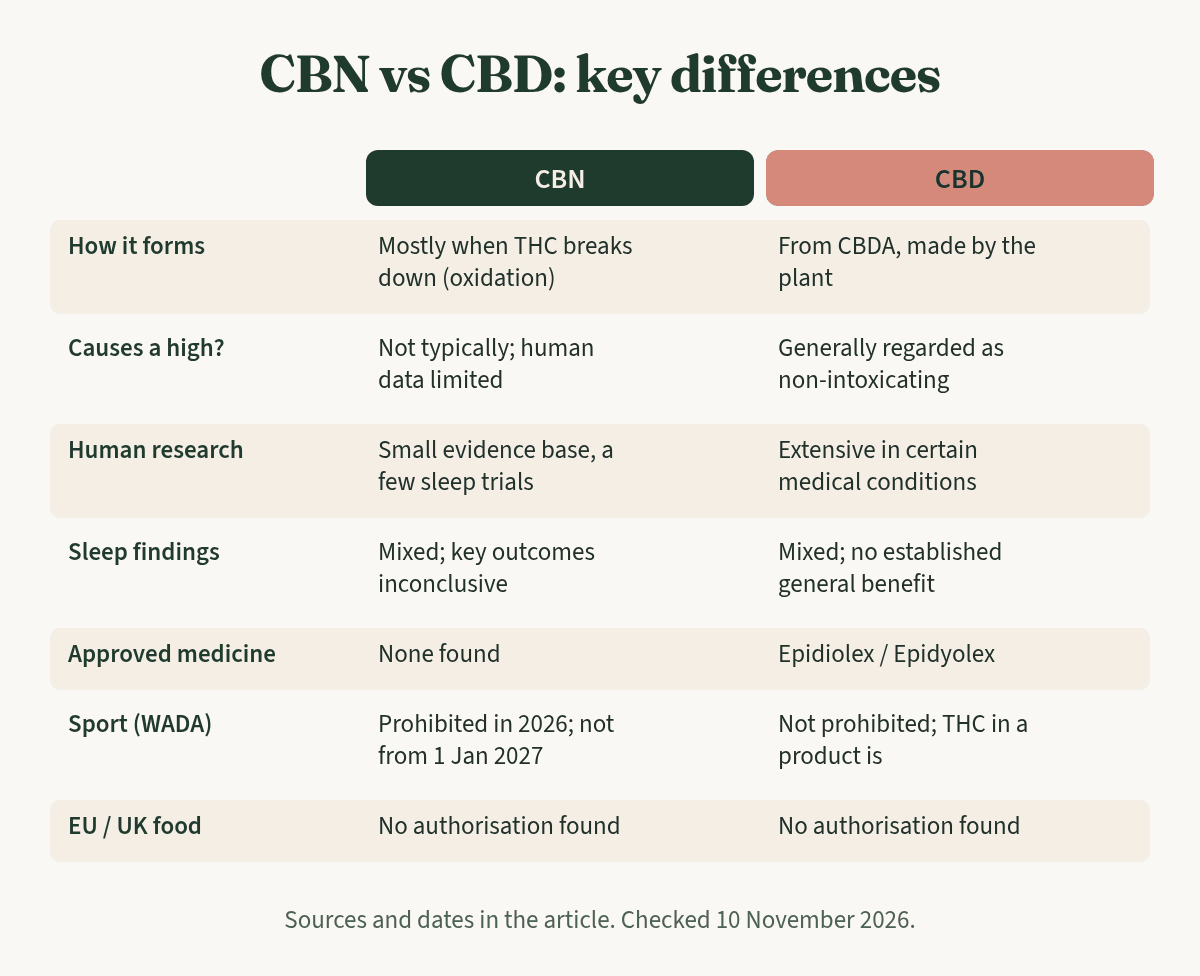
| Sport (WADA) | Not prohibited; THC in a product still is | Prohibited in competition in 2026; not prohibited from 1 January 2027 [24][25] |
Neither cannabinoid is universally stronger, safer or more effective than the other. Those comparisons depend on what is being measured and the evidence available.
What Are CBD and CBN?
Both compounds belong to a large family of naturally occurring substances called cannabinoids. Despite sharing that classification, they reach their familiar forms through different chemical processes.
How CBD forms in the cannabis plant
CBD stands for cannabidiol. It is among the best-known cannabinoids associated with Cannabis sativa L.
The living plant primarily produces the acidic precursor of CBD, called cannabidiolic acid (CBDA).
An enzyme known as CBDA synthase converts cannabigerolic acid (CBGA) into CBDA. This pathway was characterised in research published by Taura and colleagues in 1996. [1]
CBDA can subsequently lose carbon dioxide through a reaction called decarboxylation, producing CBD. Heating encourages this transformation, although changes can also occur gradually under certain storage conditions.
In simplified form:
CBGA → CBDA → CBD
The first step involves the plant’s biosynthetic machinery. The second involves decarboxylation.
That difference is worth keeping in mind when reading cannabinoid labels: compounds measured in finished products do not always appear in exactly the same proportions as they did in fresh plant material.
How CBN forms from THC
CBN stands for cannabinol.
Unlike CBD, CBN is not associated with an established plant biosynthetic pathway comparable to the production of CBDA. Instead, it is primarily associated with the chemical transformation of THC-related cannabinoids.
A simplified pathway is:
THCA → THC → CBN
THCA can form THC through decarboxylation. THC can then undergo oxidation, contributing to the formation of CBN.
Another recognised route involves THCA oxidising into cannabinolic acid (CBNA), which can subsequently form CBN through decarboxylation. [2]
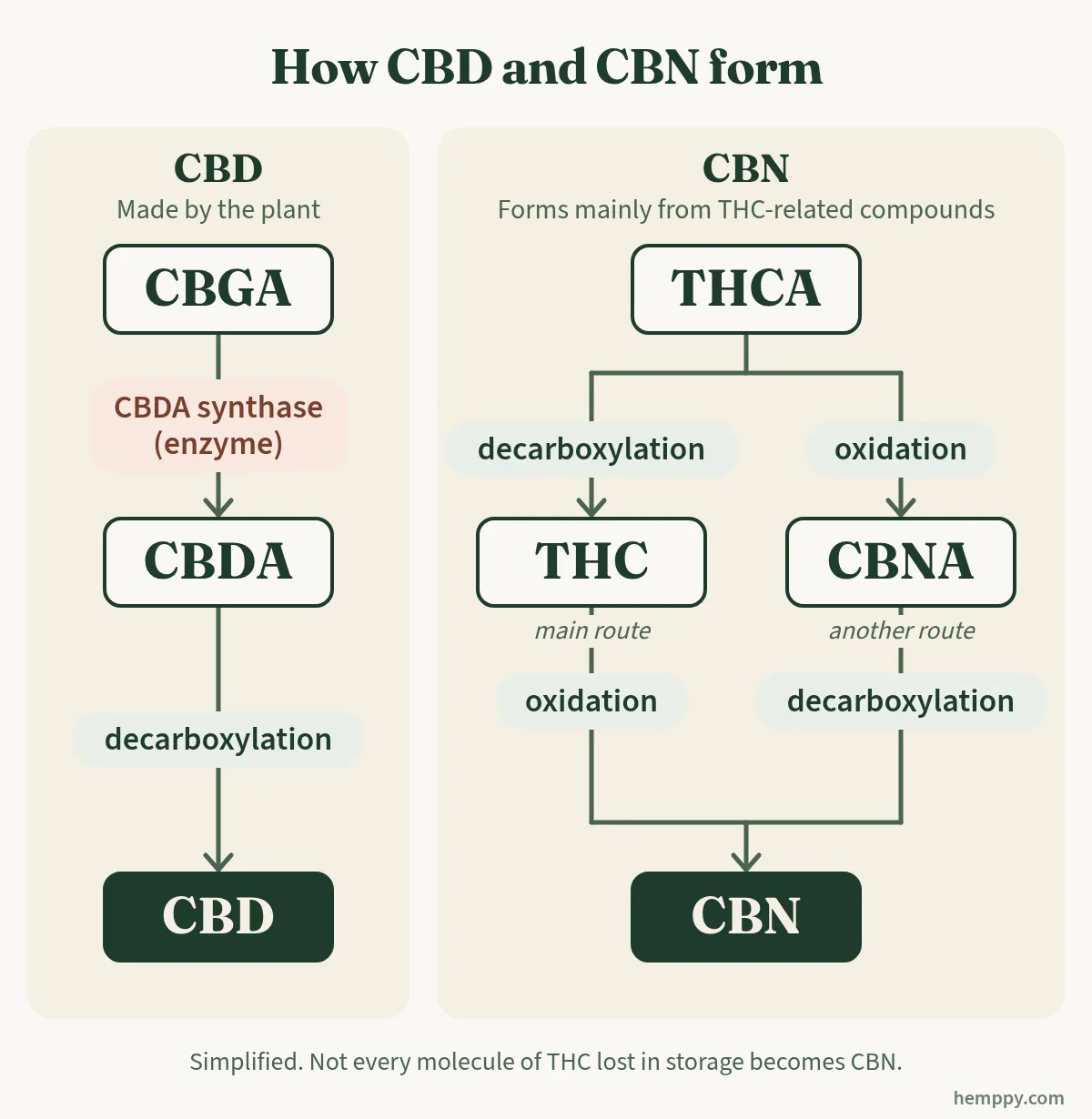
Oxidation and decarboxylation are different reactions. Heating a material does not automatically convert its THC into CBN, nor does every molecule of THC lost during storage become CBN.
Exposure to air, light, temperature and time can all influence changes in cannabinoid composition. But their effects depend on the material and the conditions involved.
In an early storage experiment, Fairbairn and colleagues found that the disappearance of THC did not always correspond to an increase in CBN. [3] More recent research has also demonstrated that different cannabis varieties and storage conditions produce different chemical changes. [2]
This explains why the amount of CBN in a product can be informative without telling the whole story.
It also matters that commercial CBN ingredients are not necessarily obtained by allowing plant material to age naturally. Controlled chemical conversion is another possible production route. The presence of CBN alone cannot identify how an ingredient was manufactured.
Do CBD and CBN Cause a High?
CBD is generally described as non-intoxicating. It does not produce the characteristic THC-like high, although that does not mean it has no effects on the brain or nervous system.
CBN is more difficult to describe in equally definitive terms.
Laboratory research suggests that CBN interacts with cannabinoid receptors differently from THC. A 2022 review reported that CBN binds to the CB1 receptor with about ten times lower affinity than THC, and that it was less effective than THC in a laboratory measure of CB1 receptor activity. [4] However, the available human evidence is not sufficient to guarantee that CBN can never cause impairment or other noticeable effects.
There is also a difference between intoxication and sleepiness.
A compound being investigated for sleep-related outcomes is not necessarily intoxicating. Equally, evidence of receptor activity in laboratory experiments does not reliably predict how a person will feel after exposure.
The composition of a finished product creates another complication.
If an oil contains CBD, CBN, THC and other cannabinoids, a person’s experience cannot simply be attributed to one ingredient. The concentration of each compound, the formulation and the presence of THC all matter.
For this reason, descriptions such as “CBN is stronger than CBD” are incomplete. Stronger in which sense: receptor activity, intoxicating potential or demonstrated clinical effect?
Those are separate questions, and current research does not support one universal answer.
CBN vs CBD for Sleep: What Does the Research Show?
Sleep is one of the most common reasons people compare CBN with CBD.
CBN has acquired a reputation as a sleep-related cannabinoid. Yet that reputation is more established in product marketing than in clinical evidence.
That does not mean researchers have found nothing. Controlled human studies now exist, including a trial published in 2026. The important point is that their results need to be interpreted carefully.
What human studies have found about CBN
A 2024 study led by Bonn-Miller examined CBN alone and in combination with CBD over seven consecutive nights. Its analysis included 293 participants who reported poor sleep.
Participants receiving CBN alone reported fewer nighttime awakenings and less overall sleep disturbance compared with placebo.
However, the study’s primary measure of overall sleep quality did not show a statistically significant improvement. There were also no significant differences in several other outcomes, including time taken to fall asleep and time spent awake after initially falling asleep.
Adding CBD did not improve the tested CBN effects. Because the study did not include a CBD-only group, it cannot establish whether CBN performs better than CBD. The study’s authors were affiliated with cannabis companies (Canopy Growth Corporation and Wana Brands). [5]
A larger 2024 study, led by Kolobaric, investigated three CBN formulations, melatonin and placebo in 1,020 participants over four weeks.
The CBN groups showed statistically significant improvements in reported sleep-disturbance scores compared with placebo. However, the proportions achieving the study’s defined threshold for a clinically meaningful change did not differ significantly from placebo.
The study was funded by the product manufacturer, a relevant consideration when evaluating the strength and independence of the evidence. [6]
A further trial published in 2026 examined CBN in 20 adults with diagnosed insomnia. Researchers used overnight polysomnography, which measures sleep through recordings of brain activity and other physiological signals.
Neither tested CBN dose significantly improved the study’s primary outcome: time spent awake after initially falling asleep.
At the higher experimental dose, researchers observed improvements in some secondary measures, including sleep-onset time and subjective sleep quality.
Those findings are scientifically relevant. But they do not overturn the unsuccessful primary outcome or establish that CBN is an effective long-term insomnia treatment. The study examined single-night exposure in a small group of adults. [7]
What about CBD and sleep?
CBD has a larger overall human research base, but that does not necessarily mean its usefulness for insomnia is established.
A 2024 pilot trial examined CBD against placebo in 30 adults with moderate to severe insomnia.
Most measured sleep outcomes, including insomnia severity, did not differ significantly between the groups. Some secondary findings, including an objective measure of sleep efficiency, favoured CBD.
The researchers concluded that larger studies were needed to clarify the findings. [8]
Importantly, this research involved a specific experimental preparation and exposure. It cannot be used to make claims about CBD oils or other consumer products in general.
Has either cannabinoid been shown to work better?
Not on the basis of the available evidence.
The studies differ in who participated, what formulations were tested, how long exposure lasted and how sleep was measured.
A study in which participants report sleeping better is not necessarily measuring the same thing as a study recording their sleep in a laboratory.
Similarly, an improvement in a secondary outcome is not equivalent to success on a trial’s main measure of effectiveness.
| Research | What was observed | What remains uncertain |
|---|---|---|
| Bonn-Miller et al., 2024: CBN alone and with CBD | Fewer reported awakenings with CBN alone; primary sleep-quality result was not statistically significant | Whether findings extend beyond the short trial or establish clinical benefit |
| Kolobaric et al., 2024: CBN formulations | Improvements in reported sleep-disturbance scores | Clinical significance and confirmation in independently funded trials |
| Lavender et al., 2026: CBN in adults with insomnia | No significant improvement in the primary objective sleep measure; some secondary improvements | Effects over longer periods and in larger groups |
| Narayan et al., 2024: CBD | Most sleep outcomes were similar to placebo; some secondary findings favoured CBD | Whether the findings would be replicated and whether they apply to other formulations |
These results are neither proof that CBN works better than CBD nor evidence that every potential sleep-related effect has been ruled out.
The most defensible conclusion is that clinical evidence remains insufficient to establish either cannabinoid as a generally effective insomnia treatment in consumer products.
The experimental doses reported in these trials are research conditions, not established consumer dosing recommendations.
Side Effects and Safety: What Is Known?
The safety evidence differs substantially between CBD and CBN.
CBD has been studied in clinical settings for longer and in greater detail. That provides more information about potential adverse effects, but it also means more risks have been documented.
CBN has less extensive human research. Fewer documented adverse effects should not be mistaken for evidence that it is safer.
CBD safety and medication interactions
CBD can interact with enzymes involved in processing medicines. Its effects can therefore depend on other medications a person is taking.
The European Medicines Agency has authorised a prescription cannabidiol medicine, Epidyolex, for specified seizure disorders. Its use is supervised by clinicians and subject to particular treatment conditions.
That authorisation demonstrates an established medicinal use for a specific CBD product. It does not establish the effectiveness or safety of ordinary CBD consumer products. [9]
Liver safety is one area where human research has identified concerns.
In a 2025 randomised trial involving 201 healthy adults, participants received CBD or placebo for 28 days. The CBD exposure was 5 mg per kilogram of body weight per day.
Eight participants assigned to CBD experienced liver enzyme elevations beyond the study’s defined threshold, compared with none assigned to placebo.
The result is important, but it does not mean the same rate of liver enzyme changes occurs at every CBD dose or with every formulation. Nor does an elevated laboratory measurement automatically mean liver failure. [10]
What remains unknown about CBN
Human studies of CBN have been comparatively short, and long-term safety is not well established.
Important uncertainties include prolonged exposure, interactions with medicines and effects in populations not adequately represented in existing studies.
The absence of extensive safety data is not a reason to assume that CBN is harmless.
For both cannabinoids, health circumstances and concurrent medication use can change the safety considerations. Anyone considering cannabinoid exposure alongside prescribed medicines should obtain advice from an appropriately qualified healthcare professional.
How to Read CBD and CBN on a Laboratory Report
A certificate of analysis, usually shortened to COA, can provide useful information about the tested composition of a cannabinoid product.
A laboratory may measure CBD, CBN, THC and other cannabinoids in a particular sample.
These results can help establish what was detected and at what concentration. They do not, by themselves, establish a product’s safety, effectiveness, manufacturing history or legal status.
Understanding the numbers
Suppose an illustrative laboratory report lists the following:
| Cannabinoid | Reported concentration |
|---|---|
| CBD | 40 mg/mL |
| CBN | 2 mg/mL |
A measured 0.5 mL portion of that material would contain:
- 20 mg of CBD
- 1 mg of CBN
This is a fictional arithmetic example, not a real product, recommended intake or authorised formulation.
The calculation shows why measurement units matter. A concentration expressed in milligrams per millilitre is different from the total amount in a bottle, and neither, on its own, tells the reader anything about clinical effectiveness.
Before interpreting a COA, check that the batch or sample identifier corresponds to the product in question. Look for the testing date, laboratory identity, units, analytical method and which cannabinoids were actually measured.
A result marked “not detected” does not necessarily mean a substance is entirely absent. It means the substance was not detected under the conditions and limits of that particular test.
Analytical quality also matters. Research from the US National Institute of Standards and Technology has highlighted challenges in obtaining comparable cannabinoid measurements across laboratories. [11]
A cannabinoid potency panel also does not necessarily include tests for pesticides, heavy metals, residual solvents or microbial contamination. Those require their own relevant analyses.
Does CBN indicate that a product is old?
Sometimes CBN can help researchers interpret changes in stored cannabis material, particularly when the original THC composition is known.
But it is not a universal freshness test.
A 2020 study by Milay and colleagues examined how different cannabis materials changed under varying storage conditions. The researchers found that CBN was an unsuitable ageing marker for the CBD-rich variety they tested, even after prolonged storage. [2]
Consider two hypothetical situations.
One product has been freshly formulated using an ingredient that already contains CBN. Another contains CBD-rich material that has been stored for a long period but originally contained very little THC.
The first product could show measurable CBN despite being recently manufactured. The second might show very little CBN despite its age.
A single laboratory result cannot distinguish these histories.
CBN concentration is therefore one piece of analytical information, not a reliable timestamp or a complete assessment of quality.
CBN and CBD Under European Union Rules
For European readers, the distinction between scientific evidence and legal permission is particularly important.
The EU regulates certain cannabinoid-containing foods under its novel food framework.
A novel food is generally one that was not consumed to a significant degree within the EU before 15 May 1997 and falls within the categories defined by Regulation (EU) 2015/2283.
Under this framework, a food ingredient classified as novel requires authorisation and inclusion in the Union list before it can be placed on the EU market for the relevant use. [12]
The European Commission has treated cannabinoid-containing extracts and ingredients such as CBD and CBN as falling within novel food considerations, subject to the relevant evidence and product circumstances. Its Novel Food Status Catalogue provides guidance, but the catalogue is non-binding and non-exhaustive. [13]
Three regulatory stages are often confused:
| Stage | What it means |
|---|---|
| Novel food classification | An ingredient or use falls within the novel food framework |
| EFSA safety assessment | Scientific evidence about a specified ingredient and its proposed use is evaluated |
| EU market authorisation | The relevant novel food is authorised under defined conditions through the applicable EU procedure |
A submitted application is not an authorisation. Neither is an EFSA safety assessment.
What changed in EFSA’s 2026 CBD assessment?
In February 2026, the European Food Safety Authority published an updated scientific statement on CBD as a novel food.
EFSA derived a provisional safety value of 0.0275 mg per kilogram of body weight per day, approximately 2 mg per day for a 70 kg adult, for a narrowly defined category of CBD food-supplement formulations.
The value applies only where CBD purity is at least 98%, the production process is considered safe, genotoxicity has been ruled out and exposure to small particles, including nanoparticles, is excluded.
EFSA also stated that safety could not be established for people under 25, pregnant or breastfeeding women, or people taking concurrent medicines. Important long-term safety uncertainties remained. [14]
This provisional assessment is not a universal safe dose, consumer intake recommendation, CBD food authorisation or approval of health claims. It cannot automatically be applied to CBN or other cannabinoid formulations.
In September 2026 EFSA also published its first opinion finding one specific CBD novel food safe under its proposed conditions of use: synthetic CBD of at least 98% purity, dissolved in MCT oil, in food supplements at up to 2 mg a day for adults over 25, excluding pregnant and breastfeeding women. Safety could not be established for people taking medication. An EFSA opinion is not an authorisation: the decision rests with the European Commission and the Member States. [15]
Whether an individual CBD or CBN food ingredient can lawfully be marketed must be determined from the applicable authorisation, its conditions of use and any additional relevant rules. As of 10 November 2026 we found no EU market authorisation covering CBD or CBN as a food ingredient. The Union list can change, so check its current version before relying on this. [16]
What about health claims?
EU rules also restrict what food businesses can claim about their products.
Regulation (EC) No 1924/2006 generally requires commercial health claims to meet the applicable requirements and be authorised. [17]
This is separate from novel food authorisation.
A clinical trial investigating sleep outcomes does not give businesses permission to market a cannabinoid product as an insomnia treatment or sleep aid.
The EU Register of Nutrition and Health Claims is the relevant resource for checking authorised claims and their conditions. As of 27 October 2026 we found no authorised health claim specific to CBD or CBN in the register. [18]
National laws introduce another layer. Rules concerning controlled substances, medicines, possession, imports and individual product categories can differ between countries.
Being derived from hemp does not automatically establish that a product is legally marketable as food throughout Europe.
CBN and CBD in the UK and the US
Rules outside the EU differ, and CBN does not always sit in the same legal category as CBD. These are short, dated summaries of what we found, not legal advice. Check the current rules where you live.
United Kingdom
In the UK, cannabinol is listed as a Class B drug under the Misuse of Drugs Act 1971. Pure CBD, as an isolated substance, is not controlled under that Act. [19]
A product that contains small amounts of controlled cannabinoids can fall outside those controls only if it meets the “exempt product” definition in the Misuse of Drugs Regulations 2001. It must meet all three conditions of that definition. One is that no component part contains more than 1 mg of a controlled drug. The Home Office reads that limit per container, such as a bottle of oil, not per dose, and expects producers to be able to show compliant levels of Δ9-THC, Δ8-THC and CBN. [19]
The Food Standards Agency classes CBD foods as novel foods that need authorisation. In September 2026 a Food Standards Agency Board paper recommended that ministers in England and Wales authorise the first three high-purity (at least 98%) CBD foods, intended for adults at up to 10 mg a day. The final decision rests with ministers. The paper covers CBD only; we found no mention of CBN in it. [20] As of 10 November 2026 we found no authorised CBD or CBN food in the UK and no ministerial decision on those recommendations.
United States
A federal law enacted on 12 November 2025 (Public Law 119-37) rewrites the US definition of hemp in two scheduled stages. From 12 November 2026, it is due to exclude products containing cannabinoids that the plant cannot produce naturally. From 11 December 2026, after a delay enacted in September 2026, the rest of the new definition is due to apply. That would include excluding cannabinoids the plant can produce naturally but that were synthesised or manufactured outside the plant, and final products with more than 0.4 mg per container of total THC (including THCA) combined with any other cannabinoids that have, or are marketed as having, similar effects to THC. Congress could still change the 11 December date. [21]
The law does not name CBN. Some of the questions that matter for CBN are left to the details: whether it counts as a cannabinoid the plant can produce naturally, whether a particular CBN ingredient was made outside the plant, for example by chemical conversion, and whether it is treated as having effects similar to THC. The law asked the FDA to publish lists of such cannabinoids within 90 days. The Congressional Research Service reported on 28 September 2026 that they had not been published, and as of 10 November 2026 we had not found them. [21][22] State laws vary as well.
CBN on Hemppy: Products That List It
Several products Hemppy lists combine CBN with CBD.
| Product (brand) | Format | Label facts (as the brand states them) | Extract |
|---|---|---|---|
| NuLeaf Naturals CBD:CBN Sleep Gummies Full Spectrum | Gummies, 30, 60 or 90 | 20 mg per gummy at 3:1 CBD to CBN (15 mg CBD and 5 mg CBN); jars labelled 600, 1,200 or 1,800 mg CBD:CBN | Full-spectrum |
| NuLeaf Naturals CBD:CBN Sleep Gummies Broad Spectrum 900 mg (60 ct) | Gummies, 60 | Labelled 900 mg CBD:CBN, 3:1 CBD to CBN | Broad-spectrum; “THC-free” on the brand page |
| NuLeaf Naturals Deep Rest Broad Spectrum Oil 1150 mg | Oil, 30 ml | 16.7 mg CBD and 2.5 mg CBN per 0.5 ml serving; 60 servings | Broad-spectrum; “THC-free” on the brand page |
| NuLeaf Naturals Deep Rest Broad Spectrum CBD:CBN Softgels 1200 mg (60 ct) | Softgels, 60 | 15 mg CBD and 5 mg CBN per softgel | Broad-spectrum; “THC-free” on the brand page |
| Endoca CBD + CBN Gummies, Blackcurrant | Gummies, 30 | 40 mg CBD per gummy; described as broad-spectrum CBD and CBN gummies | Broad-spectrum |
| NuLeaf Naturals Multicannabinoid Oil | Oil, 30 ml or 100 ml | 60 mg per ml of a CBD, CBC, CBG and CBN blend | Full-spectrum |
The table lists brand-published label facts; it is not a ranking or a health recommendation. Label facts are quoted as each brand publishes them and were last checked on the date shown on each product page. Product names are the brand’s own. Whether a product can be sold or shipped to you depends on where you live, so availability is shown per country on each product page.
Because these labels add CBN to CBD, Hemppy does not rank them by CBD-only price per 100 mg; see how we compare CBD products and the price per 100 mg study. All of them sit in the CBD gummies, CBD oils and CBD capsules categories, and the best CBD gummies comparison explains why blend jars are listed but not ranked. Terms such as CBD:CBN and broad-spectrum are defined in the CBD glossary.
Frequently Asked Questions
Is CBN stronger than CBD?
There is no established overall ranking. The answer would depend on whether “stronger” refers to receptor activity, intoxicating effects, or a particular clinically measured outcome. Current human evidence does not establish that CBN is generally more effective than CBD.
Does CBD turn into CBN as it gets older?
Not through the ordinary degradation pathway associated with CBN formation. CBN is primarily linked to changes in THC-related compounds. An ageing CBD-rich product should not be assumed to convert its CBD into CBN. That said, one laboratory stability study of pure CBD (Kosović and colleagues, 2021) did detect CBN in many of its partially degraded samples. Our guide to whether CBD oil expires covers that study.
Can CBD and CBN be combined?
The two compounds can be present in the same formulation, and combinations have been studied. However, combining them does not necessarily produce a greater effect, improve safety or establish legal market access. In one controlled sleep trial, adding CBD did not improve the measured effects of CBN. [5]
Can CBN affect a drug test?
Potentially, depending on the test.
A 2020 laboratory study found that CBN cross-reacted with two urine screening immunoassays designed to detect a THC metabolite.
This does not establish how often someone using a CBN-containing product would receive a positive result. Screening tests and confirmatory laboratory methods also differ. No cannabinoid product should be assumed to be drug-test safe. [23]
Are CBN and CBD legal everywhere in Europe?
There is no reliable single answer for all products and jurisdictions.
Legal status depends on the substance, formulation, intended use, product category and applicable national legislation. EU food rules do not independently settle every question concerning medicinal or controlled-substance regulation.
Is CBN banned in sport?
Under the 2026 anti-doping list, CBN counts among the cannabinoids prohibited in competition, because only CBD is exempt. [24] From 1 January 2027 the list prohibits only THC and cannabinoids that mimic its effects, and UK Anti-Doping says natural CBN will no longer be prohibited. [25] THC in a product remains prohibited, so athletes should follow their own sport and national agency.
The Bottom Line
The clearest difference between CBD and CBN lies in how they form.
CBD develops from a precursor produced through the cannabis plant’s natural biosynthetic processes. CBN forms mainly through chemical changes involving THC-related compounds.
The evidence surrounding their effects is also different. CBD has an established use in a specific prescription medicine, while human research into CBN remains more limited. Recent CBN sleep trials have produced findings worth investigating, but they do not establish that CBN is better than CBD or that it is an effective treatment for insomnia.
For anyone trying to understand a cannabinoid product, three questions are especially useful: What does it contain? What evidence supports the claims being made? And which rules apply to that particular product?
Those questions provide a more reliable starting point than a simple comparison of which cannabinoid is supposedly stronger.
Scientific and Regulatory Sources
Cannabinoid chemistry, research and laboratory analysis
- Taura F., Morimoto S., Shoyama Y. (1996). Purification and characterization of cannabidiolic-acid synthase from Cannabis sativa L. Journal of Biological Chemistry. PubMed.
- Milay L. et al. (2020). Metabolic Profiling of Cannabis Secondary Metabolites for Evaluation of Optimal Postharvest Storage Conditions. Frontiers in Plant Science. Full study.
- Fairbairn J.W., Liebmann J.A., Rowan M.G. (1976). The stability of cannabis and its preparations on storage. Journal of Pharmacy and Pharmacology. PubMed.
- Maioli C., Mattoteia D., Amin H.I.M., Minassi A., Caprioglio D. (2022). Cannabinol: History, Syntheses, and Biological Profile of the Greatest “Minor” Cannabinoid. Plants. Full review.
- Bonn-Miller M.O. et al. (2024). A double-blind, randomized, placebo-controlled study of the safety and effects of CBN with and without CBD on sleep quality. Experimental and Clinical Psychopharmacology. PubMed.
- Kolobaric A. et al. (2024). A Randomized, Double-Blind, Placebo-Controlled Trial to Assess the Effectiveness and Safety of Melatonin and Three Formulations of Floraworks Proprietary TruCBN for Improving Sleep. Pharmaceuticals. Full study.
- Lavender I. et al. (2026). Cannabinol for Acute Treatment of Insomnia Disorder in a Randomized Placebo-Controlled Crossover Trial. Journal of Sleep Research. PubMed.
- Narayan A.J. et al. (2024). Cannabidiol for moderate–severe insomnia: a randomized controlled pilot trial of 150 mg of nightly dosing. Journal of Clinical Sleep Medicine. Full study.
- European Medicines Agency. Epidyolex: European Public Assessment Report. Official EMA information.
- Florian J. et al. (2025). Cannabidiol and Liver Enzyme Level Elevations in Healthy Adults: A Randomized Clinical Trial. JAMA Internal Medicine. Full study.
- Yarberry A. et al. (2024). Cannabis Laboratory Quality Assurance Program: Exercise 2 Cannabinoid Final Report. National Institute of Standards and Technology. Official report.
European Union regulations and assessments
- European Parliament and Council. Regulation (EU) 2015/2283 on Novel Foods. EUR-Lex.
- European Commission. Novel Food Status Catalogue. Official guidance.
- EFSA Panel on Nutrition, Novel Foods and Food Allergens (2026). Update of the statement on safety of cannabidiol as a novel food. EFSA Journal. Scientific statement.
- EFSA NDA Panel. Safety of synthetic cannabidiol as a novel food pursuant to Regulation (EU) 2015/2283. EFSA Journal, 2026 (published 18 September 2026). doi.org/10.2903/j.efsa.2026.10154
- European Commission. Union List of Authorised Novel Foods. Official Union list information.
- European Parliament and Council. Regulation (EC) No 1924/2006 on Nutrition and Health Claims Made on Foods. EUR-Lex.
- European Commission. EU Register of Nutrition and Health Claims. Official register.
UK and US law
- UK Home Office. Drug licensing factsheet: cannabis, CBD and other cannabinoids (updated 3 October 2024). gov.uk · Misuse of Drugs Act 1971, Schedule 2, Part II. legislation.gov.uk.
- UK Food Standards Agency. CBD novel food applications: recommendations to ministers on first authorisations (Board paper, September 2026 Board meeting; page updated 19 October 2026). gov.uk.
- Public Law 119-37 (approved 12 November 2025), Division B, section 781 (new definition of hemp; FDA lists due within 90 days). govinfo.gov · Public Law 119-103 (approved 2 September 2026), section 2019 (delay to 11 December 2026). govinfo.gov.
- Congressional Research Service. Changes to the Statutory Definition of Hemp and Implications for Agricultural Policy, IF13136 (updated 28 September 2026). congress.gov.
Drug testing
- Kroner G.M. et al. (2020). Cannabinol (CBN) Cross-Reacts with Two Urine Immunoassays Designed to Detect Tetrahydrocannabinol (THC) Metabolite. Journal of Applied Laboratory Medicine. PubMed.
Updates checked 10 November 2026
- World Anti-Doping Agency. The 2026 Prohibited List, section S8 Cannabinoids. Official list.
- UK Anti-Doping (2026). 2027 Prohibited List: Summary of Changes (WADA published the 2027 List on 21 September 2026; in effect from 1 January 2027). UKAD.
Scientific and regulatory material reviewed: 22 October 2026; legal and regulatory summary re-checked: 10 November 2026. This article provides general educational information, not medical advice or a product-specific determination of regulatory compliance.