
This article is general information, not medical advice. Hemppy does not sell products. Our shop, opening soon, will link to partner brands’ own websites, where you buy from the brand directly. If you buy through one of those links, Hemppy may earn a commission from the brand. This article does not recommend any specific product.
Does CBD oil expire? Yes, in the sense that it does not keep its quality indefinitely. Two things age in the bottle: the CBD itself, which slowly breaks down, and the carrier oil it is dissolved in, which can oxidise and turn rancid. Gummies age too, for slightly different reasons.
How fast that happens depends far more on storage than on the calendar. In laboratory tests, CBD in oil kept in the dark at 25 °C showed no significant loss for six months, yet lost about 42% within a year. At 40 °C with the vial left open, almost none remained after a year. [1] Light, heat and air all speed things up. [2][3]
The date on the label is the manufacturer’s estimate of how long the product keeps its quality when stored as instructed. Storage decides how close a real bottle gets to that estimate, and neither the date nor the bottle’s appearance can confirm how much CBD is still inside.
On this page
- CBD Oil Shelf Life at a Glance
- Does CBD Oil Expire? What Actually Changes
- What the Stability Studies Show
- How Long Does a Bottle Last Once Opened?
- How to Read the Date on a CBD Label
- How to Store CBD Oil
- Signs a CBD Oil Has Changed
- Do CBD Gummies Expire Too?
- Is It Safe to Use Expired CBD Oil?
- Frequently Asked Questions
- The Bottom Line
CBD Oil Shelf Life at a Glance
| Question | Short answer |
|---|---|
| Does CBD (cannabidiol) degrade? | Yes, mainly through oxidation; light, heat and air speed it up |
| Does the carrier oil change? | Yes, it can oxidise and go rancid; its fatty acid make-up affects how fast |
| Unopened vs opened | Opening lets in air; the label may give a “use within” period |
| Typical label date | Set by the manufacturer for that product; no universal figure |
| Gummies | Moisture, sugar crystallisation and heat limit their shelf life |
| Signs of change | Darker colour, thicker texture, rancid smell or taste, mould |
| What a “best before” date means | Quality, not safety; “use by” dates concern safety |
A best-before date is not a switch that turns a product unsafe overnight, and it is no guarantee of the stated strength either.
Does CBD Oil Expire? What Actually Changes
A bottle of CBD oil is a mixture, and its parts age at different speeds.
CBD itself breaks down
CBD is chemically sensitive. A 2026 review from a Polish state research institute names oxygen, light, heat and acidic conditions as the main causes of its degradation. Oxidation, the main route, turns CBD into CBD quinone and other oxidation products. [4]
One stress test of pure CBD also detected CBN (cannabinol) in many of its partially degraded samples. [1] That does not make CBN a reliable age marker. A 2020 storage study found it unsuitable as one for the CBD-rich cannabis it tested. [5] The CBN vs CBD guide explains where CBN normally comes from.
The carrier oil can go rancid
Most CBD oils are an extract dissolved in an edible oil such as MCT (medium-chain triglyceride) oil, olive oil or hemp seed oil. Edible oils oxidise in storage, and the breakdown products give old oil its stale, rancid smell and taste. Temperature, light, oxygen and the oil’s fatty acid make-up all affect the speed. [6]
That matters for hemp seed oil, which contains up to 90% unsaturated fatty acids, most of them polyunsaturated. Its natural tocopherols act as antioxidants, but chlorophyll left over from pressing can promote oxidation in light. [7]
A 2018 analysis of 14 CBD oils sold in Europe found that the one made with MCT oil was almost free of fat oxidation products, unlike the olive and hemp seed oil samples. [8] Rancidity is a different measure from CBD loss, though, as the studies below show.
Flavourings, terpenes and other ingredients
Everything else in the bottle can change too, from flavourings to the plant compounds in full-spectrum extracts. In gummies, the structure itself is the weak point: the gelling agent, the sugars or polyols and the water they hold together determine texture and storage stability. [9]
What the Stability Studies Show
Many consumer guides repeat “one to two years” without a source. The published stability data are more useful, and more varied.
Pure CBD in sunflower oil (Kosović et al., 2021)
A Czech team stored pure CBD (99.9%) as a powder and dissolved in sunflower oil, in open and closed vials, in the dark for up to a year. The two test conditions were 25 °C with 60% humidity and 40 °C with 75% humidity. The Czech Ministry of the Interior funded the work, and the authors declared no conflicts of interest. [1]
At 25 °C, CBD in oil was stable for at least 180 days. After a year, 58% of the original CBD remained. At 40 °C, the open vials had lost 20% by day 90 and kept about 1% after a year. The closed vials lost 16.5% by day 180 and kept about 24% after a year. The powder was far more stable, losing around 8% to 10% in a year at 25 °C. [1]
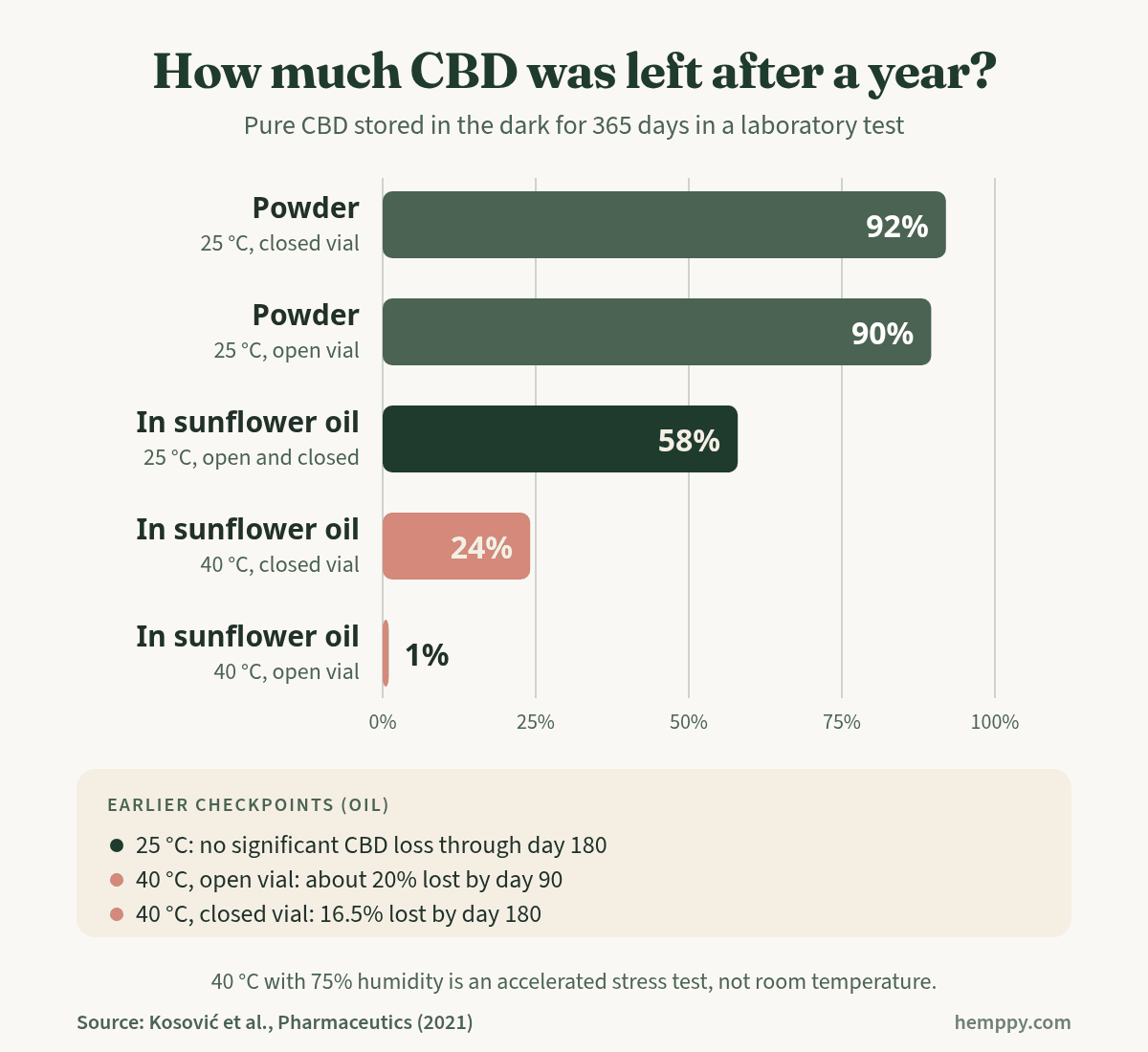
The oil also darkened after about 180 days, and the open samples at 40 °C became roughly 80 times more viscous. A five-day light test caused little or no extra loss, and the authors concluded that light alone had no strong effect but may add to heat and oxygen. [1]
What it does not show: these were small vials of pure CBD, not retail extracts. The 40 °C condition is an accelerated test designed to stress a product, not a model of a kitchen cupboard.
CBD in MCT oil under light, air and cold (Ryu et al., 2026)
A 2026 study stored CBD in MCT oil for up to 192 days in clear or amber vials, in light or darkness, sealed or open, at −18 °C, 4 °C, 23 °C and 40 °C. Clear vials under light showed the largest CBD loss and colour change. Air mainly sped up discolouration. Low temperatures prevented both. [2]
Yellowing tracked CBD loss closely (correlation −0.79), but the authors concluded that colour cannot quantify how much CBD has gone. It can only hint at poor storage. The study is listed among publications supported by the Institute of Cannabis Research in Colorado. [2]
Real-world oils from patient associations (Valdez et al., 2026)
A Brazilian university team stored 12 cannabis oils from patient associations, made with MCT, olive, corn or sesame oil, for 180 days at 5 °C or 20 °C, under household LED light or in the dark. The work was publicly funded, with no conflicts declared. [3]
CBD losses over six months ranged from 13.1% to 94.6%. Light was the most significant factor, MCT-based samples degraded most, and added vitamin E had only a limited effect. [3]
Even the most protective combination (corn or sesame oil, light protection, antioxidants and refrigeration) lost 19.3% to 51.6% of its CBD. The authors noted that an earlier sesame oil study had found no significant change over a year, a reminder of how much results vary. [3]
Older and smaller studies
An Italian study of a cannabis-based olive oil reported a 30% fall in CBD within ten weeks. Two of its four authors were affiliated with a hemp company. [10]
In 1976, Fairbairn and colleagues stored cannabis, resin, extracts and pure cannabinoid solutions for up to two years. Light was the greatest single cause of loss, air oxidation also mattered, and temperatures up to 20 °C made little difference. [11]
| Study | Conditions | What was observed | What remains uncertain |
|---|---|---|---|
| Kosović et al., 2021 | Pure CBD in sunflower oil, dark, 25 °C or 40 °C, 1 year | 58% left at 25 °C; 24% (closed) and 1% (open) at 40 °C | Pure CBD in small vials, not a retail extract |
| Ryu et al., 2026 | CBD in MCT oil, light vs dark, −18 °C to 40 °C, 192 days | Light caused the most loss; cold prevented loss and yellowing | Colour cannot measure potency |
| Valdez et al., 2026 | 12 association oils, four carriers, 5 °C or 20 °C, 180 days | CBD losses 13.1% to 94.6%; light the strongest factor | Small local producers; one LED set-up |
| Morini et al., 2017 | Cannabis-based olive oil, room temperature | 30% CBD loss within ten weeks | Limited detail in the published summary |
| Fairbairn et al., 1976 | Cannabis, resin and extracts, up to 2 years | Light the greatest single factor; air oxidation significant | Not modern CBD oils |
The carrier findings point in different directions. MCT oil showed the fewest fat oxidation products in one survey [8], yet MCT-based samples lost the most CBD in another [3]. A product can do well on rancidity and badly on CBD loss.
The most defensible conclusion is that CBD in oil degrades measurably over months, and that the rate depends heavily on light, temperature, air, the carrier and the formulation. Laboratory conditions differ from home storage, so no single month figure applies to every product.
How Long Does a Bottle Last Once Opened?
Each opening lets in fresh air, and a dropper can touch fingers or a worktop before it goes back into the oil. The evidence on air alone is mixed. At 25 °C, open and closed vials of CBD in sunflower oil did not differ significantly over the year as a whole, while at 40 °C the open vials degraded far faster. [1] In MCT oil, air exposure mainly sped up discolouration. [2]
In the EU and the UK, food labels must give storage conditions or a time limit for consumption after opening “where appropriate”. [12] That is where lines such as “use within six months of opening” come from, and the manufacturer, who knows the formulation, sets the period.
There is no universal “opened” shelf life for CBD oil, and any figure that ignores storage conditions is a guess.
“How long does a bottle last” can also mean how many days of servings it holds. That depends on the serving size printed on the label, which this guide does not advise on.
How to Read the Date on a CBD Label
A date on a food label is one of two kinds, and they mean different things.
“Best before” vs “use by” in the EU and UK
EU law defines the “best before” date as the date until which a food keeps its specific properties when properly stored, followed where needed by the storage conditions that period assumes. Highly perishable foods carry a “use by” date instead, after which the food is deemed unsafe. [12]
“Best before” is used when the date includes a day, “best before end” otherwise. A month and year are enough for foods that keep three to 18 months, and the year alone beyond that. [12]
Guidance from the European Food Safety Authority (EFSA) says the manufacturer chooses the type of date product by product and sets the shelf life for reasonably foreseeable storage conditions. [13] The UK kept the same regulation after Brexit, and GOV.UK states that use-by dates relate to safety and best-before dates to quality. [12][14]
The United States
According to the USDA’s Food Safety and Inspection Service, federal rules do not require dates on food except infant formula, and dates are not safety indicators. [15] The FDA has separately concluded that adding CBD to food in interstate commerce is a prohibited act. [16] Which labelling rules apply to a particular CBD product is a legal question this guide does not settle.
Whether a CBD product may be sold as food at all is a separate question again. What Is CBD? covers the current EU, UK and US position, with dates.
Batch number and production date
The lot or batch number identifies the production run. [17] Matching it to the batch certificate of analysis shows when the batch was tested, and a lab result describes the oil on that date, not after a year in a warm kitchen.
A worked example
Suppose an illustrative label reads “Best before end 03/2027. Once opened, use within 6 months.” The bottle is opened on 1 November 2026.
Six months after opening is 1 May 2027, but the best-before date, the end of March 2027, comes first. The earlier date is the one the manufacturer’s estimate supports. A bottle marked “best before end 12/2027” and opened on 1 January 2026 would instead reach its limit on 1 July 2026.
This is a fictional example, not a real product or a recommendation about use.
How to Store CBD Oil
The studies above point to the same short list.
- Keep it dark. Light was the largest single factor in three of the studies above, although a short light test in the sunflower oil study found little effect on its own. [2][3][11][1] Amber or other dark glass, kept in its box or a cupboard, limits exposure.
- Keep it cool. Low temperatures prevented CBD loss and colour change in MCT oil, including at −18 °C and 4 °C. [2] Heat at 40 °C was the most destructive condition in the sunflower oil study. [1]
- Keep it closed. Close the cap promptly; air sped up discolouration and, in the warm test, CBD loss. [1][2]
- Keep the dropper clean. Avoid touching it to anything before it goes back in the bottle.
- Avoid hot spots. A car in summer, a sunny windowsill and a shelf above a radiator combine heat and light.
The fridge is optional unless the label says otherwise. A chilled oil pours more slowly and may turn hazy; if that clears at room temperature, temperature is the likely cause. Cold, including freezing, prevented CBD loss in the MCT study, but follow the brand’s storage line. [2]
Signs a CBD Oil Has Changed
Some changes are harmless and reversible. Others suggest it has deteriorated.
Changes to watch:
- A rancid, sharp or paint-like smell or taste. These off-flavours come from the breakdown of oxidised fats. [6]
- A clearly darker colour. Darkening tracked CBD loss in two studies, though it cannot tell you how much CBD is left. [1][2]
- A much thicker texture at room temperature. Viscosity rose sharply in oil stored warm and open. [1]
- Visible mould or fuzzy growth. GOV.UK gives visible mould as an example of what to check for after a best-before date. [14]
Changes that are not necessarily spoilage: haze or thickening that clears as a chilled bottle warms up. Crystals or sediment are harder to read. CBD has a limited solubility in oil, reported at about 90 to 100 mg per ml in MCT oil, so a very concentrated product may be close to that limit. [4] If solids appear, the brand is the right place to ask.
Do CBD Gummies Expire Too?
Yes. A gummy is a gel made from a gelling agent such as gelatin or pectin, sugars or polyols, and water. The way those ingredients bind water decides how firm the gummy stays, how sticky it gets and how long it keeps. [9]
Three things limit a gummy’s shelf life:
- Moisture. Sugars and polyols lower water activity, the measure of how much water is free to move. That limits moisture migration and can improve microbial and physical stability. [9] Gels can also lose water over time, a process called syneresis. [9]
- Crystallisation. Sugar can crystallise inside the gel, causing a grainy, cloudy texture and loss of quality. Glucose syrup in the recipe slows it. [9]
- Heat. Gelatin is thermoreversible: in warm conditions a gelatin gummy can soften, melt and even turn liquid. [9]
CBD in a gummy faces the same chemistry as in oil, with one difference. In a gelatin-based matrix, CBD is often dispersed rather than fully dissolved. [4] We found no published long-term stability study of CBD content in commercial gummies as of 22 October 2026.
Keep the jar closed, dry and away from heat. The CBD oil vs CBD gummies comparison covers the two formats in more detail.
Is It Safe to Use Expired CBD Oil?
Food law separates the two kinds of date for a reason. A best-before date concerns quality, while a use-by date concerns safety, and after a use-by date a food is deemed unsafe in the EU. [12][14] The first step is to check which of the two a CBD label carries.
After a best-before date, GOV.UK says food is usually safe but may not be of the same quality, and suggests using sight, smell and taste. [14] EFSA’s guidance did not set indicative time limits for food sold or donated past its best-before date, citing the variability between products and consumer habits. [13] A rancid smell, mould or an unusual appearance is a reason not to consume it.
For CBD oil there is a second issue. The CBD content may now be lower than the label states, as the stability studies show. [1][3] Nothing on the bottle reveals by how much.
None of this is medical advice. Regulators’ advice on CBD intake is a separate matter, covered in the What Is CBD? guide linked above, and anyone taking prescribed medicines should obtain advice from an appropriately qualified healthcare professional before using any cannabinoid product.
Frequently Asked Questions
Should CBD oil be refrigerated?
Not necessarily, unless the label says so. Cold storage at 4 °C prevented CBD loss and yellowing in a 2026 MCT oil study. [2] A cool, dark cupboard away from heat sources is the minimum. A refrigerated oil may thicken or turn hazy until it warms up.
Can you freeze CBD gummies?
We found no study on freezing CBD gummies as of 22 October 2026. Freezing protected CBD in oil [2], but a gummy is a water-containing gel whose texture depends on how it holds that water. [9] Follow the brand’s storage instructions.
Does CBD turn into THC as it ages?
Not in the sunflower oil storage study, which looked for it. Δ9-THC was not detected in its degraded CBD samples, although the authors noted their scanning method could miss small amounts. [1] CBD can convert to THC isomers under strongly acidic laboratory conditions, which are not normal storage conditions. [4] No cannabinoid product should be assumed to be drug-test safe.
Does hemp seed oil expire?
Yes. Like other edible oils it oxidises over time and can turn rancid, and it is unusually rich in polyunsaturated fats, which its natural tocopherols protect from oxidation. [6][7] Light can speed this up through the chlorophyll some pressed oils contain. [7] The CBD oil vs hemp seed oil guide explains how the two products differ.
Does CBD isolate last longer than CBD oil?
In one study, yes. Pure CBD powder lost around 8% to 10% over a year at 25 °C, while the same CBD dissolved in sunflower oil lost about 42%. [1] Isolate is still sensitive to heat, light and air, so the same storage rules apply.
Whether partner shop links are shown depends on your country.
The Bottom Line
CBD oil does expire. The CBD slowly breaks down and the carrier oil can turn rancid, and gummies have their own limits in moisture, crystallisation and heat.
Laboratory studies show CBD losses from under 10% to almost all of it, depending on light, heat, air and formulation. No single month figure applies to every product.
Three checks are useful for any bottle or jar: what kind of date it carries and when that is, what storage line the label gives, and which batch and test date the certificate of analysis shows.
Storing a product cool, dark and closed is a more reliable way to protect it than relying on the printed date alone.
Scientific and Regulatory Sources
Stability, oil chemistry and formulation research
- Kosović E., Sýkora D., Kuchař M. (2021). Stability study of cannabidiol in the form of solid powder and sunflower oil solution. Pharmaceutics 13(3):412. Full study.
- Ryu B.-R., Kinney C.A., Gim G.-J., Kwon T.-H., Park S.-H. (2026). Storage-induced color change as an indicator of cannabidiol degradation in MCT oil. Industrial Crops and Products 247:123456. doi.org/10.1016/j.indcrop.2026.123456.
- Valdez A.S.B., Castañeda J.B.B., Rastely N.B.C., Ferreira W., Nascimento F.P., Toci A.T. (2026). Evaluation of the stability of cannabidiol and delta-9-tetrahydrocannabinol in cannabis-based oily product: effects of light, temperature, excipients and antioxidant additives. Brazilian Journal of Analytical Chemistry 13(52):133–149. Full study.
- Talar-Śpionek A., Juszczuk-Kubiak E., Roszko M. (2026). Cannabidiol in dietary supplements: characteristics, routes of administration, bioavailability, and research challenges. Molecules 31(13):2385. Full review.
- Milay L. et al. (2020). Metabolic profiling of cannabis secondary metabolites for evaluation of optimal postharvest storage conditions. Frontiers in Plant Science. Full study.
- Choe E., Min D.B. (2006). Mechanisms and factors for edible oil oxidation. Comprehensive Reviews in Food Science and Food Safety 5(4):169–186. doi.org/10.1111/j.1541-4337.2006.00009.x.
- Farinon B., Molinari R., Costantini L., Merendino N. (2020). The seed of industrial hemp (Cannabis sativa L.): nutritional quality and potential functionality for human health and nutrition. Nutrients 12(7):1935. Full review.
- Pavlovic R. et al. (2018). Quality traits of “cannabidiol oils”: cannabinoids content, terpene fingerprint and oxidation stability of European commercially available preparations. Molecules 23(5):1230. Full study.
- Vásquez-Senador M., Pérez-Bermúdez I., Orellana-Palma P., Petzold G. (2026). Gummies: from confectionery to functional hydrogel-based bioactive delivery systems. Gels 12(9):841. Full review.
- Morini L., Porro G., Liso M., Groppi A. (2017). Therapeutic use of Δ9-THC and cannabidiol: evaluation of a new extraction procedure for the preparation of cannabis-based olive oil. Current Pharmaceutical Biotechnology 18(10):828–833. PubMed.
- Fairbairn J.W., Liebmann J.A., Rowan M.G. (1976). The stability of cannabis and its preparations on storage. Journal of Pharmacy and Pharmacology 28(1):1–7. PubMed.
Food labelling law and guidance
- European Parliament and Council. Regulation (EU) No 1169/2011 on the provision of food information to consumers, Articles 2(2)(r), 9(1)(f)–(g), 24 and 25 and Annex X. EUR-Lex | UK version (legislation.gov.uk).
- EFSA Panel on Biological Hazards (2020). Guidance on date marking and related food information: part 1 (date marking). EFSA Journal 18(12):6306. doi.org/10.2903/j.efsa.2020.6306.
- UK Government (published 25 June 2026). Understanding food labelling: best before and use-by dates. GOV.UK guidance.
- US Department of Agriculture, Food Safety and Inspection Service. Food product dating. Official FSIS guidance.
- US Food and Drug Administration. FDA regulation of cannabis and cannabis-derived products, including cannabidiol (CBD): questions and answers. Official FDA information.
- European Parliament and Council. Directive 2011/91/EU on indications or marks identifying the lot to which a foodstuff belongs, Articles 1 and 2. EUR-Lex.
Scientific and regulatory material reviewed: 22 October 2026. This article provides general educational information, not medical advice or a product-specific determination of regulatory compliance.