
This article is general information, not medical advice. Hemppy does not sell products. Our shop, opening soon, will link to partner brands’ own websites, where you buy from the brand directly. If you buy through one of those links, Hemppy may earn a commission from the brand. This article does not recommend any specific product.
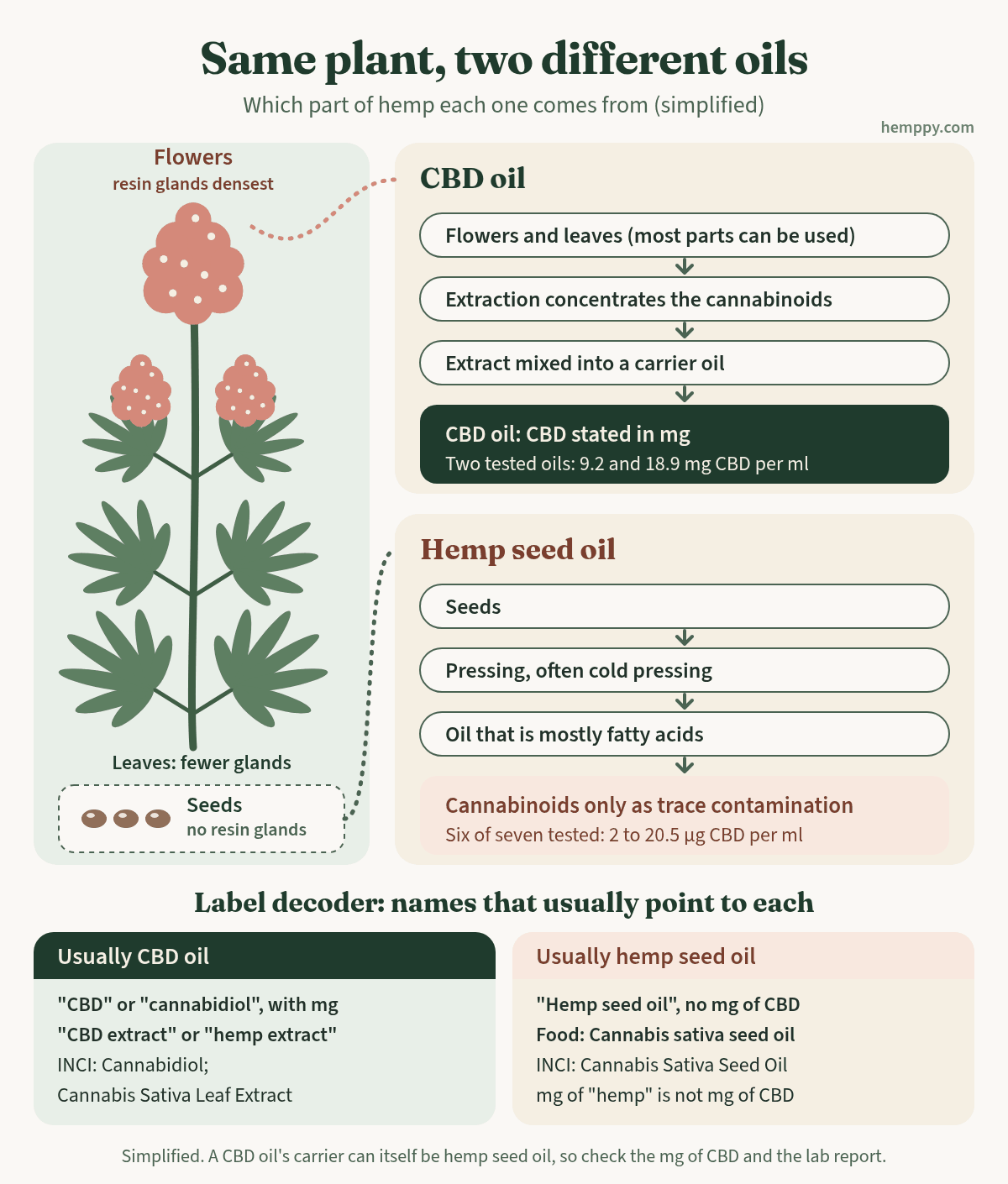
In any CBD oil vs hemp seed oil comparison, start with the plant. Both come from hemp, Cannabis sativa, but from different parts of it, and they contain different things. One is built around a cannabinoid extract. The other is a pressed food oil.
Hemp seeds make almost no cannabinoids of their own. Any CBD or THC in hemp seed oil comes mainly from resin that rubs off the flowers during harvest, so the amounts are traces. CBD oil is a cannabinoid extract dissolved in a carrier oil.
The two often sit side by side under one word: “hemp”. That word describes the plant, not what the bottle contains. The ingredient list, the milligrams of CBD on the label and the batch lab report are what tell them apart.
On this page
- CBD Oil and Hemp Seed Oil at a Glance
- What Are CBD Oil and Hemp Seed Oil?
- Does Hemp Seed Oil Contain CBD or THC?
- How to Tell Them Apart on a Label
- Why Is Hemp Seed Oil Used as a Carrier?
- Can Hemp Seed Oil Affect a Drug Test?
- CBD Oil and Hemp Seed Oil Under EU, UK and US Rules (2026)
- Frequently Asked Questions
- The Bottom Line
CBD Oil and Hemp Seed Oil at a Glance
| CBD oil | Hemp seed oil | |
|---|---|---|
| Part of the plant | Most parts can be extracted; resin glands are densest on the flowers | Seeds |
| How it is made | Extraction, then the extract is mixed into a carrier oil | Pressing the seeds, often cold pressing |
| Main components | A cannabinoid extract plus a carrier oil | Fatty acids, mostly polyunsaturated |
| CBD content | Stated in mg; two tested oils held 9.2 and 18.9 mg/ml | Traces; six of seven tested oils held 2 to 20.5 µg/ml |
| THC | Depends on the extract; check the batch report | Trace contamination; EU limit 7.5 mg/kg as Δ9-THC equivalents |
| EU food status | Cannabinoid extracts treated by the Commission as novel foods | Listed as not novel |
| Label clue | “CBD” or “cannabidiol” with a figure in mg | “Hemp seed oil” or “Cannabis Sativa Seed Oil”, no mg of CBD |
A bottle that says “hemp” tells you about the plant, not about its cannabinoid content.
What Are CBD Oil and Hemp Seed Oil?
They are two different products with one botanical source. The difference starts with where the plant makes its cannabinoids.
How hemp seed oil is made
Cannabinoids are made and stored in glandular trichomes, tiny resin glands. These are abundant on the female flowers, sparser on leaves and stems, and absent from roots and seeds. [1]
Seeds can still pick up resin from the bracts around them during harvest. Any cannabinoids found in hemp seeds are therefore a contamination, and the amount depends on the variety and on how well the seed is cleaned. [1]
Hemp seed oil is pressed from those seeds. One method is cold pressing. It yields relatively little oil, and the oil tends to be rich in chlorophyll, probably released as the seed cells are crushed. [1]
Chemically, the oil is mostly fat. A 2020 review of published analyses reported up to 90% unsaturated fatty acids, with polyunsaturated fatty acids making up 70% to over 80%. The main ones are linoleic acid, an omega-6, and alpha-linolenic acid, an omega-3. [1]
The oil also contains tocopherols, compounds of the vitamin E family that act as antioxidants within the oil itself. [1] That is a description of composition, not a health benefit.
How CBD oil is made
CBD extracts can be made from most parts of the hemp or cannabis plant. Selective extraction concentrates the CBD, and some processes also change other components of the plant material. [2]
The Belgian food authority describes a CBD oil as an oil containing CBD. Often it is hemp seed oil or another edible oil to which CBD or a CBD extract has been added. [3] Extracts differ in how much of the plant’s other compounds they keep, which is what full-spectrum vs broad-spectrum CBD explains.
Concentration is the point. Researchers in Japan who tested two commercial CBD oils in 2020 measured 18.9 and 9.2 mg of CBD per millilitre. Both were close to the amounts stated on the products. [4]
Why “hemp oil” is a confusing name
“Hemp oil” is used loosely. Some sellers mean the pressed seed oil and others mean a cannabinoid extract. The authors of that 2020 study noted that some products are marketed without a clear distinction between the two. [4]
The Belgian authority finds the question “are they the same thing?” common enough to answer in its official guidance. Its answer is no. [3] Cannabis sativa is simply the plant’s botanical name, so it appears in the names of seed oils and extracts alike.
Does Hemp Seed Oil Contain CBD or THC?
It can contain traces of both. Seeds do not make cannabinoids, but analyses of real seeds and oils keep finding small amounts.
In a 2000 study at the University of Mississippi, Ross and colleagues measured total Δ9-THC in drug-type and fibre-type (hemp) cannabis seeds. Hemp seeds held 0 to 12 µg/g, against 35.6 to 124 µg/g for drug-type seeds. [5]
Most of that THC sat on the surface. A quick solvent wash removed about 90%, and hemp seed kernels contained less than 0.5 µg/g. [5]
The 2020 Japanese study bought seven hemp seed oils and two CBD oils online. It measured CBD by liquid chromatography after heating the samples, which converts the acid form, CBDA, into CBD. Six of the seven seed oils contained 2.0 to 20.5 µg of CBD per ml, and one had none detectable. No THC was detected in any sample. [4]
That sample was small and came from one market. The method’s quantification limit was 4.6 µg/ml, so the lowest values are less precise than the highest. The paper declares no external funding and no competing financial interests; four of its seven authors were affiliated with Morinda, a private company. [4]
Results also depend on the method. A 2017 Canadian study of three consumer hemp seed brands found Δ9-THC estimates above Canada’s 10 µg/g limit in almost all cases, varying with the extraction procedure. The authors could not explain the levels, and two disclosed consulting fees from Scientus Pharma. [6]
| Study | What was measured | What remains uncertain |
|---|---|---|
| Ross et al., 2000 | THC in hemp seeds: 0 to 12 µg/g, mostly on the surface | Seeds tested around 2000; specific seed lots |
| Kitamura et al., 2020 | CBD in 7 seed oils (2.0 to 20.5 µg/ml in six) and 2 CBD oils | One market; small sample; low values near method limits |
| Yang et al., 2017 | THC in 3 seed brands, 4 extraction methods | Why levels were high; results varied by method |
What “trace” means in numbers
The units matter. One milligram (mg) is 1,000 micrograms (µg). The seed oils in the 2020 study held micrograms of CBD per millilitre, while the CBD oils held milligrams. Depending on which two samples are compared, the gap is a few hundred to several thousand times. [4]
Regulators describe THC in seed products the same way. In December 2018 the FDA said hemp seeds do not naturally contain THC. The seed ingredients it reviewed contain only trace amounts of THC and CBD, picked up during harvesting and processing. [7]
In the EU, maximum levels have applied since 1 January 2023. They are 3.0 mg/kg for hemp seeds and products made from them, and 7.5 mg/kg for hemp seed oil. [8][9] Both are expressed as Δ9-THC equivalents, the sum of Δ9-THC and 0.877 × THCA, because THCA can turn into THC during processing. [8]
Behind those limits is a 2015 EFSA opinion that set an acute reference dose of 1 µg of Δ9-THC per kg of body weight. A 2020 EFSA report then found that dose exceeded in certain acute exposure estimates. [8][10] A legal maximum is a ceiling for food on sale. It is not a measurement of any particular bottle.
How to Tell Them Apart on a Label
The front of a bottle can be ambiguous. The ingredient list and the numbers usually are not.
Ingredient names on foods and supplements
On food labels, a seed oil is normally listed as “hemp seed oil” or “Cannabis sativa seed oil”. A CBD product adds a second ingredient: “CBD”, “cannabidiol“, “CBD extract” or a “hemp extract” of some kind. In the US, the FDA notes that products containing hemp seed ingredients must declare them by name on the ingredient list. [7]
If the only hemp ingredient is the seed oil, the product is a seed oil, whatever the front label says.
INCI names on cosmetics
Cosmetics use standard INCI names. The EU’s cosmetic ingredient database, CosIng, defines Cannabis Sativa Seed Oil as “the fixed oil expressed from the seeds” of the plant. [11]
CosIng lists extracts of named plant parts separately, such as Cannabis Sativa Leaf Extract and Cannabis Sativa Flower/Leaf/Stem Extract. Cannabidiol has two entries of its own: synthetically produced, and derived from an extract, tincture or resin of cannabis. [11] An extract name says which part of the plant was extracted. It says nothing about how much CBD is in the jar.
Milligrams of what?
The most useful question on any label is: milligrams of what? A CBD oil should state its CBD in mg per bottle and, ideally, per ml. A large number next to the word “hemp” may describe the amount of oil or extract rather than the amount of CBD. The CBD oil label guide explains how mg per bottle, mg per ml and percentages relate.
A certificate of analysis (COA) from an independent laboratory settles it. Check that the batch number matches the bottle and that the report covers CBD and THC. Check the units, too: µg/g and mg/g differ by a factor of 1,000. “Not detected” means not detected by that method, at that laboratory’s limits.
A worked example
Suppose two fictional labels sit side by side.
- Bottle A: “Cold-pressed hemp seed oil, 250 ml”. Ingredients: hemp seed oil. No CBD figure. Its lab report shows 0.02 mg of CBD per ml.
- Bottle B: “CBD oil, 10 ml, 1,000 mg CBD”. Ingredients: hemp seed oil, CBD extract. That works out at 100 mg per ml.
- The arithmetic: the whole of Bottle A holds 0.02 mg × 250 = 5 mg of CBD. A single millilitre of Bottle B holds 100 mg, twenty times more than all of Bottle A.
Both labels list hemp seed oil. Only the CBD figure, and the lab report behind it, shows the difference. This is a fictional arithmetic example, not a real product, recommended intake or authorised formulation.
“Hemp oil” listings on marketplaces
On large online marketplaces, one listing pattern deserves a second look. The title says “hemp oil” or “hemp extract” next to a very large milligram figure. The details give no CBD amount and no lab report, and the ingredient list, if shown, names only hemp seed oil.
Such a product may be a perfectly ordinary seed oil. It simply cannot be compared with a CBD oil on the numbers given, because none of them describe CBD.
Why Is Hemp Seed Oil Used as a Carrier?
A carrier oil dilutes the extract so that it can be measured in millilitres. Hemp seed oil is one common choice, alongside other edible oils. [3] Using it keeps the ingredient list to a single plant: hemp seed oil plus a hemp extract.
The trade-off is stability. Hemp seed oil’s linoleic and alpha-linolenic acids make it highly sensitive to oxidation and photo-oxidation, which can lead to rancidity despite its natural antioxidants. [12] Polyunsaturated fatty acids oxidise easily even at room temperature, because their multiple double bonds make it easier for reactive radicals to form. [13] Chlorophyll in cold-pressed oil can also speed up light-driven oxidation. [1]
In a 2024 Italian study, cold-pressed hemp seed oil was stored for 270 days in vials of four materials, either at 25 °C in diffused light or at 10 °C in the dark. Amber glass wrapped in foil, kept cool, gave the most protection. The authors declared no conflicts of interest. [12]
That study tested a seed oil, not a CBD oil, so it shows how the carrier behaves rather than how CBD changes. The CBD side is covered in does CBD oil expire?
Can Hemp Seed Oil Affect a Drug Test?
Possibly, but confirmed positives appeared unlikely at the THC levels in seed oils studied around 2000. Urine tests for cannabis look for a THC metabolite, THC-COOH, so what matters is how much THC an oil carries. [14]
Earlier studies had shown that eating hemp foods could cause screening and confirmed positive results. In a 2001 study, Leson and colleagues gave 15 THC-naive adults a daily blend of hemp and canola oil. Over four successive 10-day periods, the THC dose rose from 0.09 to 0.6 mg a day. [14]
No one taking 0.45 mg a day screened positive at the 50 ng/ml cutoff. At 0.6 mg a day, one specimen screened positive. The highest confirmed THC-COOH level was 5.2 ng/ml, below the 15 ng/ml confirmation cutoff used in US federal testing. [14]
The authors calculated that 0.6 mg a day equals about 125 ml of hemp oil containing 5 µg/g of THC. [14] The EU maximum for hemp seed oil, 7.5 mg/kg, equals 7.5 µg/g, which is above that level. [9]
Fifteen people is a small group, and the conclusions apply to the oils and cutoffs of that study. Funding came from a Canadian agricultural research initiative and hemp industry organisations and companies. [14]
CBD oils are a different case, because many carry THC from the extract itself. The CBD vs THC guide covers drug testing in more detail. No hemp or cannabinoid product should be assumed to be drug-test safe.
CBD Oil and Hemp Seed Oil Under EU, UK and US Rules (2026)
The rules treat the two products very differently, and the details change often. What follows describes the position as of 22 October 2026. It is general information, not legal advice for any product or country.
European Union
The European Commission’s Novel Food Status Catalogue states that hemp seeds, seed oil, hemp seed flour and defatted hemp seed have a history of consumption in the EU. They are therefore not novel, although national legislation may restrict their sale in some Member States. [15]
Cannabinoid extracts are another matter. The catalogue’s cannabinoid entry, whose wording the Finnish Food Authority also uses, treats extracts containing cannabinoids as novel foods. That applies to the extracts themselves and to any product they are added to, “such as hemp seed oil”. [15][16]
The Belgian authority applies this directly. Pure pressed hemp seed oil is not considered novel. CBD oil is considered an unauthorised novel food that may not be marketed in the EU, including online. [3]
The science on CBD is still moving. In February 2026, EFSA wrote that CBD products intended for oral consumption remain unauthorised under the Novel Food Regulation. [17] In September 2026 it published its first opinion finding one specific CBD novel food safe under proposed conditions. [18]
Those conditions are narrow: synthetic CBD of at least 98% purity in MCT oil, in food supplements at up to 2 mg a day, for adults over 25, excluding pregnant and breastfeeding women. Safety could not be established for people taking medication. An EFSA opinion is not an authorisation. [18] The CBD oil vs gummies guide covers the wider food rules for CBD products.
Hemp seed oil stays subject to the THC maximum levels described above. [9] Claims are a separate layer. EU law allows a nutrition claim such as “source of omega-3 fatty acids” only when a food meets the conditions in Regulation (EC) No 1924/2006. [19] Hemppy makes no nutrition or health claims for either product.
United Kingdom
FSA guidance lists hemp seeds as not novel, including hemp seed oil, ground hemp seeds and partially defatted hemp seeds. CBD extracts, CBD isolates and products they are added to are novel foods that need authorisation. The guidance states that none has been authorised. [2]
As of 22 October 2026 we found no authorised CBD food. In September 2026 an FSA Board paper recommended that ministers in England and Wales authorise the first three high-purity CBD foods; the decision rests with ministers. [20]
United States
In December 2018 the FDA said it had no questions about one company’s conclusion that three hemp seed ingredients are generally recognised as safe (GRAS) under their intended uses. They are hulled hemp seed (GRN 765), hemp seed protein powder (GRN 771) and hemp seed oil (GRN 778). [7] The FDA’s position on CBD is different: CBD cannot be sold as a dietary supplement or added to food sold across state lines. [21]
Federal law is also changing. A law enacted on 12 November 2025 rewrites the definition of hemp. It separately defines “industrial hemp”, which includes hemp grown for the oil, cake and other non-cannabinoid products of its seeds. [22]
The same law defines a “hemp-derived cannabinoid product” as one derived from hemp other than industrial hemp that contains cannabinoids. Final products of that kind with more than 0.4 mg of total THC and similar cannabinoids per container fall outside the new definition of hemp. [22] A 2026 law set these changes to take effect in stages on 12 November and 11 December 2026, and Congress could still change the dates. [23] State laws differ as well.
Elsewhere, rules vary widely. Being made from hemp does not on its own establish that a product can be sold as food in a given country.
Frequently Asked Questions
Is hemp oil the same as CBD oil?
Not necessarily. “Hemp oil” can mean pressed seed oil or a product containing a cannabinoid extract. Check the ingredient list and the CBD figure in milligrams. [3]
Does hemp seed oil have CBD?
Usually only traces. In one 2020 analysis, six of seven hemp seed oils held 2 to 20.5 µg of CBD per ml, and one had none detectable. The CBD oils tested held 9.2 and 18.9 mg per ml. [4]
Can hemp seed oil get you high?
Not at the trace levels in hemp seed foods, according to the FDA. Its 2018 statement says the hemp seed ingredients it reviewed cannot make consumers “high”. [7] The EU still caps THC in hemp seed oil as a food-safety measure. [9]
Can you take hemp seed oil and CBD oil together?
Many CBD oils already combine them, with hemp seed oil as the carrier. What matters is the CBD and THC content of the finished product. The FSA advises people who take medication, are pregnant or breastfeeding to avoid CBD unless under medical direction. [24]
EFSA says safety could not be established for these groups. [17] Anyone in that position should speak to a doctor or pharmacist.
Why is hemp seed oil so much cheaper?
Because it has no added cannabinoid extract. Seed oil is a pressed food oil, while a CBD oil also contains an extract that has to be produced and concentrated. [2] Price per bottle says nothing useful about CBD, since a seed oil contains almost none.
Whether partner shop links are shown depends on your country.
The Bottom Line
CBD oil and hemp seed oil share a plant, not a purpose. One carries a cannabinoid extract. The other is pressed from seeds that make no cannabinoids of their own.
The measured differences are large. Hemp seed oils in one study held micrograms of CBD per millilitre; CBD oils held milligrams. THC in seed oil comes from contamination, and EU law caps it.
Three checks settle almost every case. Which part of the plant do the ingredients come from? How many milligrams of which cannabinoid does the label state? And does a batch lab report confirm it?
The word “hemp” answers none of those questions. The label does.
Scientific and Regulatory Sources
Plant composition, laboratory analysis and food-safety limits
- Farinon B., Molinari R., Costantini L., Merendino N. (2020). The seed of industrial hemp (Cannabis sativa L.): nutritional quality and potential functionality for human health and nutrition. Nutrients. Full study.
- UK Food Standards Agency. Cannabidiol (CBD) guidance: business guidance on CBD as a novel food (England and Wales), sections 1.1 and 1.2. Official guidance.
- Belgian Federal Public Service Health, Food Chain Safety and Environment (August 2026). Questions and answers on the use of hemp (Cannabis sativa L.) and cannabinoids (such as cannabidiol) as or in food, questions 5, 6 and 11. Official FAQ (PDF).
- Kitamura M., Kiba Y., Suzuki R. et al. (2020). Cannabidiol content and in vitro biological activities of commercial cannabidiol oils and hemp seed oils. Medicines. Full study.
- Ross S.A., Mehmedic Z., Murphy T.P., ElSohly M.A. (2000). GC-MS analysis of the total Δ9-THC content of both drug- and fiber-type cannabis seeds. Journal of Analytical Toxicology. PubMed.
- Yang Y., Lewis M.M., Bello A.M. et al. (2017). Cannabis sativa (hemp) seeds, Δ9-tetrahydrocannabinol, and potential overdose. Cannabis and Cannabinoid Research. Full study.
- US Food and Drug Administration. FDA responds to three GRAS notices for hemp seed-derived ingredients for use in human food (constituent update, 20 December 2018). Official FDA information.
- Commission Regulation (EU) 2022/1393 of 11 August 2022 amending Regulation (EC) No 1881/2006 as regards maximum levels of Δ9-THC in hemp seeds and products derived therefrom (recitals 2 to 5, Article 3). EUR-Lex.
- Commission Regulation (EU) 2023/915 on maximum levels for certain contaminants in food, Annex I, entries 2.6.1 to 2.6.3 (Δ9-THC equivalents). EUR-Lex.
- EFSA Panel on Contaminants in the Food Chain (2015). Scientific opinion on the risks for human health related to the presence of tetrahydrocannabinol (THC) in milk and other food of animal origin. EFSA Journal 13(6):4141. doi.org/10.2903/j.efsa.2015.4141.
Labels, storage and drug testing
- European Commission. CosIng cosmetic ingredient database: entries Cannabis Sativa Seed Oil (55065), Cannabis Sativa Leaf Extract (97599), Cannabis Sativa Flower/Leaf/Stem Extract (95512), Cannabidiol – Synthetically Produced (93486) and Cannabidiol – Derived from Extract or Tincture or Resin of Cannabis (96287). CosIng.
- Bonazza F., Monti L., Povolo M. et al. (2024). Monitoring the shelf life of hemp seed oil stored at two temperatures in different materials via near-infrared (NIR) spectroscopy. Molecules. Full study.
- Kim S., Hwang H.S. (2024). Understanding the oxidation of hemp seed oil and improving its stability by encapsulation into protein microcapsules. Journal of Food Science. PubMed.
- Leson G., Pless P., Grotenhermen F., Kalant H., ElSohly M.A. (2001). Evaluating the impact of hemp food consumption on workplace drug tests. Journal of Analytical Toxicology. doi.org/10.1093/jat/25.8.691 · Authors’ study summary with funding (PDF).
Regulation and official guidance (EU, UK and US)
- European Commission. Novel Food Status Catalogue, entries “Cannabis sativa L.” and “Cannabinoids”. Official catalogue.
- Finnish Food Authority (Ruokavirasto). Hemp as food. Official guidance.
- EFSA Panel on Nutrition, Novel Foods and Food Allergens (2026). Update of the statement on safety of cannabidiol as a novel food. EFSA Journal. doi.org/10.2903/j.efsa.2026.9862.
- EFSA Panel on Nutrition, Novel Foods and Food Allergens (2026). Safety of synthetic cannabidiol as a novel food pursuant to Regulation (EU) 2015/2283. EFSA Journal (published 18 September 2026). doi.org/10.2903/j.efsa.2026.10154.
- Regulation (EC) No 1924/2006 on nutrition and health claims made on foods, Annex (omega-3 entries added by Commission Regulation (EU) No 116/2010). EUR-Lex.
- UK Food Standards Agency. CBD novel food applications: recommendations to ministers on first authorisations (Board paper, September 2026 Board meeting). Official Board paper.
- US Food and Drug Administration. FDA regulation of cannabis and cannabis-derived products, including cannabidiol (CBD): questions and answers. Official FDA information.
- Public Law 119-37 (enacted 12 November 2025), Division B, section 781 (new definitions of hemp, industrial hemp and hemp-derived cannabinoid product). GovInfo.
- Public Law 119-103 (enacted 2 September 2026), section 2019 (phased effective dates). GovInfo.
- UK Food Standards Agency. Food Fact Check: CBD safety and health claims (22 June 2026). Official guidance.
Scientific and regulatory material reviewed: 22 October 2026. This article provides general educational information, not medical advice, legal advice or a product-specific determination of regulatory compliance.