
This article is general information, not medical advice. Hemppy does not make CBD products; the shop lists independent brands and links to their own websites. If you buy through one of those links, Hemppy may earn a commission from the brand, and you pay the same price. See our affiliate disclosure. This article does not recommend any specific product.
CBC and THCV are minor cannabinoids that sometimes appear on CBD labels and certificates of analysis. They are not CBD, and THCV is not the same molecule as THC.
This guide explains where each compound comes from in the plant, what small human studies have measured, how to read them on a lab report, and which rules are commonly confused. It does not claim health benefits, and it does not say whether any product is legal to sell where you live.
On this page
- CBC and THCV at a Glance
- What Is CBC?
- What Is THCV?
- How They Differ from CBD and THC
- What Human Studies Have Measured
- How They Appear on a CBD Label and COA
- Rules, Sport and Drug Testing (2026)
- Frequently Asked Questions
- The Bottom Line
CBC and THCV at a Glance
| CBC (cannabichromene) | THCV (tetrahydrocannabivarin) | |
|---|---|---|
| Family | Cannabinoid | Cannabinoid |
| Plant route | From CBGA via CBCA, then decarboxylation | A propyl analogue related to THC |
| Intoxicating like THC? | Generally described as non-intoxicating | Structurally related to THC but pharmacologically distinct |
| Typical place on a COA | Own line; sometimes with CBCA | Own line; not a substitute for Δ9-THC |
| Human evidence | Sparse; one oral PK pilot in a CBD/THC oil | Sparse; small pilot with oral THCV then IV THC |
| UK drugs law (primary text) | Does not match the MDA 1971 “cannabinol derivatives” definition on its face | On the Part IV wording, falls within tetrahydro / 3-alkyl cannabinol homologues; Home Office also lists THC-V |
Figures and legal notes below are dated 27 October 2026. Product rules differ by country and can change.
What Is CBC?
CBC stands for cannabichromene. In the living plant, an enzyme converts the shared precursor CBGA into CBCA, the acid form of CBC. Heat or time then decarboxylates CBCA into CBC, the same kind of step that turns CBDA into CBD and THCA into THC. [1] [2]
CBC is one of the better-known “minor” cannabinoids next to CBG and CBN. CBG vs CBD and CBN vs CBD cover those two. Amounts of CBC in consumer CBD oils are usually much lower than CBD when they are present at all.
A 2024 pharmacology review summarised CBC’s receptor profile and early research areas. Almost all of that work is preclinical. It is not evidence that a retail CBD oil with a CBC line treats any condition. [3]
What Is THCV?
THCV stands for tetrahydrocannabivarin. It is a cannabinoid with a shorter side chain than Δ9-THC. A 2025 commentary stressed that THCV is not THC: the two are often confused in marketing and in regulation, despite different pharmacology at the doses reported so far. [4]
Authors of that commentary, some of whom work for cannabinoid companies, also noted that nicknames such as “diet weed” come from preclinical appetite and blood-sugar findings. Those findings are not established as human health effects, and this article does not repeat them as claims. [4]
THCV can appear in cannabis and in some hemp chemotypes. On a lab report it has its own line. It is not the same analyte as Δ9-THC. Under the USDA hemp-testing definition in force on 27 October 2026, “Total THC” means potential Δ9-THC from Δ9-THC plus THCA only; that formula does not add THCV. [5] Later US statutory wording uses the plural “tetrahydrocannabinols” and is treated separately in the rules section below.
How They Differ from CBD and THC
CBD, CBC and THC (via THCA) all start from CBGA, then branch through different enzymes. [1] THCV is a related cannabinoid with a three-carbon (propyl) side chain rather than the pentyl chain of Δ9-THC. [4]
Practical differences for a CBD shopper:
- CBD is the main labelled cannabinoid in these products.
- CBC is a separate, usually minor, non-THC line.
- THCV is separate from both CBD and Δ9-THC; treating it as “just THC” or “just CBD” is wrong on the chemistry. [4]
- Δ9-THC and THCA are the lines used for current US hemp “Total THC” arithmetic and for many drug tests; THCV is reported separately. [5]
The CBD vs THC guide explains the intoxicating compound and total THC arithmetic.
What Human Studies Have Measured
Human data for both compounds are limited. The studies below used research doses; they are not product recommendations.
CBC with CBD and THC (oral oil)
A 2022 pilot study re-analysed plasma from a trial of an oral cannabis oil that contained CBD, THC and CBC together. Forty-three adults were randomised to placebo or to daily oil providing about 6.6 to 26.4 mg of CBC (with CBD and THC in fixed proportion) for seven days.
After single and repeated doses, CBC Cmax rose 1.3 to 1.8-fold for each twofold dose increase, and Tmax was about 1.6 to 4.3 hours. Relative to the amounts given, CBC appeared in plasma more readily than CBD or THC in this combination. [6]
Limits: it was a secondary analysis; CBC was never given alone; authors were affiliated with the oil’s manufacturer (Canopy Growth). It describes absorption from that product, not a benefit.
THCV with THC (oral then intravenous)
A 2016 King’s College London pilot enrolled ten healthy men with limited cannabis experience. They took 10 mg oral pure THCV or placebo daily for five days, then received 1 mg intravenous THC on day five, in a double-blind crossover.
THCV was well tolerated and subjectively like placebo. Under THCV, THC’s effect on delayed verbal recall and heart rate was smaller than under placebo, and nine of ten people rated THC as weaker; some memory intrusions increased. The authors urged caution because the sample was small and THC alone did not produce the usual psychotomimetic effects at that dose. [7]
This is not a study of consumer “THCV gummies” or of appetite. It does not establish a safe or effective intake.
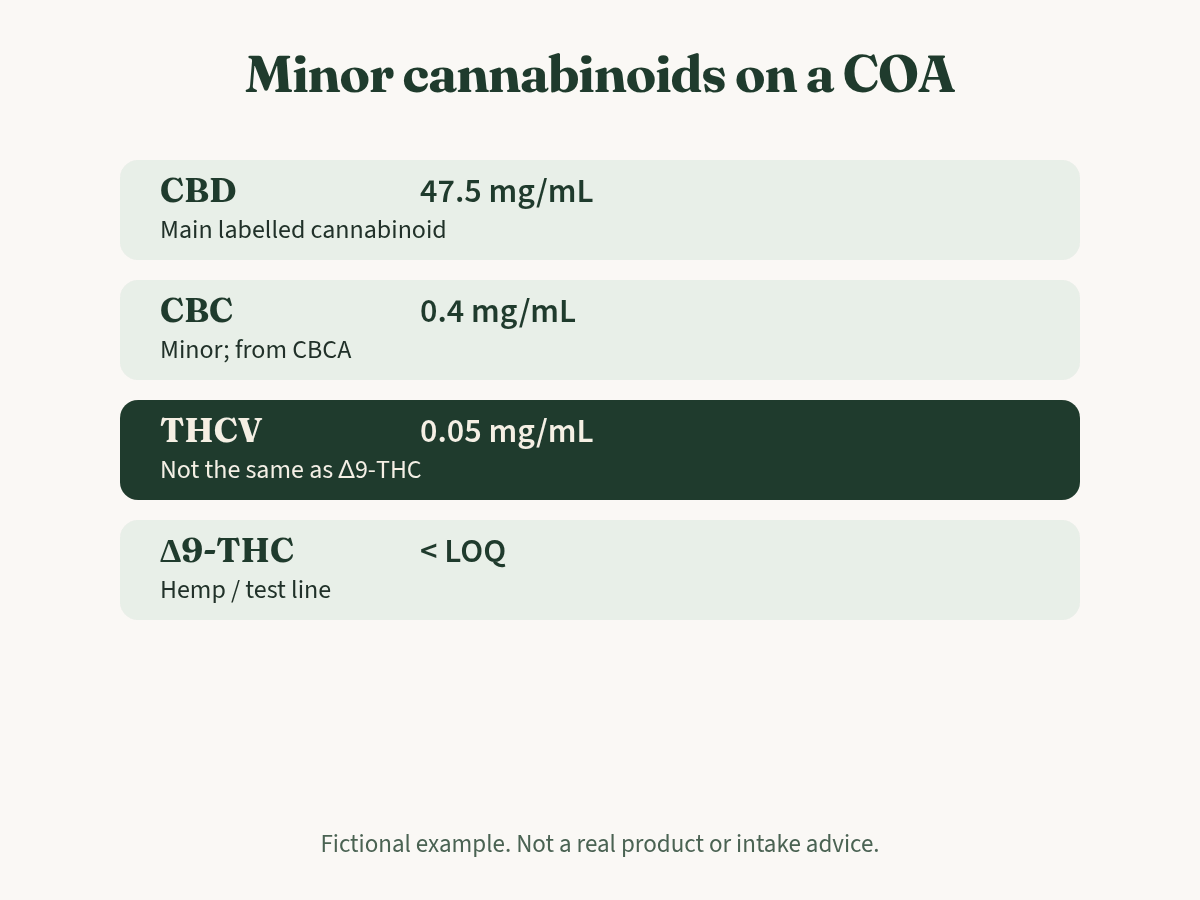
How They Appear on a CBD Label and COA
Full-spectrum extracts can retain minor cannabinoids; isolates usually do not. [8] Whether CBC or THCV shows up depends on the chemotype and the process.
On a certificate of analysis:
- CBC / CBCA. Separate lines. Some labs report only the neutral form.
- THCV. Its own line. Do not add it into Δ9-THC unless a specific method says so.
- Δ9-THC / THCA / total THC. Still required for hemp arithmetic where those rules apply. [5]
- Batch match. The number on the COA should match the pack. [9]
A 2024 US labelling audit found many CBD products off their CBD claim; minor cannabinoid lines were not the focus, but the same lesson holds: the label is not proof. [9] The full-spectrum vs broad-spectrum guide shows how extract type changes what you should expect to see. Lab terms are in the CBD glossary.
Rules, Sport and Drug Testing (2026)
The notes below are educational summaries of primary texts, checked on 27 October 2026 (Europe/Riga). They are not legal advice, not a product-compliance determination, and not a statement that any CBC or THCV product is lawful to make, sell or buy in any place.
United Kingdom (Misuse of Drugs Act 1971 and MDR 2001)
Schedule 2, Part II of the Misuse of Drugs Act 1971 lists cannabinol and “cannabinol derivatives” as Class B controlled drugs. [10]
Schedule 2, Part IV defines “cannabinol derivatives” as “the following substances, except where contained in cannabis or cannabis resin, namely tetrahydro derivatives of cannabinol and 3-alkyl homologues of cannabinol or of its tetrahydro derivatives”. [10]
THCV. Δ9-Tetrahydrocannabivarin is a tetrahydrocannabinol with a three-carbon (propyl) side chain. On that wording, it falls within “tetrahydro derivatives of cannabinol” and/or “3-alkyl homologues … of its tetrahydro derivatives”. The Home Office factsheet, as a secondary statement of departmental position, names “THC and THC-V” as examples of controlled cannabinol derivatives and refers to “delta-9-tetrahydrocannabinol-C3 (THC-V)”. [11] [10]
CBC. Cannabichromene has a chromene structure. It is not named in Schedule 2, Part II, and it does not, on its face, match the Part IV definition of “cannabinol derivatives”. [10] That reading of the statute is not a finding that a CBC product is uncontrolled: the product may still contain controlled cannabinoids such as THC or THCV, and other regimes (medicines, novel food, consumer law) can still apply.
Exempt product. Where a preparation contains a controlled drug, the Misuse of Drugs Regulations 2001, regulation 2(1), defines an “exempt product” as a preparation or other product consisting of one or more component parts, any of which contains a controlled drug, where all three conditions are met: [12]
- it is not designed for administration of the controlled drug to a human being or animal;
- the controlled drug in any component part is packaged so that it cannot be recovered by readily applicable means or in a yield which constitutes a risk to health; and
- no one component part contains more than one milligram of the controlled drug (with a separate microgram threshold for certain lysergide-related substances, not relevant here).
The Home Office factsheet discusses how it applies that test to CBD products that contain controlled cannabinoids; it is guidance, not the statute. [11] [12]
European Union (novel food)
The European Commission’s Novel Food Status Catalogue is a non-binding orientation tool. The catalogue entries this site relies on are “Cannabinoids” and “Cannabis sativa L.”. [13] On 27 October 2026 we did not find separately named catalogue entries for cannabichromene or tetrahydrocannabivarin. Extracts and products containing cannabinoids are still assessed under the novel-food framework when used as food; whether a particular product needs authorisation depends on what it contains and how it is used. [13] [14]
The catalogue itself warns that it is non-exhaustive and that EU countries may restrict marketing through specific national legislation. This review did not map CBC or THCV controls country by country across the EU/EEA. [13]
In the UK, the Food Standards Agency also classes CBD as a novel food; that CBD-specific novel-food track is separate from the MDA analysis above. [15]
United States (hemp definition and scheduled changes)
In force on 27 October 2026. 7 U.S.C. §1639o defines hemp by a delta-9 tetrahydrocannabinol concentration of not more than 0.3 percent on a dry weight basis (plant and derivatives). [16] USDA’s hemp-testing definition of “Total THC” is potential delta-9 THC after decarboxylation: Total THC = Δ9-THC + (0.877 × THCA). [5]
CSA cross-reference. 21 U.S.C. §812 Schedule I lists “Tetrahydrocannabinols, except for tetrahydrocannabinols in hemp (as defined under section 1639o of title 7)”. [17] Whether a given THCV material is “tetrahydrocannabinols in hemp” turns on that hemp definition and on how the substance is produced and sold. This article does not resolve that for any product.
Public Law 119-37 (enacted 12 November 2025), section 781, replaces the hemp definition, effective 365 days after enactment (12 November 2026). The new text uses “total tetrahydrocannabinols concentration (including tetrahydrocannabinolic acid)” of not more than 0.3 percent. [18]
It also excludes certain intermediate and final hemp-derived cannabinoid products. For final products, one exclusion is greater than 0.4 milligrams combined total per container of total tetrahydrocannabinols (including THCA) and any other cannabinoids that have similar effects (or are marketed to have similar effects) as a tetrahydrocannabinol, as determined by HHS. [18]
Public Law 119-103 (enacted 2 September 2026), section 2019, provides that until 11 December 2026 those section 781 amendments apply only to products with cannabinoids that are not capable of being naturally produced by Cannabis sativa L. From 11 December 2026 the remainder of the amended definition, including the 0.4 mg per container limb, is due to apply unless Congress changes the date again. [19]
THCV can be produced by the plant. The statute’s plural “tetrahydrocannabinols” is not limited on its face to delta-9-THC. As of 27 October 2026 we found no published HHS or USDA interpretation that settles whether THCV is counted inside that “total tetrahydrocannabinols” sum or only under the separate “similar effects / marketed as” limb. Treat both pathways as open. Do not assume a THCV line is outside US hemp or CSA analysis.
Sport (WADA 2026)
The World Anti-Doping Agency 2026 Prohibited List, section S8 (in-competition), states that all natural and synthetic cannabinoids are prohibited, with examples including cannabis products and natural and synthetic tetrahydrocannabinols (THCs). The only listed exception is cannabidiol. [20] CBC and THCV are not named in that exception.
Drug tests
Standard workplace urine immunoassays target THC-COOH, a metabolite of THC, not CBC. THCV is a different analyte; some forensic methods can measure it. A typical employment screen remains a THC-metabolite test. No cannabinoid product should be assumed to be drug-test safe.
Frequently Asked Questions
Is THCV the same as THC?
No. They are related but distinct cannabinoids. [4] In UK drugs law, THCV can still fall under the “cannabinol derivatives” heading even though it is not Δ9-THC; chemistry and control status are different questions. [10]
Does CBC get you high?
CBC is generally described as non-intoxicating. That does not make a CBC-containing product free of THC or THCV, and it is not a statement about legality. [1]
Can I tell CBC or THCV from the front of the pack?
Only if the brand lists them. The batch COA is the document that shows measured amounts. [9]
Are CBC or THCV allowed in sport?
Cannabidiol is the cannabinoid WADA exempts for 2026. Other natural cannabinoids are prohibited in competition. [20]
Do minor cannabinoids make a product “full-spectrum”?
Full-spectrum is mostly a trade label; New York is an exception with a legal definition. Minor cannabinoid lines can be consistent with a full-spectrum extract, but they do not prove the label on their own. [8]
The Bottom Line
CBC and THCV are minor cannabinoid lines that may appear beside CBD. CBC comes from CBGA via CBCA. THCV is not THC, despite the similar name.
Human evidence is thin: one oral CBC pharmacokinetic pilot inside a CBD/THC oil, and one small THCV pilot with intravenous THC. Neither supports health claims for consumer products.
For a reader comparing labels, the useful steps are to read the specific COA lines, keep THCV separate from Δ9-THC in the current USDA “Total THC” sum, and treat regulatory status from the primary texts above, not from a front-of-pack slogan. This article does not say that THCV products are legal to buy anywhere.
Scientific and Regulatory Sources
Chemistry
- Tahir M.N., Raz F.S., Rondeau-Gagné S., Trant J.F. (2021). The biosynthesis of the cannabinoids. Journal of Cannabis Research 3:7. Full study.
- Wang M., Wang Y.H., Avula B. et al. (2016). Decarboxylation study of acidic cannabinoids: a novel approach using ultra-high-performance supercritical fluid chromatography/photodiode array-mass spectrometry. Cannabis and Cannabinoid Research 1(1):262–271. Full study.
- Sepulveda D.E., Vrana K.E., Kellogg J.J. et al. (2024). The potential of cannabichromene (CBC) as a therapeutic agent. Journal of Pharmacology and Experimental Therapeutics 391(2):206–213. Review (pharmacodynamics and pharmacokinetics overview). PubMed.
- Haghdoost M., Peters E.N., Roberts M., Bonn-Miller M.O. (2025; online 2024). Tetrahydrocannabivarin is not tetrahydrocannabinol. Cannabis and Cannabinoid Research 10(1):1–5. Authors from Nalu Bio, Emerald Mountain Consulting and Charlotte’s Web. PubMed · Full article (PMC).
- US Department of Agriculture. 7 CFR 990.1, Domestic hemp production program: definitions (“Total THC”). eCFR.
Human data and labels
- Peters E.N., MacNair L., Mosesova I. et al. (2022; online 2021). Pharmacokinetics of cannabichromene in a medical cannabis product also containing cannabidiol and Δ9-tetrahydrocannabinol: a pilot study. European Journal of Clinical Pharmacology 78(2):259–265. Authors affiliated with Canopy Growth Corporation. PubMed.
- Englund A., Atakan Z., Kralj A. et al. (2016). The effect of five day dosing with THCV on THC-induced cognitive, psychological and physiological effects in healthy male human volunteers: a placebo-controlled, double-blind, crossover pilot trial. Journal of Psychopharmacology 30(2):140–151. PubMed.
- New York State Office of Cannabis Management. 9 NYCRR Part 114, Cannabinoid Hemp: §114.1 Definitions (“broad spectrum”, “distillate”, “full spectrum”, “isolate”) and §114.9(e), as amended effective 13 December 2023. Official text (PDF) · §114.1 (LII).
- Gidal B.E., Vandrey R., Wallin C. et al. (2024). Product labeling accuracy and contamination analysis of commercially available cannabidiol product samples. Frontiers in Pharmacology 15:1335441. Funded by Jazz Pharmaceuticals. Full study.
Rules
- Misuse of Drugs Act 1971, Schedule 2: Part II (Class B: cannabinol; cannabinol derivatives) and Part IV (meaning of “cannabinol derivatives”). Part II (legislation.gov.uk) · Part IV (legislation.gov.uk).
- UK Home Office. Drug licensing factsheet: cannabis, CBD and other cannabinoids (updated 3 October 2024), paragraphs 26 to 34 (exempt product definition). Official guidance.
- The Misuse of Drugs Regulations 2001 (SI 2001/3998), regulation 2(1), definition of “exempt product”. legislation.gov.uk.
- European Commission. Novel Food Status Catalogue (entries “Cannabinoids” and “Cannabis sativa L.”). Official guidance.
- Regulation (EU) 2015/2283 of the European Parliament and of the Council of 25 November 2015 on novel foods, Articles 3, 6 and 10 to 12 (definition, Union list and authorisation procedure). EUR-Lex.
- UK Food Standards Agency. Cannabidiol (CBD) guidance: business guidance on CBD as a novel food (England and Wales), updated 28 August 2026. Official guidance.
- United States Code, 7 U.S.C. §1639o (definition of hemp, as in force on 27 October 2026). GovInfo.
- United States Code, 21 U.S.C. §812, Schedule I(c)(17): “Tetrahydrocannabinols, except for tetrahydrocannabinols in hemp (as defined under section 1639o of title 7)”. GovInfo.
- Public Law 119-37 (enacted 12 November 2025), Division B, section 781 (new definition of hemp). GovInfo.
- Public Law 119-103 (enacted 2 September 2026), section 2019 (phased effective dates). GovInfo.
- World Anti-Doping Agency. The 2026 Prohibited List, section S8 Cannabinoids. Official list.
Scientific and regulatory material reviewed: 27 October 2026. This article provides general educational information, not medical advice, legal advice or a product-specific determination of regulatory compliance.