
This article is general information, not medical or legal advice. Hemppy does not test products itself: it explains how to read the reports that brands and laboratories publish. The shop lists independent brands and links to their own websites; if you buy through one of those links, Hemppy may earn a commission from the brand, and you pay the same price. See our affiliate disclosure.
A CBD lab report, also called a certificate of analysis (COA), is a batch-specific test result. How to read a CBD lab report comes down to eight checks, in order: who ran the test, whether the batch number matches your bottle, the cannabinoid table and its units, total THC, the “ND” and “LOQ” limits, contaminant panels, the dates, and whether the numbers match the label.
This guide walks through each step with an annotated example, fictional worked numbers and a red-flag list. It explains how to read a document; it cannot tell you whether a product is lawful, safe or right for you.
On this page
- What Is a CBD Lab Report (COA)?
- The 8-Step COA Checklist
- Annotated Example: A Generic COA
- Step 1: Who Made the Report?
- Step 2: Does the Batch Match Your Bottle?
- Step 3: Read the Cannabinoid Table
- Step 4: Total THC and the 0.877 Formula
- Step 5: ND, LOD and LOQ
- Step 6: Look for Contaminant Tests
- Step 7: Check the Dates
- Step 8: Match the Report to the Label
- COA Red Flags
- What a COA Cannot Tell You
- Frequently Asked Questions
- The Bottom Line
What Is a CBD Lab Report (COA)?
A certificate of analysis is a laboratory’s written result for one sample of one batch. For CBD products it usually lists cannabinoid amounts. A fuller report adds panels for heavy metals, pesticides, residual solvents and microbes. A “third-party” report is one produced by a laboratory that does not belong to the brand.
A COA is the only way to compare what the label says with what a laboratory measured. That matters because testing studies keep finding gaps. In a 2017 US study of 84 online CBD products, 31% were within 10% of the labeled CBD. [1] A UK study of 29 products found a mean advertised CBD content of 4.5% against a measured 3.2%. [2] A 2024 US analysis of 202 products found that 74% deviated from the label’s CBD claim by at least 10%. [3] These studies are small, partly industry-funded and not current for any brand, but they explain why a report is worth reading.
The 8-Step COA Checklist
| Step | Check | Red flag |
|---|---|---|
| 1 | Laboratory name, accreditation (ISO/IEC 17025) and independence | No lab named, or only a logo |
| 2 | Batch or lot number matches your bottle | No batch number, or a different one |
| 3 | Cannabinoid table: units and CBD against the label | Units missing, CBD far from the label |
| 4 | Total THC (THC + 0.877 × THCA) | Only a “THC” line, with no total |
| 5 | ND, LOD or LOQ: how low the test can see | “ND” with no limit given |
| 6 | Contaminant panels | Cannabinoid panel only |
| 7 | Test date against production date | Undated, or older than the batch |
| 8 | Same product, same strength as the label | A report for a different product |
Annotated Example: A Generic COA
The image below is an invented document in a generic layout. It marks where each of the eight checks sits on a typical report. Layouts differ between laboratories, but the same blocks appear on nearly all of them.
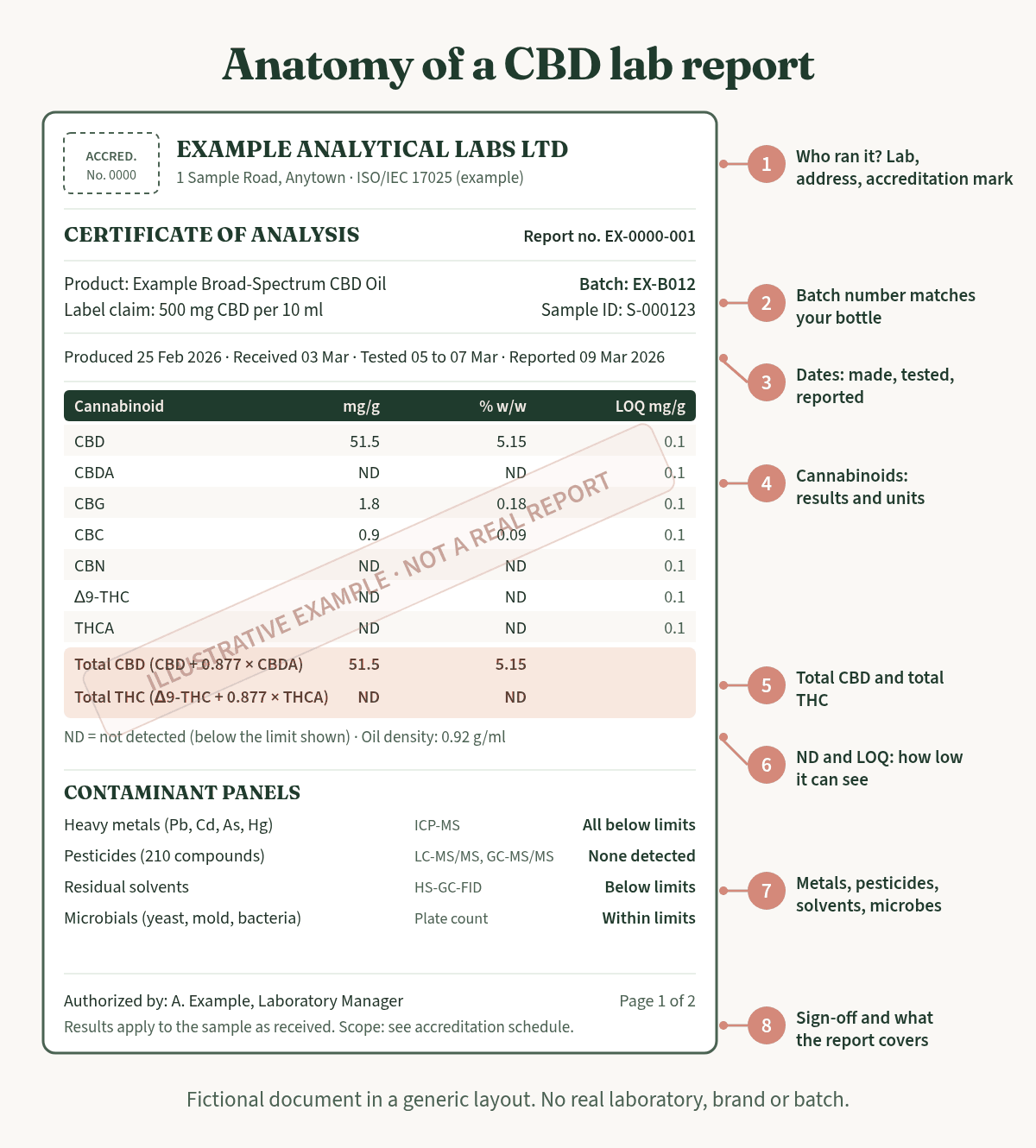
The numbers mark where each check sits on the page. The steps below run in a different order, the one that is most useful when reading. The key, with the matching step:
1. Laboratory and accreditation (step 1): name, address and an accreditation mark with a number. 2. Sample and batch (step 2): product name, batch number, sample ID and the strength on the label. 3. Dates (step 7): received, tested, reported. 4. Cannabinoid table (step 3): each compound with its result, unit and limit. 5. Total lines (step 4): total CBD and total THC. 6. Limits, ND and LOQ (step 5): the lowest amount the method reports reliably. 7. Contaminant panels (step 6): metals, pesticides, solvents and microbes. 8. Sign-off (steps 1 and 2): an authorized person, a report number and what the report covers.
Step 1: Who Made the Report?
Start with the laboratory. A usable report names the lab, its address and a report number. A label saying “lab tested” is not a report.
Accreditation. The international standard for testing laboratories is ISO/IEC 17025, which sets general requirements for the competence of testing and calibration labs. [4] In the UK the national accreditation body is UKAS. [5] Accreditation is granted for a defined scope of methods, so an accredited lab may not be accredited for cannabinoid testing. Look for the accreditation mark and number on the report, then check the lab’s scope in the accreditation body’s own directory.
Accreditation shows a lab runs under a competence standard. It does not guarantee that any one result is right.
Independence. A lab owned by the brand is not independent. That does not make its numbers wrong, but it means nobody outside the company checks them. A report from a lab with no stake in the sale carries more weight.
Step 2: Does the Batch Match Your Bottle?
A COA describes one batch. It says nothing about the next one. Find the batch or lot number on your bottle or jar, usually printed with a best-before date, and find the same number on the report.
Check that the report also names the same product and strength. A report for “Oil 500 mg, batch 12” does not cover “Oil 1000 mg, batch 12”. If the brand shows one generic report for a whole product line, the report is a sample at best.
If a brand publishes certificates, ask how old the newest one is and whether a more recent batch is on sale. A bottle from a newer batch may have no published report yet.
Step 3: Read the Cannabinoid Table
The table lists compounds, each with a result and a unit. Common lines are CBD, CBDA, CBG, CBC, CBN, Δ9-THC and THCA. A real report lists more, for example a published CBD oil certificate with 18 cannabinoid lines. [6]
Units. Results come as a percentage (% w/w), mg/g (weight per weight) or mg/ml (weight per volume). They are not interchangeable:
- 1% w/w is 10 mg/g.
- Going from mg/g to mg/ml needs the oil’s density, in g/ml. Oils are less dense than water, so mg/ml is lower than mg/g.
- Labels use mg per bottle or mg per ml.
If the report does not state a density, you cannot reliably convert, and a label of “500 mg in 10 ml” cannot be checked precisely. Treat that as a gap.
CBD against CBDA. CBDA is the acid form of CBD. A finished oil usually shows mostly CBD, and a “Total CBD” line combines both (see step 4 for the formula).
Minor cannabinoids. CBG, CBC, CBN and others may appear. A label that claims “full-spectrum” or “broad-spectrum” can be compared with this list. In the 2024 US analysis, 26% of products did not meet the definition of the type they claimed. [3] Our guide to full-spectrum vs broad-spectrum CBD explains the terms.
Matching the label. Studies use a result within 10% of the label as “accurate”. That is a research convention, not a legal tolerance.
Step 4: Total THC and the 0.877 Formula
THC occurs in the plant mainly as THCA, its acid form, which converts to THC with heat. A fair measure of THC therefore adds a share of the THCA to the THC. The formula used in US hemp rules is:
Total THC = Δ9-THC + 0.877 × THCA
The 0.877 is a molecular-mass ratio, since THCA loses a carboxyl group when it converts. [7] [8] Many reports show a “Total THC” line, and a “Total CBD” line built the same way from CBD and CBDA. [6]
Fictional example. A report shows Δ9-THC at 0.02 mg/g and THCA at 0.04 mg/g:
- Total THC = 0.02 + 0.877 × 0.04 = 0.055 mg/g (0.0055%).
- If the bottle holds 9.2 g of oil, the total is 0.055 × 9.2 = about 0.51 mg of THC per bottle.
Why this matters: a percentage looks tiny, but legal limits may apply per container. UK drug law, for example, defines an “exempt product” partly as one with no more than 1 mg of a controlled drug per container. [9] [10] A result in mg/g cannot be turned into a per-container amount without the fill weight. If a report shows a “THC” line but no total, ask for the total.
Step 5: ND, LOD and LOQ
Three terms appear in the “limit” column. They are often misread.
- ND means “not detected”. It does not mean “zero”. It means that the signal was below what the method can detect.
- LOD (limit of detection) is the lowest amount the method can detect, not necessarily as an exact value. [11]
- LOQ (limit of quantification) is the lowest amount that can be measured with suitable accuracy and precision. [11]
A result printed as “< LOQ” or “< 0.1 mg/g” means the compound might be present below that line. The limit tells you how much room remains.
Fictional example: a report shows Δ9-THC “< 0.1 mg/g (LOQ)”. A bottle holding 9.2 g of oil could still contain up to 0.1 × 9.2 = 0.92 mg without breaching the reported result. So a high limit hides more than a low one, and a report that gives “ND” with no limit can’t be checked at all.
When two reports are compared, compare their limits too. A lab reporting “< 0.0025%” and one reporting “< 0.1 mg/g” are using different cut-offs (0.0025% is 0.025 mg/g).
Step 6: Look for Contaminant Tests
A cannabinoid panel says nothing about contaminants. A fuller report adds:
- Heavy metals: usually lead, cadmium, arsenic and mercury. The cannabis plant is described as a bioaccumulator that takes up metals from soil, so a test is relevant. [12]
- Pesticides: a screen of many compounds, with the number of compounds tested stated.
- Residual solvents: leftovers of extraction, such as ethanol, hexane or methanol. Hexane and methanol were among the solvents found most often in the 2024 US analysis below.
- Microbials: yeast, mold and bacteria counts.
- Mycotoxins (optional): toxins made by molds.
Contaminants do turn up. In the 2024 US analysis of 202 products, heavy metals were detected in 44, pesticides in 30 and residual solvents in 181; a few results breached regulatory thresholds. [3] A separate US study of 121 edible CBD products detected lead in 42%, cadmium in 8%, arsenic in 28% and mercury in 37%. [12] Both studies were funded by a pharmaceutical company that makes a CBD medicine.
If a panel is present, check that it names the method, the limit for each result and the pass or fail threshold used. A “Pass” without numbers cannot be verified. If a panel is missing, the report does not cover contaminants, and the brand may hold results it has not published. Our guide to how CBD oil is made explains where solvents enter the process.
Step 7: Check the Dates
A good report shows several dates: sample received, tested, reported, and the batch’s production date.
- The test date should fall after production and before the best-before date.
- A report dated before the batch was made cannot describe it.
- Oil can change over time. Our guide to whether CBD oil expires covers shelf life. A report is a snapshot at the test date.
- No standard says how old a report may be. A recent report for the batch you hold is the target. An undated report is unverifiable.
Step 8: Match the Report to the Label
Now compare the headline numbers.
Fictional example. The label says “500 mg CBD in 10 ml”. The report gives CBD 51.5 mg/g and a density of 0.92 g/ml.
1. Label: 500 mg ÷ 10 ml = 50 mg/ml. 2. Report: 51.5 mg/g × 0.92 g/ml = 47.4 mg/ml. 3. Ratio: 47.4 ÷ 50 = 95% of the label.
That is within the ±10% convention. With no density on the report, step 2 is impossible, and the match can only be roughly judged. For the percentage logic on labels, see CBD oil 10% vs 5% and our CBD glossary.
Finally, check the product name, strength and format. A report for oil does not cover a capsule or gummy.
COA Red Flags
- No laboratory name, address or report number.
- A batch number that does not match your pack, or none at all.
- A screenshot or image with no accreditation mark and no signature.
- Cannabinoids only, with no contaminant panel and no explanation.
- “ND” or “Pass” with no limits or thresholds.
- A THC line without a total THC value.
- Units that are missing or that cannot be converted to the label’s units.
- A report that is undated, or older than the batch.
- Numbers that are suspiciously round or identical to another batch’s report.
- A report for a different product, strength or format.
One flag is a reason to ask the brand a question. It is not proof of a problem.
What a COA Cannot Tell You
- Legality. A clean report does not make a product lawful to sell or buy. In the UK, FSA guidance updated on 28 August 2026 classes CBD extracts and isolates as novel foods that need authorization and says none has yet been authorized. [13] In the EU, cannabinoid extracts are listed in the Novel Food Status Catalogue and need authorization before sale. [14] [15] As of 3 November 2026 we found no CBD on the Union list. [16] This is not legal advice.
- Safety or suitability. The report measures what is in a sample. Whether CBD is suitable for a person is a question for a doctor or pharmacist, especially for anyone pregnant, breastfeeding, taking medication or under 18.
- Effects. No number on a COA says what a product does.
- Other batches. Only the batch named on the report.
- Forgery or error. A document can be altered. Where it matters, ask the lab to confirm the report number.
For a worked example of a published set, see our Love CBD review, which lists the cannabinoid certificates the brand publishes and notes what they do not cover. Hemppy is an affiliate of that brand, as stated in the review.
Frequently Asked Questions
What is a COA for CBD?
A certificate of analysis is a laboratory report for one batch. It lists measured cannabinoids and, in a fuller version, contaminants such as heavy metals, pesticides, residual solvents and microbes.
What does ND mean on a CBD lab report?
ND means “not detected”: the lab’s method did not detect the compound at or above its detection limit. It does not mean the amount is zero. Look for the limit printed next to it.
What is the difference between LOD and LOQ?
The limit of detection is the lowest amount a method can detect. The limit of quantification is the lowest amount it can measure with suitable accuracy and precision, so it is higher. [11]
How do I calculate total THC?
Add Δ9-THC to 0.877 times THCA. With 0.02 mg/g THC and 0.04 mg/g THCA, total THC is 0.02 + 0.877 × 0.04 = 0.055 mg/g. [7]
Is a lab report from the brand’s own lab reliable?
It can be accurate, but no outside party checks it. A report from an independent, ISO/IEC 17025-accredited laboratory, accredited for the methods used, adds assurance. [4]
How old can a CBD lab report be?
There is no universal rule. What matters most is that the report covers the batch you hold and was issued after that batch was made. Treat undated reports as unverifiable.
Does every CBD product need a COA?
Many brands publish one and some publish none. Not having one is a reason to ask, because without it a label cannot be checked.
What contaminants should a CBD report test for?
A fuller report covers heavy metals, pesticides, residual solvents and microbes, and sometimes mycotoxins. Check that it names the methods, the limits and the thresholds used.
The Bottom Line
Reading a COA is a short routine: lab, batch, cannabinoid table and units, total THC, ND and limits, contaminant panels, dates, and the match to the label. Each step catches a different problem, and a gap at any step is a reason to ask the brand a question.
A report cannot show that a product is lawful, safe or right for you. It shows what a laboratory measured in one sample of one batch.
Scientific and Regulatory Sources
What a report is and how to read it
- Bonn-Miller M.O., Loflin M.J.E., Thomas B.F., Marcu J.P., Hyke T., Vandrey R. (2017). Labeling accuracy of cannabidiol extracts sold online. JAMA 318(17):1708–1709. Full study.
- Liebling J.P., Clarkson N.J., Gibbs B.W., Yates A.S., O’Sullivan S.E. (2022). An analysis of over-the-counter cannabidiol products in the United Kingdom. Cannabis and Cannabinoid Research 7(2):207–213. Full study.
- Gidal B.E., Vandrey R., Wallin C. et al. (2024). Product labeling accuracy and contamination analysis of commercially available cannabidiol product samples. Frontiers in Pharmacology 15:1335441. Funded by Jazz Pharmaceuticals. Full study.
- International Organization for Standardization. ISO/IEC 17025: General requirements for the competence of testing and calibration laboratories (overview page). ISO.
- UK Government. Accreditation (guidance on conformity assessment and accreditation, naming UKAS as the UK national accreditation body). GOV.UK.
- Eurofins Food Testing UK Limited. Example of a published certificate of analysis for a CBD oil (Love CBD Dutch 300 mg, Batch 10, certificate AR-25-CC-011506-01), showing cannabinoid lines, Total CBD and Total THC. Used only to show the layout of a real report. Certificate PDF.
- US Department of Agriculture. 7 CFR 990.1, Domestic hemp production program: definitions (“Total THC”). eCFR.
- Wang M., Wang Y.H., Avula B. et al. (2016). Decarboxylation study of acidic cannabinoids: a novel approach using ultra-high-performance supercritical fluid chromatography/photodiode array-mass spectrometry. Cannabis and Cannabinoid Research 1(1):262–271. Full study.
- The Misuse of Drugs Regulations 2001 (SI 2001/3998), regulation 2(1), definition of “exempt product”. legislation.gov.uk.
- UK Home Office. Drug licensing factsheet: cannabis, CBD and other cannabinoids (updated 3 October 2024), paragraphs 26 to 34 (exempt product definition). Official guidance.
- International Council for Harmonisation (2023). ICH Q2(R2) Guideline on validation of analytical procedures, Step 5 (EMA/CHMP/ICH/82072/2006), glossary: “detection limit” and “quantitation limit”. EMA PDF.
Contaminants and accuracy
- Gardener H., Wallin C., Bowen J. (2022). Heavy metal and phthalate contamination and labeling integrity in a large sample of US commercially available cannabidiol (CBD) products. Science of the Total Environment 851(Pt 1):158110. Funded by Greenwich Biosciences (Jazz Pharmaceuticals). PubMed.
Limits and rules
- UK Food Standards Agency. Cannabidiol (CBD) guidance: business guidance on CBD as a novel food (England and Wales), updated 28 August 2026. Official guidance.
- European Commission. Novel Food Status Catalogue (entries “Cannabinoids” and “Cannabis sativa L.”). Official guidance.
- Regulation (EU) 2015/2283 of the European Parliament and of the Council of 25 November 2015 on novel foods, Articles 3, 6 and 10 to 12 (definition, Union list and authorisation procedure). EUR-Lex.
- European Commission. Union list of novel foods. Official list.
Facts checked: 3 November 2026 (Europe/Riga). Example documents and numbers in this article are fictional unless a source is named. This article provides general educational information, not medical advice, legal advice or an assessment of any particular product.