
This article is general information, not medical advice. Hemppy does not make CBD products; the shop lists independent brands and links to their own websites. If you buy through one of those links, Hemppy may earn a commission from the brand, and you pay the same price. See our affiliate disclosure. This article does not recommend any specific product.
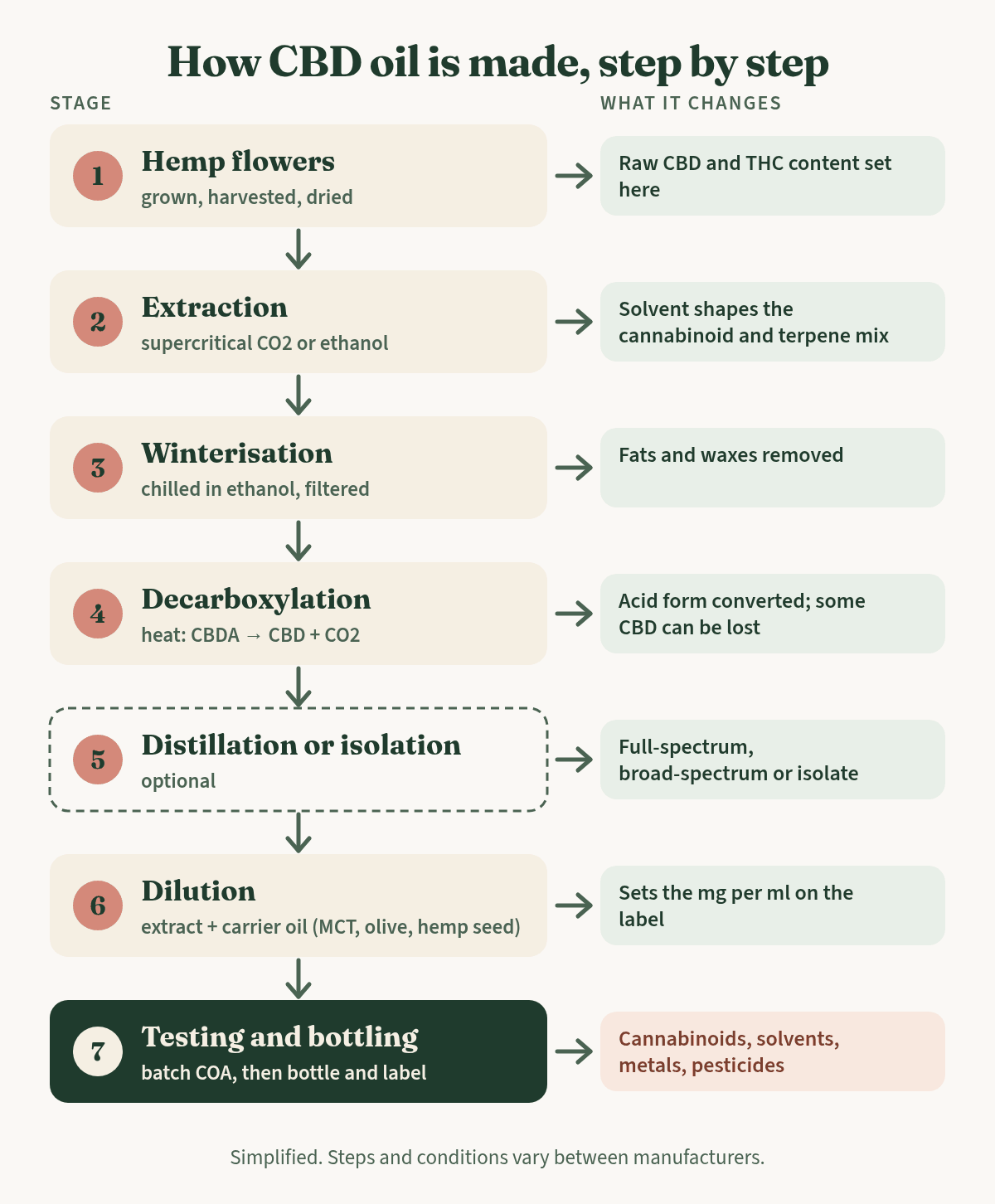
How is CBD oil made? In outline, CBD is extracted from hemp, mainly the flowers and leaves, with a solvent such as carbon dioxide or ethanol. The extract is cleaned up and heated, sometimes purified to an isolate, then mixed into a carrier oil, tested and bottled.
Each step changes what ends up in the bottle. The solvent shifts the balance of cannabinoids and terpenes. [1] Refining removes plant waxes and sometimes THC, and the amount of extract added sets the strength on the label.
None of this is visible on the bottle. The ingredient list and batch lab report say more than words such as “pure” or “CO2-extracted”.
On this page
- How CBD Oil Is Made at a Glance
- Where Does the CBD in CBD Oil Come From?
- How Is CBD Extracted From Hemp?
- From Crude Extract to Refined Ingredient
- Turning the Extract Into an Oil
- Testing, Bottling and Labelling
- What the Label and COA Can and Cannot Show
- How CBD Oil Production Is Regulated (2026)
- Frequently Asked Questions
- The Bottom Line
How CBD Oil Is Made at a Glance
| Stage | What happens | What it changes |
|---|---|---|
| Growing and drying | Low-THC hemp is grown, harvested and dried | How much CBD, and THC, the raw material holds |
| Extraction | CO2, ethanol or another solvent dissolves cannabinoids out of the plant | The mix of cannabinoids, terpenes and waxes |
| Winterisation | The extract is chilled in ethanol and filtered | Removes fats and waxes |
| Decarboxylation | Heat turns CBDA into CBD | How much CBD versus its acid form |
| Distillation or isolation (optional) | Cannabinoids are concentrated, THC is separated or CBD is crystallised | Full-spectrum, broad-spectrum or isolate |
| Dilution | The extract or isolate is mixed into a carrier oil | The strength in mg per ml |
| Testing and bottling | The batch is analysed, bottled and labelled | What the label and lab report can show |
Where Does the CBD in CBD Oil Come From?
CBD is made by the hemp plant, Cannabis sativa L., in tiny resin glands called glandular trichomes. These are found mainly on the flowering tops and the leaves. [2][3] Both CBD ingredients EFSA assessed in 2026 were extracted from hemp leaves. [4][3] Hemp seed oil, pressed from the seeds, is a different product.
The living plant makes mostly cannabidiolic acid (CBDA), which turns into CBD when heated. [5][6]
The same species also makes THC. EU farm rules limit approved hemp varieties to 0.3% THC, a limit for the plant rather than the oil. [7]
Harvesting and drying
Fresh hemp is mostly water, so it is dried before extraction, in hours with hot air or about a week at room temperature. In a 2025 study, drying did not significantly change total cannabinoid content but converted some of the acid forms. [8]
How Is CBD Extracted From Hemp?
Extraction uses a solvent to pull cannabinoids out of the plant material. EU food law allows carbon dioxide, ethanol, butane and propane for all uses, provided only harmless, technically unavoidable residues remain; others, such as hexane and methanol, have specific conditions and residue limits. [9]
| Method | How it works | What studies found |
|---|---|---|
| Supercritical CO2 | Pressurised CO2 acts as a solvent, then returns to gas | More cannabinoids, fewer terpenes in one comparison |
| Ethanol | Plant material is soaked in ethanol, which is then evaporated | More of the acid forms, such as CBDA |
| Hydrocarbons (butane, propane) | Cold liquid gas dissolves resin | Wax content rises with extraction temperature |
| Steam (hydrodistillation) | Steam carries volatile compounds out | Most terpenes, used mainly for aroma oils |
| Infusion in edible oil | Plant material is heated in oil | Incomplete extraction; strength hard to predict |
Supercritical CO2 extraction
Under pressure and mild heat, carbon dioxide becomes “supercritical”: it behaves partly like a gas and partly like a liquid, and it can dissolve cannabinoids. [10] When the pressure is released, the CO2 turns back into gas and leaves the extract.
It is used for at least one licensed cannabis medicine and for one of the CBD ingredients EFSA assessed in 2026. [11][3] A 2024 study compared the three main commercial methods on the same CBD and CBG-rich hemp. CO2 extracts contained the widest range and highest amounts of cannabinoids but only a narrow range of terpenes. [1]
Ethanol extraction
Here the plant material is soaked in ethanol, which is filtered off and evaporated; the CBD isolate EFSA assessed in 2026 started this way. [4] In the 2024 comparison, ethanol extracts held the most acid cannabinoids and the least varied terpenes. The authors, funded in part by the US Department of Agriculture, concluded that the three methods produced substantially different profiles from the same plant. [1]
Hydrocarbons, steam and oil
Butane and propane are used mainly for inhalable concentrates; colder runs carry over less plant wax. [12] Steam distillation gave the most terpenes in the 2024 comparison. [1]
Some Italian pharmacies make medical cannabis oils by heating the plant in olive oil. [13] In a 2017 study of this method, even the most efficient run left about a third of the CBD in the plant. [14]
From Crude Extract to Refined Ingredient
A crude extract still carries plant fats and waxes, and much of its CBD may be in acid form.
Winterisation and filtration
Winterisation removes the fats and waxes. [12] The extract is dissolved in ethanol and chilled, often for a day or more, so the waxes separate and can be filtered out. [1] Both EFSA dossiers include this step. [4][3]
Decarboxylation
Decarboxylation turns CBDA into CBD: heat removes the carboxyl group, which leaves as carbon dioxide. [5] In a 2016 laboratory study, some CBDA was lost in ways the researchers could not account for, so heating can cost some CBD. [6]
Distillation and isolation
Distillation concentrates the cannabinoids, a separation step can take out THC, and crystallisation can pull out nearly pure CBD. EFSA’s 2026 opinions show the end points: a distilled CO2 extract with 57 to 65% CBD plus other cannabinoids, and a crystallised isolate of at least 98% CBD. [3][4] EFSA could not establish the safety of either, because neither applicant supplied requested data, including on production. [4][3] The full-spectrum, broad-spectrum and isolate guide explains how these types differ.
Turning the Extract Into an Oil
A refined extract is thick and concentrated, and an isolate is a powder, so either is diluted in an edible oil, in which CBD dissolves well. In a 2018 analysis of 14 CBD oils sold in Europe, most used olive oil or hemp seed oil, and one used MCT oil (medium-chain triglycerides). [13]
Does the carrier oil matter?
Human evidence on carrier oils is thin. In a 2020 crossover study, 12 healthy men took synthetic CBD as a powder, dissolved in sesame oil, or in a self-emulsifying formulation. Both oil-based forms gave significantly higher blood levels than the powder, and the sesame oil and self-emulsifying forms gave similar overall exposure. [15] One author was from a private company.
That study shows that dissolving CBD in oil can matter. It did not compare different everyday carrier oils, so it says little about whether olive, hemp seed or MCT oil is the better choice.
Comparisons between oils come mostly from animals: in a 2021 rat study, adding MCT to sesame oil made absorption less variable but not higher. [16] Rat results do not reliably predict what happens in people.
Water-soluble products take a different route, turning the oil into tiny droplets or a powder; the water-soluble CBD guide looks at what those formulations change. The same extracts and isolates also go into edibles, described in what CBD gummies are made of.
How the strength is set
The label strength comes from arithmetic based on the CBD measured in the extract. For a 10 ml bottle with 1,000 mg of CBD, an extract testing at 60% CBD needs 1,000 ÷ 0.60 = 1,667 mg, made up to 10 ml with carrier oil. If the extract was really 55% CBD, the bottle would hold about 917 mg, roughly 8% below the label. This is a fictional arithmetic example, not a real product, recommended intake or authorised formulation. The conversion from percent to mg is covered in CBD oil 10% vs 5%.
Real products often miss their labels. Nine of the 14 European oils in the 2018 analysis differed notably from the declared CBD content. [13] In a UK study of 29 CBD products, only 11 were within 10% of the advertised CBD content. [17] The CBD oil label guide explains how to read the numbers.
Testing, Bottling and Labelling
Before bottling, a batch can be tested for cannabinoids, residual solvents, heavy metals, pesticides and sometimes microbes, with results on the certificate of analysis (COA). Contaminant testing matters for hemp in particular, because it takes up heavy metals from soil efficiently enough to be studied for cleaning contaminated land. [18] How to read a CBD lab report explains each line, from total THC to contaminant panels.
Testing studies show what can slip through: a 2024 US analysis of 202 CBD products detected residual solvents in most of them, heavy metals in 44 and pesticides in 30. Only a small share of results exceeded a regulatory threshold. The study was funded by Jazz Pharmaceuticals, which makes a prescription CBD medicine. [19]
The UK study found solvent residues, lead and arsenic in many products, all within acceptable levels, and measurable THC or CBN in more than half. The products were tested blind by an independent laboratory. [17]
What the Label and COA Can and Cannot Show
Claims such as “CO2-extracted” cannot be checked from the label. The ingredient list and the COA tell you more, within limits.
- Ingredients in order of weight. In the EU, ingredients are listed by descending weight, so the carrier oil usually comes first. [20]
- Residual solvents. A solvent panel shows which residues were measured, in parts per million. It does not identify the extraction method on its own: a CO2-extracted oil may still have been winterised in ethanol.
- CBDA on the cannabinoid panel. A large CBDA result means much of the CBD in that sample is still in acid form. That fits an extract that was not fully decarboxylated or a deliberately “raw” one; the report alone cannot say which.
- THC and other cannabinoids. These show which cannabinoids were measured in the tested sample. They help assess whether the composition matches the declared extract type, but cannot establish whether THC was removed during processing.
- Batch number. The report must match the bottle; another batch’s report says nothing about yours.
“Not detected” means the substance was not found under that test’s limits, not that it is absent. A potency test alone does not cover contaminants. For an oil’s production, the batch COA is a better guide than the name of the extraction method.
How CBD Oil Production Is Regulated (2026)
Production matters to regulators because it shapes what the product contains. This is a dated summary as of 26 October 2026, not legal advice.
European Union. The European Commission’s Novel Food Status Catalogue lists cannabinoid extracts, including CBD, as novel foods. Whether a particular ingredient needs authorisation, and on what terms, depends on what it is and how it is used. [21] Separately, EFSA’s provisional safe intake for CBD, published in February 2026, covers only CBD of at least 98% purity, without nanoparticles and made by a process considered safe. [22] An EFSA opinion is not an authorisation.
United Kingdom. The Food Standards Agency regards CBD foods as novel foods. Its June 2026 guidance said no CBD food products had been authorised. [23] In September 2026 its Board considered recommendations to ministers on the first three CBD authorisations; ministers make the final decision. [24]
United States. The FDA’s position is that CBD cannot lawfully be added to food or sold as a dietary supplement. [25] Federal THC rules for hemp products are covered in the CBD vs THC guide.
Frequently Asked Questions
Is CBD oil made from marijuana?
Usually not. Most consumer CBD oils are made from hemp, the same species as marijuana but bred to contain very little THC. [7]
Is CO2-extracted CBD oil better than ethanol-extracted?
Not in any way that has been demonstrated. The two methods give different chemical profiles from the same plant, and both are used for ingredients submitted to EFSA. [1][3][4] What happens after extraction, such as winterisation, distillation or isolation, also changes the result.
Does heating CBD turn it into THC?
Not under the dry-heat conditions tested in a 2026 study: heated hemp flower lost CBD, but no meaningful THC built up. Conversion of CBD to THC has been reported under acidic conditions, a different situation from making an oil. [26] Some of the authors work for a company that sells hemp flower.
Can CBD oil be made at home?
Home recipes usually heat hemp in olive or coconut oil, but the strength can’t be known without a lab test. Even in controlled conditions, small temperature changes shifted how much CBD was extracted. [14] Hemp flower is also treated differently by the law in many countries.
How is hemp seed oil made?
Hemp seed oil is pressed from the seeds, for example by cold pressing, without extracting the flowers or leaves. [27] Its cannabinoid content is usually extremely low. [13] The CBD oil vs hemp seed oil comparison covers the differences.
Explore CBD oils · Explore CBD gummies
The Bottom Line
CBD oil is CBD diluted in a carrier oil. The CBD can be a hemp extract, usually made from flowers and leaves, or a purified isolate. Most extracts are winterised and decarboxylated first, and some are distilled or separated further.
Research shows that the extraction method shapes the chemical profile, not that one method gives a better product. Testing studies find problems most often in label accuracy and contaminants.
Which rules apply depends on the specific ingredient, the type of product and where it is sold.
Scientific and Regulatory Sources
Plant, extraction and refining
- Chacon F.T., Raup-Konsavage W.M., Vrana K.E., Kellogg J.J. (2024). Effect of hemp extraction procedures on cannabinoid and terpenoid composition. Plants 13(16):2222. Full study.
- Livingston S.J., Quilichini T.D., Booth J.K. et al. (2020). Cannabis glandular trichomes alter morphology and metabolite content during flower maturation. The Plant Journal 101(1):37–56. PubMed.
- EFSA Panel on Nutrition, Novel Foods and Food Allergens (2026). Safety of Cannabis sativa L. extract as a novel food pursuant to Regulation (EU) 2015/2283. EFSA Journal (published September 2026). doi.org/10.2903/j.efsa.2026.10319.
- EFSA Panel on Nutrition, Novel Foods and Food Allergens (2026). Safety of cannabidiol isolated from Cannabis sativa L. as a novel food pursuant to Regulation (EU) 2015/2283. EFSA Journal (published September 2026). doi.org/10.2903/j.efsa.2026.10318.
- Tahir M.N., Raz F.S., Rondeau-Gagné S., Trant J.F. (2021). The biosynthesis of the cannabinoids. Journal of Cannabis Research 3:7. Full study.
- Wang M., Wang Y.H., Avula B. et al. (2016). Decarboxylation study of acidic cannabinoids: a novel approach using ultra-high-performance supercritical fluid chromatography/photodiode array-mass spectrometry. Cannabis and Cannabinoid Research 1(1):262–271. Full study.
- European Commission. Hemp: rules for cultivation and EU support (Regulation (EU) 2021/2115). Official information.
- Baek Y., Grab H., Chen C. (2025). Postharvest drying and curing affect cannabinoid contents and microbial levels in industrial hemp (Cannabis sativa L.). Plants 14(3):414. Full study.
- Directive 2009/32/EC of the European Parliament and of the Council of 23 April 2009 on the approximation of the laws of the Member States on extraction solvents used in the production of foodstuffs and food ingredients (recast), Article 1 and Annex I. EUR-Lex.
- Pattnaik F., Hans N., Patra B.R. et al. (2022). Valorization of wild-type Cannabis indica by supercritical CO2 extraction and insights into the utilization of raffinate biomass. Molecules 28(1):207. Full study.
- Grof C.P.L. (2018). Cannabis, from plant to pill. British Journal of Clinical Pharmacology 84(11):2463–2467. Full study.
- Sosa M.E. et al. (2026). Temperature control minimizes wax-derived alkane carryover in hydrocarbon cannabis extraction. ACS Omega 11(27):39743–39752. Full study.
- Pavlovic R., Nenna G., Calvi L. et al. (2018). Quality traits of “cannabidiol oils”: cannabinoids content, terpene fingerprint and oxidation stability of European commercially available preparations. Molecules 23(5):1230. Full study.
- Morini L., Porro G., Liso M., Groppi A. (2017). Therapeutic use of Δ9-THC and cannabidiol: evaluation of a new extraction procedure for the preparation of cannabis-based olive oil. Current Pharmaceutical Biotechnology 18(10):828–833. PubMed.
Carrier oils, absorption and label accuracy
- Izgelov D., Davidson E., Barasch D. et al. (2020). Pharmacokinetic investigation of synthetic cannabidiol oral formulations in healthy volunteers. European Journal of Pharmaceutics and Biopharmaceutics 154:108–115. PubMed.
- Feng W., Qin C., Cipolla E. et al. (2021). Inclusion of medium-chain triglyceride in lipid-based formulation of cannabidiol facilitates micellar solubilization in vitro, but in vivo performance remains superior with pure sesame oil vehicle. Pharmaceutics 13(9):1349. Study in rats. Full study.
- Liebling J.P., Clarkson N.J., Gibbs B.W., Yates A.S., O’Sullivan S.E. (2022). An analysis of over-the-counter cannabidiol products in the United Kingdom. Cannabis and Cannabinoid Research 7(2):207–213. Full study.
Testing, contaminants and labelling
- Placido D.F., Lee C.C. (2022). Potential of industrial hemp for phytoremediation of heavy metals. Plants 11(5):595. Full study.
- Gidal B.E., Vandrey R., Wallin C. et al. (2024). Product labeling accuracy and contamination analysis of commercially available cannabidiol product samples. Frontiers in Pharmacology 15:1335441. Funded by Jazz Pharmaceuticals. Full study.
- Regulation (EU) No 1169/2011 on the provision of food information to consumers, Article 18 (list of ingredients), consolidated text. EUR-Lex.
Regulation in the EU, UK and US
- European Commission. Novel Food Status Catalogue (entries “Cannabinoids” and “Cannabis sativa L.”). Official guidance.
- EFSA Panel on Nutrition, Novel Foods and Food Allergens (2026). Update of the statement on safety of cannabidiol as a novel food. EFSA Journal 24(2):9862 (published February 2026). Full text (Europe PMC) · EFSA Journal.
- UK Food Standards Agency (22 June 2026). Food Fact Check: CBD safety and health claims. Official FSA blog.
- UK Food Standards Agency (September 2026 Board meeting). CBD novel food applications: recommendations to ministers on first authorisations. Official Board paper.
- US Food and Drug Administration. FDA regulation of cannabis and cannabis-derived products, including cannabidiol (CBD). Official FDA information.
Heat conversion and hemp seed oil
- Carrera D.Á., Mazurov A.A., Latino D.A.R.S. et al. (2026). Thermal conversion of cannabinoids in hemp flower: decarboxylation kinetics and potential accumulation of Δ9-tetrahydrocannabinol. ACS Omega 11(41):62490–62500. Authors include employees of a company selling hemp flower. Full study.
- Farinon B., Molinari R., Costantini L., Merendino N. (2020). The seed of industrial hemp (Cannabis sativa L.): nutritional quality and potential functionality for human health and nutrition. Nutrients 12(7):1935. Full study.
Scientific and regulatory material reviewed: 26 October 2026. This article provides general educational information, not medical advice, legal advice or a product-specific determination of regulatory compliance.