
This article is general information, not medical advice. Hemppy does not make CBD products; the shop lists independent brands and links to their own websites. If you buy through one of those links, Hemppy may earn a commission from the brand, and you pay the same price. See our affiliate disclosure. This article does not recommend any specific product.
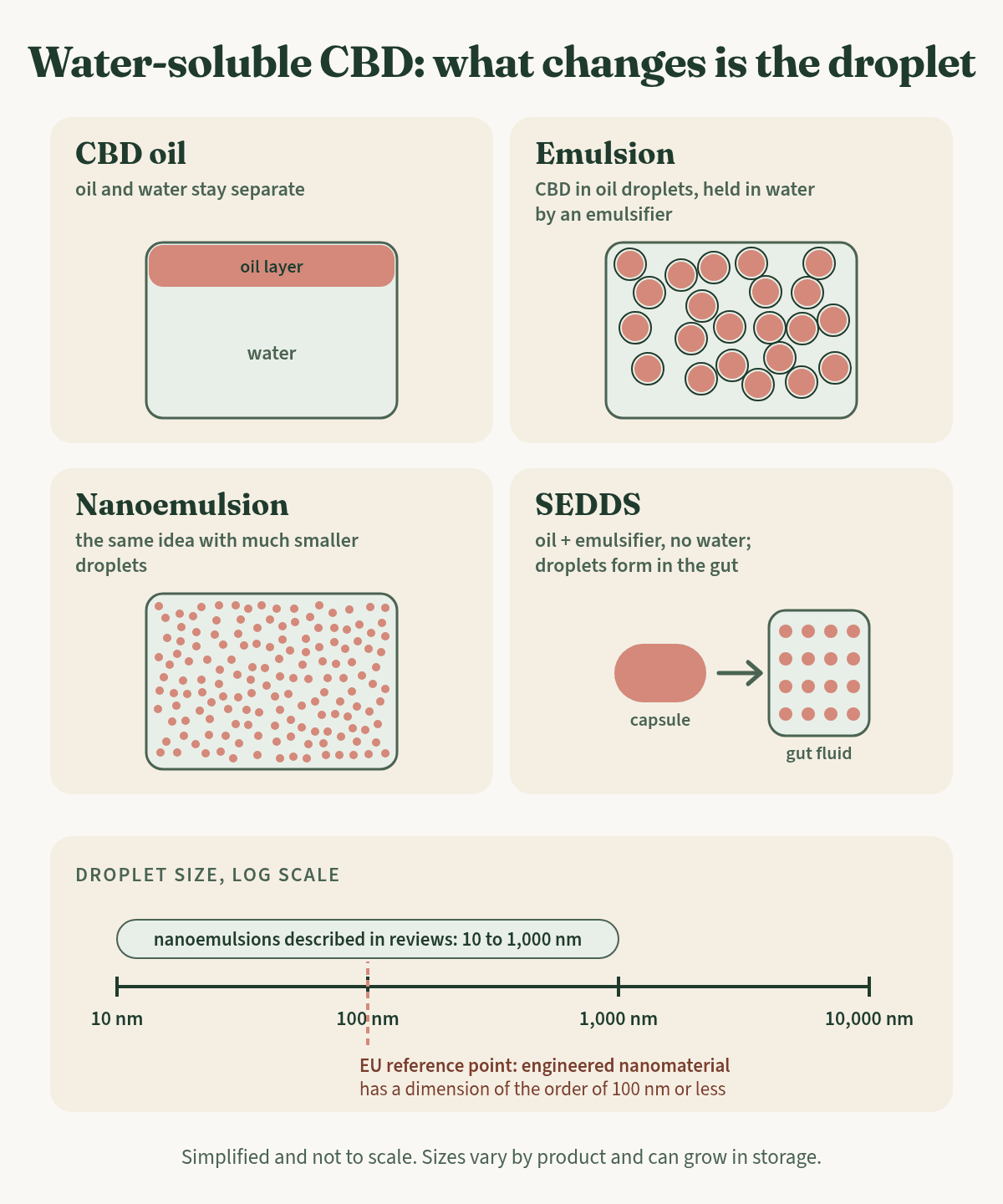
Water-soluble CBD is CBD that has been formulated so it mixes into water. In most products the CBD molecule is no more soluble than before. It is dispersed as tiny oil droplets coated with emulsifiers, carried in an oil and emulsifier blend that forms droplets in the gut, or held inside carrier molecules such as cyclodextrins that do dissolve. [1]
Small human studies, mostly funded by the companies that make these formulations, found that some of them raise blood CBD levels faster and higher than the other forms they were compared with. [2][3] Higher blood levels are not the same as a better effect, and results vary widely between people.
“Nano” is a looser word than it sounds. In EU food law, “engineered nanomaterial” has a specific legal meaning with its own labelling and safety rules, and not every product marketed as nano meets it.
On this page
- Water-Soluble CBD at a Glance
- What Is Water-Soluble CBD?
- Is Water-Soluble CBD Absorbed Better? What Human Studies Show
- Faster Absorption Is Not the Same as a Better Effect
- What Does “Nano CBD” Mean?
- Water-Soluble CBD, THC and Drug Tests
- Safety and Rules for Nano and Water-Soluble CBD (2026)
- How to Read a Water-Soluble CBD Label
- Frequently Asked Questions
- The Bottom Line
Water-Soluble CBD at a Glance
| Form | What it is | What the evidence shows |
|---|---|---|
| CBD oil | CBD dissolved in a carrier oil | Absorption is slow and variable |
| Emulsion | Oil droplets carrying CBD, dispersed in water with an emulsifier | A water-compatible liquid was fastest in one study |
| Nanoemulsion | The same idea with much smaller droplets | Nano-based forms reached peak blood level sooner in pooled data, as did oils; results depend on the formulation; droplets can grow in storage |
| Self-emulsifying system (SEDDS) | Oil and emulsifiers that form droplets on contact with water in the gut | Higher, faster peaks in two trials; similar to oil overall in a third |
| Water-soluble powder | CBD held by a carrier such as a cyclodextrin or a polymer | Higher exposure than a lipid powder in a 10-person pilot |
Results depend on the specific formulation, dose and study conditions.
What Is Water-Soluble CBD?
CBD is a fat-loving molecule. In its pure form it is a white powder that barely dissolves in water, which is why most CBD products are oils. [1] Stir CBD oil into water and the two stay separate.
“Water-soluble” products get around this with formulation rather than chemistry. The CBD molecule is unchanged; what changes is the package it travels in. [4] Three different ideas share the label:
- Molecular solubility. The substance itself dissolves molecule by molecule. CBD on its own barely does.
- Complexation. CBD sits inside a carrier molecule such as a cyclodextrin, and the complex dissolves better.
- Dispersion. CBD stays in oil droplets spread through water, as in emulsions, nanoemulsions and self-emulsifying systems. [1]
Emulsions and nanoemulsions
An emulsion is a mixture of oil and water held together by an emulsifier, such as gum arabic or a polysorbate. In a CBD emulsion, the CBD sits inside the oil droplets. [1]
A nanoemulsion simply has much smaller droplets. Reviews describe droplet sizes for CBD nanoemulsions anywhere from 10 to 1,000 nanometres (nm), so the term covers a wide range. [1]
The same review notes a practical weakness: nanoemulsion droplets can grow during storage, in one CBD formulation to several times their original size. [1] A “nano” claim describes the product when it was made, not necessarily when it is used.
Self-emulsifying systems
A self-emulsifying drug delivery system (SEDDS, or SNEDDS for the nano version) is an oil and emulsifier blend without water. It forms fine droplets once it meets fluid in the gut. [1] These are usually sold in capsules or as powders.
Powders and cyclodextrins
CBD powders sold as water-soluble usually pair the CBD with a carrier. Cyclodextrins are one common choice: ring-shaped sugar molecules with a water-loving outside and a fat-loving inside that can hold CBD as an inclusion complex. [1] Another approach keeps CBD in an amorphous, non-crystalline form, which dissolves faster than crystalline CBD but tends to recrystallise unless stabilised with a carrier. [4]
Is Water-Soluble CBD Absorbed Better? What Human Studies Show
Oral CBD is poorly and unevenly absorbed whatever the form, and much of the absorbed dose is broken down by the liver before it reaches the rest of the body. [1] A 2018 systematic review of 24 human studies found that none had measured the absolute oral bioavailability of CBD. It did find higher peak levels in fed states and with lipid formulations. [5] The CBD oil vs gummies comparison covers absorption from standard oils in detail.
Bioavailability is the share of a dose that reaches the bloodstream. Absorption studies usually report the peak blood concentration (Cmax), the time taken to reach it (Tmax) and total exposure over time, the area under the curve (AUC). A much higher peak can come with a smaller rise in total exposure.
The studies below compared water-compatible forms with oil or another powder. All are small, and results apply to the products tested.
| Study | People | Comparison | Main finding | Funding |
|---|---|---|---|---|
| Knaub et al., 2019 | 16, fasted | SEDDS vs MCT oil, same extract, 25 mg | Cmax 4.4× higher; Tmax 1 h vs 3 h; AUC 1.7× higher | Formulation maker |
| Williams et al., 2021 | 15 | Five 30 mg preparations in water | 5% CBD liquid with gum arabic and MCT fastest and highest | Product maker |
| Hobbs et al., 2020 | 10 | Water-soluble vs lipid-soluble powder, 30 mg | About 4.5× more exposure with water-soluble powder; ex vivo inflammation marker also measured | Product maker, student fellowship |
| Hermush et al., 2025 | 14 | Self-emulsifying powder vs oil drops, 8 mg CBD with 8 mg THC | Higher, faster peaks of THC and a CBD metabolite | Formulation maker |
| Izgelov et al., 2020 | 12 men | Sesame oil vs SNEDDS vs powder | Oil and SNEDDS similar overall; both above powder | Not stated; one author from a company |
Self-emulsifying systems against oil
In a 2019 randomised, double-blind crossover trial, 16 healthy adults took the same hemp extract in two forms. A self-emulsifying formulation gave a much higher and earlier peak blood level (Cmax and Tmax) than the extract diluted in MCT oil. Total exposure over 24 hours (AUC) also rose, but by less than the peak. [2] The study was sponsored by the company behind the formulation, which took part in discussions on the design and outcome measures. [2]
A 2020 academic trial points the other way. In 12 healthy men, a self-nanoemulsifying system and plain sesame oil gave similar overall CBD exposure. The nano system produced a more uniform early peak, while the oil showed some people absorbing early and others late. [6]
A 2025 crossover study gave 14 volunteers CBD with an equal amount of THC, once as a self-emulsifying powder and once as oil drops. The powder gave higher and faster peaks of THC and of a CBD breakdown product, 7-OH-CBD. The study was funded by the company that makes the powder, whose chief executive is an author. [7]
Liquids and powders mixed into water
A 2021 crossover study gave 15 adults five different CBD preparations, each in a glass of water. A 5% CBD liquid made with gum arabic and MCT reached the highest and fastest peak, although not every comparison was statistically significant. Results varied considerably between people within each preparation. [3]
The products were supplied by Caliper Foods, which sponsored the study and employed one of the authors. [3] In an earlier 10-person pilot from the same university, part-funded by the same company, a water-soluble powder gave several times more exposure than a lipid-soluble powder. [8]
The pilot also stimulated blood immune cells in the laboratory: cells taken 90 minutes after dosing released less of the inflammatory marker TNF than cells taken before. This ex vivo measure, in a pilot without a placebo group, is not a clinical outcome. [8]
What the studies add up to
A 2024 systematic review and meta-regression pooled 112 trial arms from 39 human studies. These were not 39 direct nano-versus-oil comparisons; they covered oral, under-the-tongue, inhaled and intravenous use and many formulations. Both nano-based and oil-based formulations reached peak blood levels sooner (lower Tmax) than the reference, a prescription CBD medicine’s formulation. Dose, route and whether people had eaten were among the main factors shaping CBD levels. [9]
Faster Absorption Is Not the Same as a Better Effect
These are mainly pharmacokinetic studies. They measure how much CBD reaches the blood and how fast. Apart from the ex vivo inflammation marker in the Hobbs pilot, they did not measure effects, and none shows that a water-dispersible form gives better clinical outcomes than CBD oil. [8]
Higher exposure also cuts both ways. If a formulation delivers more CBD per milligram, the same label figure means a larger dose in the body. The same review linked eating before a dose with higher CBD levels, so food intake also shapes the result, not only the form. [9]
The “times more bioavailable” figures in marketing usually come from studies like these. Three questions put any such figure in context: compared with what, in how many people, and paid for by whom?
What Does “Nano CBD” Mean?
In everyday marketing, “nano” usually just means small droplets or particles. In EU law, “engineered nanomaterial” has a precise meaning.
Regulation (EU) 2015/2283 defines an engineered nanomaterial as intentionally produced material with one or more dimensions of the order of 100 nm or less, or made of discrete functional parts of that size. The definition also covers structures, agglomerates or aggregates above that size that keep properties characteristic of the nanoscale. Food consisting of engineered nanomaterials is one of the regulation’s novel food categories. [10]
EU labelling law adds a visible rule. Every ingredient present as an engineered nanomaterial must be named in the ingredient list followed by the word “nano” in brackets. [11] A “nano CBD” marketing claim does not, by itself, establish that the product contains an engineered nanomaterial under EU law. If an ingredient meets that legal definition, the applicable ingredient-labelling requirements must be followed. If the front says “nano” and the ingredient list does not, ask the maker which applies.
EFSA has separate guidance on assessing the risk of nanomaterials in food, and on when a conventional ingredient contains enough small particles to need that extra assessment. [12] That assessment is in addition to the usual novel food evaluation.
Water-Soluble CBD, THC and Drug Tests
CBD can convert to THC in acidic conditions, which has raised questions about stomach acid. A 2023 laboratory study, with authors from a US federal agency, tested this in synthetic gastric fluid.
Without any added surfactant, a THC-free water-dispersible CBD converted at most 0.063% to Δ9-THC over 3 hours, more than an oil or a powder did but still a tiny fraction. Conversion of the nano-formulated CBD reached 33 to 36% only when the researchers added 1% sodium dodecyl sulfate (SDS), a strong laboratory surfactant, to the fluid. [13] These were artificial test-tube conditions, so they are not evidence of similar conversion in the human stomach.
The authors concluded that conversion at around 30 mg of CBD a day is unlikely to produce a positive urine test. THC already present in a product is a separate issue, covered in the full-spectrum and broad-spectrum guide. [13]
Safety and Rules for Nano and Water-Soluble CBD (2026)
The following is a dated summary as of 26 October 2026, not legal advice.
European Union. The European Commission’s Novel Food Status Catalogue lists cannabinoid extracts, including CBD, as novel foods. Whether a particular ingredient needs authorisation, and on what terms, depends on what it is and how it is used. [14] EFSA’s provisional safe intake for CBD, published in February 2026, applies only to CBD of at least 98% purity used in food supplements without nanoparticles. Nano forms fall outside it. [15] An ingredient that meets the legal definition of an engineered nanomaterial must be labelled “(nano)” in the ingredient list. [11]
United Kingdom. The Food Standards Agency regards CBD foods as novel foods. Its June 2026 guidance said no CBD food products had been authorised, and it advises healthy adults to limit CBD to 10 mg a day and says some groups, including people who are pregnant or taking medication, should avoid it. [16] In September 2026 its Board considered recommendations to ministers on the first three CBD authorisations; ministers make the final decision. [17]
United States. The FDA’s position is that CBD cannot lawfully be added to food or sold as a dietary supplement. [18]
How to Read a Water-Soluble CBD Label
Water-soluble products are often labelled by the weight of the formulation, not of the CBD. Check these points before comparing products.
- CBD per serving and per pack. The figure that matters is milligrams of CBD, not milligrams of powder or emulsion.
- The CBD source. Isolate, broad-spectrum or full-spectrum, which affects THC content. See the CBD oil label guide.
- “(nano)” in the ingredient list. In the EU it is required for ingredients that meet the legal definition of an engineered nanomaterial. The legal classification decides this, not the word “nano” in advertising. [11]
- Emulsifiers and carriers. Gum arabic, polysorbates, cyclodextrins or starches show which approach was used.
- A batch COA for the finished product. A test of the raw extract does not show what the finished drink or powder contains.
A fictional example shows why. A powder labelled “20% water-soluble CBD”, sold in 10 g pouches, contains 0.20 × 10,000 mg = 2,000 mg of CBD per pouch. If the 20% instead referred to a CBD emulsion concentrate that is itself 25% CBD, the pouch would hold 500 mg. This is a fictional arithmetic example, not a real product or recommended intake. A batch-matched COA for the finished product shows the CBD content actually measured.
Frequently Asked Questions
Is water-soluble CBD better than CBD oil?
It has not been shown to be better. In some small studies it reached the blood faster and at higher levels, but these studies do not show better clinical outcomes than CBD oil. [2][3] One trial found a nano system and sesame oil gave similar overall exposure. [6]
Is nano CBD the same as water-soluble CBD?
Not always. “Water-soluble” describes how a product behaves in water; “nano” in marketing usually describes droplet size. In EU law, an engineered nanomaterial has dimensions of the order of 100 nm or less, or is a larger structure, agglomerate or aggregate that keeps nanoscale properties. The legal definition, not the word on the pack, decides whether an ingredient qualifies. [10]
Does water-soluble CBD work faster?
Some nano-based CBD formulations have shown faster absorption in human studies, but results depend on the specific formulation, dose and study conditions. The 39-study review pooled many routes and formulations, not direct nano-versus-oil comparisons, and found a shorter time to peak for both nano-based and oil-based forms than for a prescription CBD medicine. [9] A faster rise in blood levels is not the same as a faster felt effect.
Is nano CBD safe?
Its safety has not been established. EFSA’s provisional safe intake excludes CBD with nanoparticles, and EFSA guidance calls for a specific risk assessment of nanomaterials in food. [15][12]
How much water-soluble CBD should I take?
Hemppy does not give dosing advice. The UK FSA’s general advice is that healthy adults limit CBD to 10 mg a day, and that some groups should avoid it. [16] In September 2026 its Board considered recommendations to ministers on the first three CBD authorisations; ministers make the final decision. [17] Anyone taking medicines should speak to a doctor or pharmacist first.
Explore CBD oils · Explore CBD gummies
The Bottom Line
Water-soluble CBD is ordinary CBD in a different package: oil droplets, self-emulsifying blends or carrier powders that let it mix into water.
Small trials show that some of these formulations reach the blood faster and at higher levels than the forms they were compared with, but results depend on the specific product. “Nano” has a legal meaning in the EU that comes with labelling and safety requirements, and a batch COA for the finished product is the clearest check on CBD content.
For how the oil itself is produced, see how CBD oil is made. For edibles, see what CBD gummies are.
Scientific and Regulatory Sources
Formulation and absorption research
- Paczkowska-Walendowska M., Trzaskoma P., Dziopa A. et al. (2025). Innovative strategies to enhance the bioavailability of cannabidiol: nanotechnology and advanced delivery systems. Pharmaceuticals 18(11):1637. Review. Full study.
- Knaub K., Sartorius T., Dharsono T., Wacker R., Wilhelm M., Schön C. (2019). A novel self-emulsifying drug delivery system (SEDDS) based on VESIsorb formulation technology improving the oral bioavailability of cannabidiol in healthy subjects. Molecules 24(16):2967. Sponsored by Vesifact AG. Full study.
- Williams N.N.B., Ewell T.R., Abbotts K.S.S. et al. (2021). Comparison of five oral cannabidiol preparations in adult humans: pharmacokinetics, body composition, and heart rate variability. Pharmaceuticals 14(1):35. Sponsored by Caliper Foods. Full study.
- Koch N., Jennotte O., Gasparrini Y. et al. (2020). Cannabidiol aqueous solubility enhancement: comparison of three amorphous formulations strategies using different type of polymers. International Journal of Pharmaceutics 589:119812. PubMed.
- Millar S.A., Stone N.L., Yates A.S., O’Sullivan S.E. (2018). A systematic review on the pharmacokinetics of cannabidiol in humans. Frontiers in Pharmacology 9:1365. Full study.
- Izgelov D., Davidson E., Barasch D. et al. (2020). Pharmacokinetic investigation of synthetic cannabidiol oral formulations in healthy volunteers. European Journal of Pharmaceutics and Biopharmaceutics 154:108–115. PubMed.
- Hermush V., Mizrahi N., Brodezky T., Ezra R. (2025). Enhancing cannabinoid bioavailability: a crossover study comparing a novel self-nanoemulsifying drug delivery system and a commercial oil-based formulation. Journal of Cannabis Research 7:35. Funded by Capsoil Technologies. Full study.
- Hobbs J.M., Vazquez A.R., Remijan N.D. et al. (2020). Evaluation of pharmacokinetics and acute anti-inflammatory potential of two oral cannabidiol preparations in healthy adults. Phytotherapy Research 34(7):1696–1703. Funding included Caliper Foods. PubMed.
- Moazen-Zadeh E., Chisholm A., Bachi K., Hurd Y.L. (2024). Pharmacokinetics of cannabidiol: a systematic review and meta-regression analysis. Cannabis and Cannabinoid Research 9(4):939–966. Full study.
EU rules on nanomaterials
- Regulation (EU) 2015/2283 on novel foods, Article 3(2)(a)(viii) and 3(2)(f) (definition of engineered nanomaterial). EUR-Lex.
- Regulation (EU) No 1169/2011 on the provision of food information to consumers, Article 18(3) (engineered nanomaterials in the list of ingredients), consolidated text. EUR-Lex.
- EFSA Scientific Committee (2021). Guidance on risk assessment of nanomaterials to be applied in the food and feed chain: human and animal health. EFSA Journal 19(8):6768; and Guidance on technical requirements for regulated food and feed product applications to establish the presence of small particles including nanoparticles. EFSA Journal 19(8):6769. EFSA Journal 6768 · EFSA Journal 6769.
THC conversion
- Hart E.D., Mullen L., Vikingsson S. et al. (2023). Conversion of water-soluble CBD to Δ9-THC in synthetic gastric fluid: an unlikely cause of positive drug tests. Journal of Analytical Toxicology 47(7):632–635. PubMed.
Regulation in the EU, UK and US
- European Commission. Novel Food Status Catalogue (entries “Cannabinoids” and “Cannabis sativa L.”). Official guidance.
- EFSA Panel on Nutrition, Novel Foods and Food Allergens (2026). Update of the statement on safety of cannabidiol as a novel food. EFSA Journal 24(2):9862 (published February 2026). Full text (Europe PMC) · EFSA Journal.
- UK Food Standards Agency (22 June 2026). Food Fact Check: CBD safety and health claims. Official FSA blog.
- UK Food Standards Agency (September 2026 Board meeting). CBD novel food applications: recommendations to ministers on first authorisations. Official Board paper.
- US Food and Drug Administration. FDA regulation of cannabis and cannabis-derived products, including cannabidiol (CBD). Official FDA information.
Scientific and regulatory material reviewed: 26 October 2026. This article provides general educational information, not medical advice, legal advice or a product-specific determination of regulatory compliance.