
This article is general information, not medical advice. Hemppy does not make CBD products; the shop lists independent brands and links to their own websites. If you buy through one of those links, Hemppy may earn a commission from the brand, and you pay the same price. See our affiliate disclosure. This article does not recommend any specific product.
What are CBD gummies? They are chewy sweets made from a gel such as gelatin or pectin, sweetened with sugar or a sugar replacer, with a set amount of CBD added to each piece. The CBD is usually an isolate or a hemp extract.
The label states an amount of CBD per gummy. In independent tests of US products, many missed that figure and some contained THC the label did not mention. Those samples do not show how often the same happens in Europe.
Gummies are also regulated as food in most places. In the EU and the UK, CBD in food falls under novel food rules, so what can be sold depends on the specific ingredient and its authorisation status. In the UK, no health claims are authorised for CBD.
On this page
- CBD Gummies at a Glance
- What Are CBD Gummies Made Of?
- How Much CBD Is Really in a CBD Gummy?
- Do CBD Gummies Contain THC?
- Are CBD Gummies Safe? What Regulators Say
- How to Read a CBD Gummy Label
- How CBD Gummies Are Regulated (2026)
- Frequently Asked Questions
- The Bottom Line
CBD Gummies at a Glance
| Part of the gummy | Common options | What to know |
|---|---|---|
| Gelling agent | Gelatin, pectin, starch, agar | Gelatin is animal-derived; pectin is plant-based |
| Sweetener | Sugar, glucose syrup, polyols | Over 10% added polyols triggers a laxative warning in the EU |
| CBD | Isolate, broad-spectrum or full-spectrum extract | Type affects whether THC may be present |
| Acids, flavours, colours | Citric acid, fruit flavours, permitted colours | Titanium dioxide (E 171) is no longer allowed in EU food |
| Label figures | mg of CBD per gummy and per pack | Compare with a batch COA |
The CBD per gummy is the key number.
What Are CBD Gummies Made Of?
A CBD gummy is a standard gummy sweet with CBD added, one of several types of CBD products. The base recipe is a gel, a sweetener, acids, flavours and colours. The choice of each affects texture, who can eat the product and what the label has to say.
The gel: gelatin, pectin or starch
Gelatin is widely used in confectionery for its gelling and texturising properties. It is animal-derived, mainly from pigs, cattle, fish or poultry, so it excludes vegans and vegetarians and can be a problem for halal or kosher diets. [1]
Gelatin also melts. Its gel is thermoreversible, so a gelatin gummy left somewhere warm can soften considerably or even turn liquid. [1]
Pectin is the most common plant-based alternative. High-methoxyl pectin gels in acidic conditions with plenty of sugar, while low-methoxyl pectin gels with calcium. Pectin gummies have a shorter, less elastic bite than gelatin ones and may need more sugar to reach the expected sweetness. Starches and seaweed-derived gels such as agar are also used. [1]
Sugar or sugar-free
Most gummies are sweetened with sugar and glucose syrup. Sugar-free versions often use polyols, such as sorbitol, maltitol, erythritol, isomalt or xylitol, which add sweetness and bulk. [1]
Polyols come with a labelling rule in the EU. Foods containing more than 10% added polyols must carry the statement “excessive consumption may produce laxative effects”. [2]
Colours, flavours and coatings
Gummies get their colour and flavour from the same kinds of additives used in other sweets. One colour has been withdrawn in the EU: titanium dioxide (E 171) may no longer be used in food. [3]
The CBD
The CBD itself is an ingredient like any other. It may be a CBD isolate, which is close to pure CBD, or a broad-spectrum or full-spectrum hemp extract containing other cannabinoids. The guide to how CBD oil is made explains where these ingredients come from. Some gummies use a water-compatible CBD formulation instead, which the water-soluble CBD guide covers.
Does the CBD come out of the gel?
A 2025 study compared a 3D-printed gelatin CBD gummy with a moulded commercial one. Both were close to their target CBD content and released all of it within 30 minutes in laboratory dissolution tests. [4]
That was a small lab study of two products. It shows the CBD in a gummy can be released quickly in simulated conditions; it does not show what happens in the body.
How Much CBD Is Really in a CBD Gummy?
Two US studies have checked labels against lab results; neither tested products sold in Europe. A 2025 analysis tested 56 CBD gummy products bought online from national brands. Their CBD content ranged from about 6 to 60 mg per gummy, and in 70% of products the CBD content differed from the label by more than 10%. [5] The study also found large differences between gummies from the same bottle, covered in the CBD oil vs gummies comparison.
A larger 2022 US study tested 516 CBD products, edibles and topicals together. Only 42% were within 10% of the labelled CBD, with more falling short than over. [6]
The same study found low-level contamination common in the 121 edibles tested. Lead was detected in 42% of them, and arsenic, mercury and cadmium in smaller shares; four exceeded a California threshold for daily lead intake. Phthalates, chemicals used in plastics, were also widespread. [6]
The study was funded by a grant from a subsidiary of Jazz Pharmaceuticals, and the lead author was paid by the Clean Label Project for the work. [6]
Do CBD Gummies Contain THC?
Some do. In the 2025 US analysis, 39% of the gummy products contained Δ9-THC, and nine held more than 0.4 mg per gummy. [5]
Full-spectrum extracts contain THC by design. Broad-spectrum and isolate products are meant to contain little or none, which only testing of the batch can confirm.
The THC per container matters more than the percentage, because the rules increasingly count milligrams.
- United States. Under federal law enacted in 2025 and amended in 2026, final hemp-derived products with more than 0.4 mg per container of total THC (including THCA) and similar cannabinoids fall outside the definition of hemp. [7] That limit is scheduled to apply from 11 December 2026 and was not in force on 26 October 2026, so check the current law before relying on it. [8] Details are in the CBD vs THC guide.
- United Kingdom. A CBD product avoids drug controls only if it meets all three “exempt product” conditions, one of which is no more than 1 mg of any controlled cannabinoid per component part. In the Home Office’s view, that unit is the container, not a serving. [9]
At those levels, small amounts add up. A hypothetical pack of 30 gummies with 0.05 mg of THC each holds 1.5 mg in total, above both the scheduled US figure and the UK 1 mg threshold.
Are CBD Gummies Safe? What Regulators Say
EFSA’s February 2026 statement set only a provisional safe intake, limited to highly pure CBD in food supplements under strict conditions. It found that safety cannot be established for people under 25, people who are pregnant or breastfeeding, or people taking medicines. [10]
The UK Food Standards Agency advises healthy adults to limit CBD to 10 mg a day. It says people under 18, those pregnant, breastfeeding or trying to conceive, and those taking medication should avoid CBD. [11]
Gummies look like ordinary sweets, which matters in a home with children. A 2023 analysis by FDA scientists of US poison centre cases involving CBD products found that about a third involved children aged 2 to 12, and nearly all exposures in that age group were unintentional. [12] Many cases lacked information on the product’s form, so the data cannot show how many involved gummies. The authors advised keeping CBD products out of reach of children. [12]
Anyone taking medicines should speak to a doctor or pharmacist before using CBD.
How to Read a CBD Gummy Label
The front of a pack usually shows a headline number. The details that matter are smaller.
- CBD per gummy and per pack. Check that the two agree: per gummy × number of gummies = per pack.
- The order of ingredients. In the EU, ingredients are listed in descending order of weight, so the first ones named are the largest by weight. That does not show whether sugars make up most of the gummy; the nutrition table, where there is one, gives sugars per 100 g. [2]
- The type of CBD. Isolate, broad-spectrum or full-spectrum, which affects THC.
- THC per gummy and per pack. Multiply it out and compare with the rules where you live.
- The gelling agent. Gelatin or pectin tells you whether it suits a vegetarian diet.
- Polyols and warnings. Sugar-free gummies may carry the laxative statement.
- A batch-matched COA. It should test the finished gummies, not only the CBD ingredient.
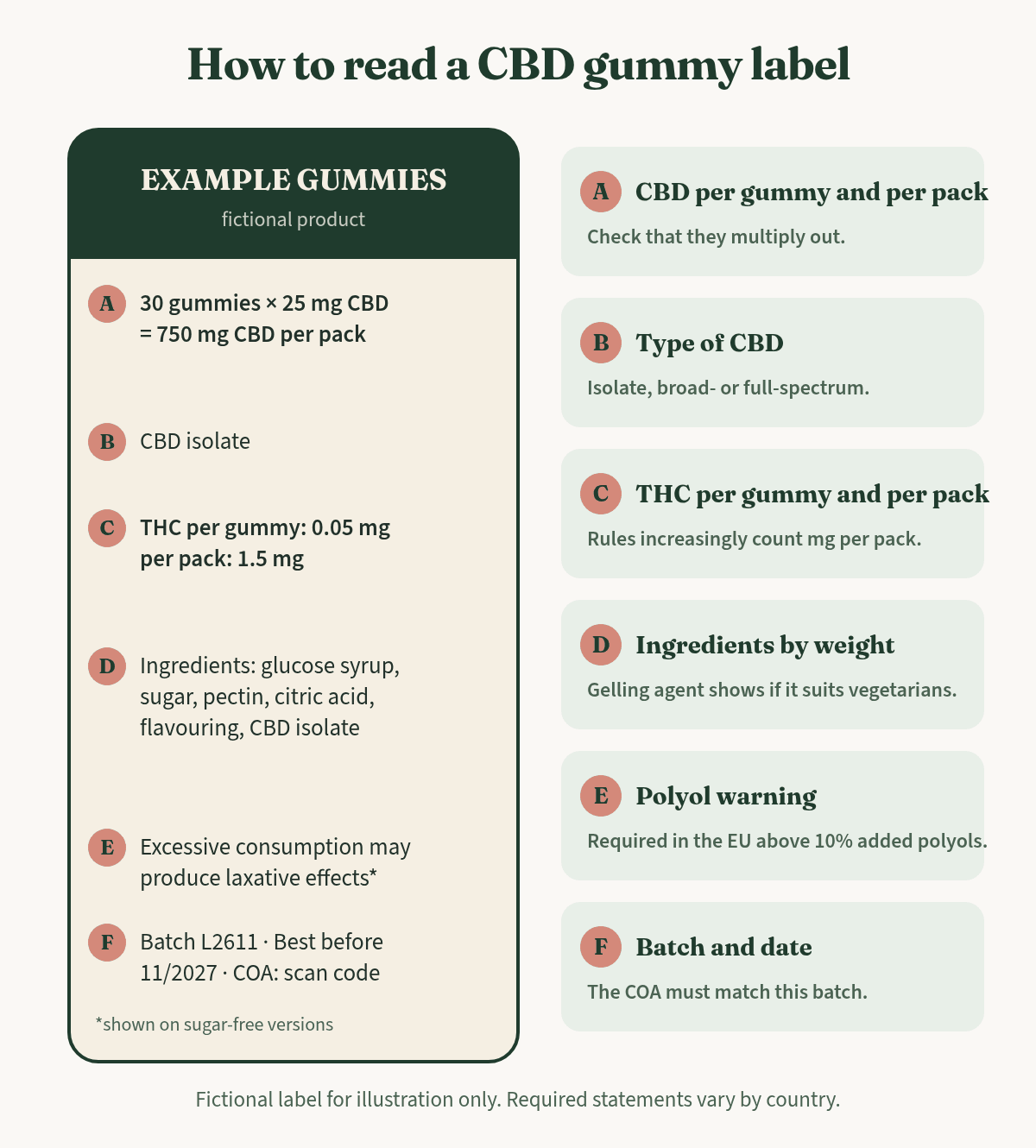
A fictional example puts these together. A pack of 30 gummies labelled 25 mg of CBD each should hold 30 × 25 = 750 mg. At a price of €30, that is 4 cents per mg of CBD. If a representative laboratory sample measures an average of 21 mg per gummy, a pack of 30 would contain approximately 630 mg of CBD, assuming the sampled gummies reflect the whole batch, and the real price would be nearly 4.8 cents per mg. Individual pieces may still vary. This is a fictional arithmetic example, not a real product, recommended intake or authorised formulation.
How CBD Gummies Are Regulated (2026)
This is a dated summary as of 26 October 2026, not legal advice.
European Union. The European Commission’s Novel Food Status Catalogue lists cannabinoid extracts, including CBD, as novel foods. Whether a particular ingredient needs authorisation, and on what terms, depends on what it is and how it is used. [13] Gummies must also follow general food law, including ingredient labelling and the polyol warning. [2]
United Kingdom. The FSA regards CBD foods as novel foods, and no health claims are authorised for CBD. Its June 2026 guidance said no CBD food products had been authorised. [11] In September 2026 its Board considered recommendations to ministers on the first three CBD authorisations; ministers make the final decision. [14]
United States. The FDA’s position is that CBD cannot lawfully be added to food or sold as a dietary supplement. [15]
Frequently Asked Questions
What do CBD gummies do?
A gummy delivers the CBD amount stated on the label by mouth, and the CBD is absorbed through the gut in amounts that vary with the product and with food. [10] Most human research has tested pharmaceutical-grade CBD in patients, such as the prescription epilepsy medicine Epidyolex, often at hundreds of milligrams a day, and EFSA notes a lack of reliable studies in healthy people. [10]
So what the much smaller amounts in gummies do is not well established. No health claims are authorised for CBD foods in the UK. [11] More on the research is in what CBD is.
Are CBD gummies vegan?
Only if they use a plant-based gel. Gelatin is animal-derived; pectin, starch and agar are plant-based. [1] The ingredient list names the gelling agent. The vegan CBD gummies guide covers gelatin, pectin and polyols in more detail.
Do CBD gummies get you high?
CBD itself is not considered intoxicating in the way THC is. The question is THC, which some gummies in a 2025 US sample contained. [5]
Can CBD gummies cause a failed drug test?
It can’t be ruled out. In a 2025 US sample, 39% of gummy products contained THC, some above 0.4 mg per gummy. [5] The UK FSA also warns that THC exposure is possible even from products labelled “THC-free”. [11] The guide to CBD and drug tests explains what studies found.
Are hemp gummies the same as CBD gummies?
Not necessarily. “Hemp” on a label can mean hemp seed oil, which is pressed from the seeds and usually contains extremely low levels of cannabinoids. [16][17] A gummy made with hemp seed oil and no added CBD extract is a different product. The CBD content per gummy on the label or COA shows which one it is.
How much CBD is in one gummy?
It varies widely. Gummies in the 2025 US analysis ranged from about 6 to 60 mg of CBD each. [5] This describes the products tested, not an amount to take.
Do CBD gummies expire?
Like other foods, they have a limited shelf life. EU law generally requires a date of minimum durability or a use-by date on prepacked food, with some exemptions, such as confectionery consisting almost solely of flavoured or coloured sugars. [2] Heat matters for gelatin gummies in particular, because the gel can melt. [1] The guide to CBD shelf life covers how CBD itself degrades.
Explore CBD oils · Explore CBD gummies
The Bottom Line
A CBD gummy is a sweet: a gel of gelatin, pectin or starch, sweetened with sugar or polyols, with CBD added at a stated amount per piece.
The ingredients decide texture and who can eat it. The label says what you should be getting; in the US samples tested, it was often wrong on CBD and sometimes silent on THC. EU and UK regulators single out groups for whom CBD is not advised or its safety is not established.
A batch COA for the finished gummies, a quick multiplication of THC per pack, and the gelling agent on the ingredient list cover the main practical checks.
Scientific and Regulatory Sources
Ingredients and food labelling
- Vásquez-Senador M., Pérez-Bermúdez I., Orellana-Palma P., Petzold G. (2026). Gummies: from confectionery to functional hydrogel-based bioactive delivery systems. Gels 12(9):841. Review. Full study.
- Regulation (EU) No 1169/2011 on the provision of food information to consumers, Articles 9, 18 and 30, Annex III point 2.4 (polyols) and Annex X point 1(d) (date exemptions), consolidated text. EUR-Lex.
- Commission Regulation (EU) 2022/63 of 14 January 2022 amending Annexes II and III to Regulation (EC) No 1333/2008 as regards the food additive titanium dioxide (E 171). EUR-Lex.
- Bagde A., Messiha M., Singh M. (2025). Development and characterization of cannabidiol gummy using 3D printing. Gels 11(3):189. Full study.
Label accuracy, contaminants and THC
- Johnson E.D., Kilgore M.W., Stafford M. et al. (2025). Cannabidiol gummy products: LC-MS/MS assessment of cannabinoid concentrations. Cannabis and Cannabinoid Research 10(6):710–718. Authors from the University of Kentucky and LGC Assure. Full study · PubMed.
- Gardener H., Wallin C., Bowen J. (2022). Heavy metal and phthalate contamination and labeling integrity in a large sample of US commercially available cannabidiol (CBD) products. Science of the Total Environment 851(Pt 1):158110. Funded by Greenwich Biosciences (Jazz Pharmaceuticals). PubMed.
- Public Law 119-37 (enacted 12 November 2025), Division B, section 781 (new definition of hemp). GovInfo.
- Public Law 119-103 (enacted 2 September 2026), section 2019 (phased effective dates). GovInfo.
- UK Home Office. Drug licensing factsheet: cannabis, CBD and other cannabinoids (updated 3 October 2024), paragraphs 26 to 34 (exempt product definition). Official guidance.
Safety advice and poison centre data
- EFSA Panel on Nutrition, Novel Foods and Food Allergens (2026). Update of the statement on safety of cannabidiol as a novel food. EFSA Journal 24(2):9862 (published February 2026). Full text (Europe PMC) · EFSA Journal.
- UK Food Standards Agency (22 June 2026). Food Fact Check: CBD safety and health claims. Official FSA blog.
- Perez-Vilar S., Karami S., Long K., Leishear K. (2023). Cannabidiol exposures in the United States, National Poison Data System, July 2014–June 2021. Clinical Toxicology 61(2):123–130. Authors from the US FDA. Full study.
Regulation in the EU, UK and US
- European Commission. Novel Food Status Catalogue (entries “Cannabinoids” and “Cannabis sativa L.”). Official guidance.
- UK Food Standards Agency (September 2026 Board meeting). CBD novel food applications: recommendations to ministers on first authorisations. Official Board paper.
- US Food and Drug Administration. FDA regulation of cannabis and cannabis-derived products, including cannabidiol (CBD). Official FDA information.
Hemp seed oil
- Pavlovic R., Nenna G., Calvi L. et al. (2018). Quality traits of “cannabidiol oils”: cannabinoids content, terpene fingerprint and oxidation stability of European commercially available preparations. Molecules 23(5):1230. Full study.
- Farinon B., Molinari R., Costantini L., Merendino N. (2020). The seed of industrial hemp (Cannabis sativa L.): nutritional quality and potential functionality for human health and nutrition. Nutrients 12(7):1935. Full study.
Scientific and regulatory material reviewed: 26 October 2026. This article provides general educational information, not medical advice, legal advice or a product-specific determination of regulatory compliance.