
This article is general information, not medical advice. Hemppy does not make CBD products; the shop lists independent brands and links to their own websites. If you buy through one of those links, Hemppy may earn a commission from the brand, and you pay the same price. See our affiliate disclosure. This article does not recommend any specific product.
Terpenes in CBD oil are aromatic plant compounds that can come from the hemp extract or be added later. They shape smell and taste. Claims that they change how CBD works are a separate, much thinner evidence base.
This guide explains what terpenes are, why some oils have more of them than others, how extraction changes the profile, and what a certificate of analysis can and cannot show. It does not claim health effects for any terpene.
On this page
- Terpenes in CBD Oil at a Glance
- What Are Terpenes?
- Do CBD Oils Contain Terpenes?
- Natural vs Added Terpenes
- Terpenes and the Entourage Effect
- What a COA Shows About Terpenes
- Rules and Product Types (2026)
- Frequently Asked Questions
- The Bottom Line
Terpenes in CBD Oil at a Glance
| Question | Short answer |
|---|---|
| What are terpenes? | Aromatic compounds made by many plants, including hemp |
| Do all CBD oils contain them? | No. Isolate oils are mostly CBD; some extracts keep plant terpenes |
| Natural or added? | Both exist; only the label and COA can show which |
| Entourage effect? | Still a hypothesis; lab results are mixed |
| On a COA? | Only if the lab ran a terpene panel; many do not |
What Are Terpenes?
Terpenes are a large family of aromatic compounds. In hemp they sit alongside cannabinoids such as CBD and THC. Familiar names include β-caryophyllene, myrcene, limonene and the pinenes. [1]
They are not unique to cannabis. The same molecules appear in citrus, herbs and spices. In a bottle of CBD oil they are usually present at far lower levels than CBD. What is CBD? places them next to the main cannabinoids.
Common names on a terpene panel
| Terpene | Also found in (examples) | Why it appears on CBD labels |
|---|---|---|
| β-Caryophyllene | Black pepper, cloves | Often among the most abundant in hemp extracts |
| Myrcene | Hops, mango | Common in cannabis and hops aroma |
| Limonene | Citrus peel | Frequent in richer commercial oils |
| α-Pinene / β-Pinene | Pine needles | Often present together |
| Linalool | Lavender | Sometimes listed on flavoured oils |
These associations explain smell. They are not evidence of a health effect in a CBD oil. [2] [3]
New York’s definition of a full-spectrum hemp extract names terpenes among the compounds kept when the extract is processed “without intentional complete removal of any compound”. [4] Elsewhere, “full-spectrum” is usually a brand description. The full-spectrum vs broad-spectrum CBD guide covers those labels.
Do CBD Oils Contain Terpenes?
It depends on how the oil was made and whether terpenes were added back.
What commercial oils have shown
A 2018 European study of 14 CBD oils bought on the open market profiled cannabinoids, terpenes and oxidation products. Nine of the 14 had CBD concentrations that differed notably from the amount declared. Terpene fingerprints varied widely: some oils held a distinct set of terpenes, and one preparation was far richer in α-pinene, β-myrcene and limonene than the others. The authors suggested that the terpene fingerprint can reflect how the hemp was extracted and which variety was used. [2]
That was a snapshot of products sold in Europe at the time. It is not a ranking of today’s brands.
How extraction changes the profile
A 2024 laboratory study compared three common hemp extraction routes on the same CBD/CBG-dominant cultivar: supercritical CO2, hydrodistillation and ethanol. The extracts differed sharply. Hydrodistilled extracts held the widest and most abundant terpene set, with β-caryophyllene the most concentrated terpene at about 25 to 42 mg/g. Supercritical CO2 extracts held fewer terpene types but the highest cannabinoid levels, with CBD about 12.8 to 20.6 mg/g. Ethanol extracts kept more acidic cannabinoids and only minor terpene levels. [3]
The study was on plant material in a lab, not on finished retail oils, and the authors declared no conflicts of interest. It still shows why two bottles labelled “CBD oil” can smell and test differently even before anyone adds flavourings: the extraction step alone rearranges both the cannabinoid and terpene profile. How CBD oil is made walks through those steps.
Isolate oils, made by crystallising CBD, are designed to leave most other compounds behind. They typically have little or no plant terpene content unless terpenes are added afterwards. [4]
Broad-spectrum oils aim to keep other compounds while removing THC. Some of the terpenes can be lost in that process; others can be restored later. The batch report is the only way to see what remained. [4]
Gummies and other flavoured formats can list “natural flavouring” that includes terpenes from non-hemp sources. That is a confectionery flavour choice, separate from a hemp terpene fingerprint. The types of CBD products guide separates extract type from product form.
Natural vs Added Terpenes
“Natural” here means terpenes that arrived with the hemp extract. “Added” means terpenes (or a terpene blend) put into the bottle later, sometimes from hemp and sometimes from other plants.
Nothing in EU or UK food law that we checked on 27 October 2026 requires a CBD oil to say which is which. The ingredient list should name flavourings where they are used. [5] A terpene panel on a COA lists what was measured in that batch; it does not, by itself, prove the source.
Terpenes and the Entourage Effect
The entourage effect is the idea that CBD works better alongside other plant compounds, including terpenes, than on its own. The term was later extended from early endocannabinoid research to plant extracts and full-spectrum products. [6]
Laboratory tests of that idea for terpenes are mixed. A 2020 study found that common cannabis terpenoids did not act at cannabinoid receptors in a way that would explain an entourage effect. [7] Another 2020 study found that terpenoids commonly found in Cannabis sativa did not modulate how phytocannabinoids or endocannabinoids acted at TRPA1 and TRPV1 channels under the conditions tested. [8]
A 2023 scoping review called the wider entourage research “in its infancy”, with contradictory findings, and with human evidence resting mostly on anecdotal and real-world data. [6]
Smell and taste are real. Any pharmacological contribution from the terpenes in a consumer CBD oil has not been established in controlled human trials. This article does not treat aroma as evidence of effect.
What a COA Shows About Terpenes
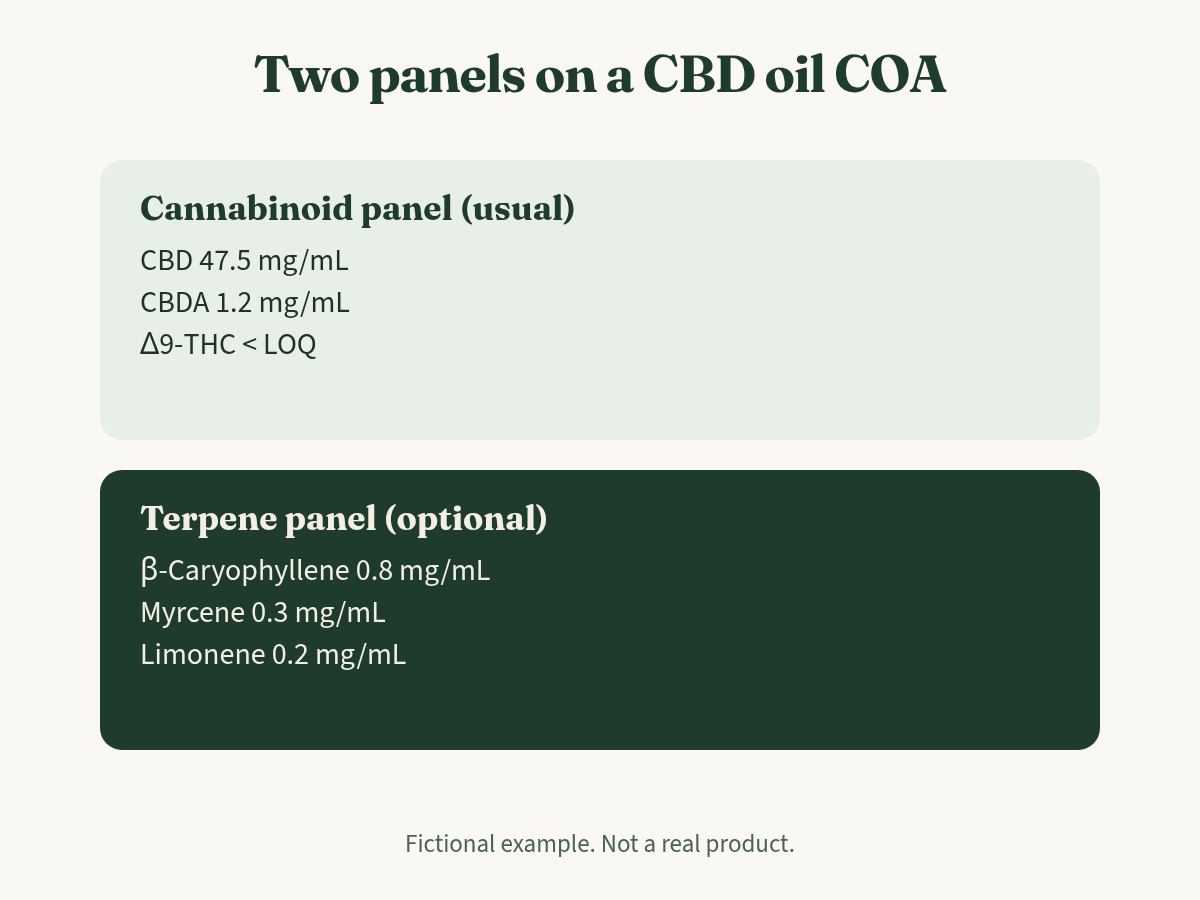
A certificate of analysis is a lab report on one batch. Cannabinoid panels are common. Terpene panels are optional.
Useful lines, when a terpene panel is present:
- Which terpenes were tested. A short panel cannot rule out compounds it did not measure.
- Units. mg/g, mg/mL and percentage answer different questions.
- LOD and LOQ. “ND” and “<LOQ” mean below the test’s limits, not proof of zero. Those terms are defined in the CBD glossary.
- Batch number. It should match the bottle. [9]
A COA without a terpene panel does not mean the oil has no terpenes. It means that lab did not report them. The CBD oil label guide covers the rest of a typical report.
Oxidation and aroma over time
The 2018 European oils study also looked at lipid oxidation products in the carrier oil. Those markers help judge how the oil milieu has aged; they are not a terpene panel. [2] Heat, light and air can change both the carrier and the more volatile aromatics, so a bottle that once smelled strong can smell flatter months later. That change is not a measure of CBD content.
Rules and Product Types (2026)
Terpenes do not change the basic regulatory questions for CBD oils. As of 27 October 2026:
The European Commission treats cannabinoid extracts as novel foods; whether a product is caught depends on what it contains and how it is used. [10] The UK FSA also classes CBD as a novel food. [11] In the US, federal hemp is defined by Δ9-THC content on a dry-weight basis, with further changes scheduled later in 2026. [12]
UK rules on controlled cannabinoids such as THC still turn on the “exempt product” test where those cannabinoids are present; terpenes are not that test. [13]
None of this is a determination that any product is lawful to sell in a particular place.
Frequently Asked Questions
Are terpenes the same as CBD?
No. CBD is a cannabinoid. Terpenes are a separate family of aromatic compounds. [1]
Do terpenes get you high?
The common hemp terpenes discussed here are not the intoxicating component of cannabis. THC is. [1]
Does a strong smell mean more CBD?
No. Smell tracks volatile aromatics. CBD content is what the cannabinoid panel reports. [2]
Should every COA include terpenes?
Only if you need that information. Many valid cannabinoid panels omit terpenes. Ask for a terpene panel when the aroma profile matters to you.
Do added terpenes count as full-spectrum?
Full-spectrum, where defined at all, refers to keeping compounds from the extract, not to flavouring an isolate. New York’s definition is about processing without intentional complete removal of compounds from the extract. [4]
Can terpenes affect a drug test?
Standard workplace urine tests target a THC metabolite, not terpenes. The risk of a positive result still comes from THC in the product, which is a THC question, not a terpene one.
The Bottom Line
Terpenes in CBD oil are aroma compounds from the plant extract, from later additions, or both. Extraction method changes how many remain. Commercial oils vary widely, and isolate oils may have almost none unless terpenes are added.
The entourage idea remains a hypothesis. What a shopper can verify is simpler: the ingredient list for flavourings, and a batch-matched COA that states which terpenes, if any, were measured.
Explore CBD oils from partner brands: Explore CBD oils.
Scientific and Regulatory Sources
What terpenes are
- Tahir M.N., Raz F.S., Rondeau-Gagné S., Trant J.F. (2021). The biosynthesis of the cannabinoids. Journal of Cannabis Research 3:7. Full study.
- Pavlovic R., Nenna G., Calvi L. et al. (2018). Quality traits of “cannabidiol oils”: cannabinoids content, terpene fingerprint and oxidation stability of European commercially available preparations. Molecules 23(5):1230. Full study.
- Chacon F.T., Raup-Konsavage W.M., Vrana K.E., Kellogg J.J. (2024). Effect of hemp extraction procedures on cannabinoid and terpenoid composition. Plants 13(16):2222. Full study.
- New York State Office of Cannabis Management. 9 NYCRR Part 114, Cannabinoid Hemp: §114.1 Definitions (“broad spectrum”, “distillate”, “full spectrum”, “isolate”) and §114.9(e), as amended effective 13 December 2023. Official text (PDF) · §114.1 (LII).
- Regulation (EU) 2015/2283 of the European Parliament and of the Council of 25 November 2015 on novel foods, Articles 3, 6 and 10 to 12 (definition, Union list and authorisation procedure). EUR-Lex.
Evidence and labels
- Christensen C., Rose M., Cornett C., Allesø M. (2023). Decoding the postulated entourage effect of medicinal cannabis: what it is and what it isn’t. Biomedicines 11(8):2323. Full study.
- Finlay D.B., Sircombe K.J., Nimick M., Jones C., Glass M. (2020). Terpenoids from cannabis do not mediate an entourage effect by acting at cannabinoid receptors. Frontiers in Pharmacology 11:359. Full study.
- Heblinski M., Santiago M., Fletcher C. et al. (2020). Terpenoids commonly found in Cannabis sativa do not modulate the actions of phytocannabinoids or endocannabinoids on TRPA1 and TRPV1 channels. Cannabis and Cannabinoid Research 5(4):305–317. Full study.
- Gidal B.E., Vandrey R., Wallin C. et al. (2024). Product labeling accuracy and contamination analysis of commercially available cannabidiol product samples. Frontiers in Pharmacology 15:1335441. Funded by Jazz Pharmaceuticals. Full study.
Rules
- European Commission. Novel Food Status Catalogue (entries “Cannabinoids” and “Cannabis sativa L.”). Official guidance.
- UK Food Standards Agency. Cannabidiol (CBD) guidance: business guidance on CBD as a novel food (England and Wales), updated 28 August 2026. Official guidance.
- United States Code, 7 U.S.C. §1639o (definition of hemp, as in force on 22 October 2026). GovInfo.
- UK Home Office. Drug licensing factsheet: cannabis, CBD and other cannabinoids (updated 3 October 2024), paragraphs 26 to 34 (exempt product definition). Official guidance.
Scientific and regulatory material reviewed: 27 October 2026. This article provides general educational information, not medical advice, legal advice or a product-specific determination of regulatory compliance.