
This article is general information, not medical advice. Hemppy does not make CBD products; the shop lists independent brands and links to their own websites. If you buy through one of those links, Hemppy may earn a commission from the brand, and you pay the same price. See our affiliate disclosure. This article does not recommend any specific product.
CBD capsules vs oil is mostly a question of format rather than ingredient. A CBD oil is a CBD extract dissolved in a carrier oil and measured out with a dropper. A capsule or softgel usually seals a fixed amount of a similar oil inside a shell, so each one holds the same stated dose.
The obvious question is absorption, and the evidence is thinner than product marketing suggests. One small trial gave eight men the same CBD oil as drops or in capsules and found no significant difference in blood levels. Studies that changed what was inside the capsule, or what people ate, found much larger differences.
So the format matters less than its contents. What the capsule or bottle actually contains, how much CBD and THC it holds per pack, and what its lab report shows tell a reader far more than the choice between a shell and a dropper. The guide to types of CBD products covers the other formats.
On this page
- CBD Capsules vs Oil at a Glance
- What Are CBD Capsules and CBD Oil?
- Are CBD Capsules or Oil Better Absorbed?
- Does the Format Change Safety?
- How to Compare CBD Capsules and Oil on a Label
- CBD Capsules and Oil Under the Rules (2026)
- Frequently Asked Questions
- The Bottom Line
CBD Capsules vs Oil at a Glance
| Feature | CBD oil (drops) | CBD capsules and softgels |
|---|---|---|
| What it is | CBD extract dissolved in a carrier oil | A shell holding a fixed amount of CBD, usually in oil |
| How the amount is set | Measured with a dropper, stated per mL | Fixed per capsule |
| Contents | Extract plus carrier oil | Often oil; sometimes powder or an emulsifying formulation |
| Same oil, drops vs capsules | No significant difference in one 8-person trial | No significant difference in one 8-person trial |
| Bigger influences found in studies | Formulation and food | Formulation and food |
| Label figures to check | mg CBD per mL and per bottle | mg CBD per capsule and per pack |
| EU food supplement law | A “dose form” (drop dispensing bottles) | A “dose form” (capsules) |
No study has shown either format, in itself, to be better absorbed, safer or more effective than the other.
What Are CBD Capsules and CBD Oil?
Both are usually taken by mouth, and both can contain full-spectrum, broad-spectrum or isolate CBD. The difference lies in packaging and measuring.
CBD oil (drops)
A CBD oil is a CBD ingredient dissolved in a carrier oil such as MCT (medium-chain triglyceride) oil, olive oil or hemp seed oil. Strength is given per millilitre, and the amount taken depends on how many drops are measured out. The CBD oil guide explains carrier oils, strengths and how to read a lab report. CBD oil 10% vs 5% shows how to turn a percentage into mg per ml and per drop.
Capsules and softgels
A capsule is a shell filled with a measured amount of an ingredient. A softgel has a soft shell, typically around a liquid. The shell may be gelatin, which is animal-derived, or a plant-based material. [1] On an EU food label, the ingredients list should show what the product is made of, shell included. [2]
Not every capsule contains oil. One 2025 trial used, as its reference product, a capsule of CBD isolate powder with microcrystalline cellulose as the only other ingredient. [3] Others contain an emulsifying formulation designed to disperse CBD in the gut, the approach behind many water-soluble CBD products. [4] So “capsule” describes the container, not what is in it.
Are CBD Capsules or Oil Better Absorbed?
It depends far more on the formulation than on the format. Before the studies, four terms are worth defining once.
Bioavailability is the share of a dose that reaches the bloodstream. Cmax is the highest blood concentration reached, Tmax is the time it takes to get there, and AUC (area under the curve) is total exposure over a set period. Higher blood levels show that more CBD was absorbed. They do not show a better outcome for the person.
EFSA’s February 2026 statement concluded that CBD’s bioavailability is variable and influenced by the delivery matrix and by food. It also noted that the exact composition of products tested in recent human studies was not always known. [5]
Drops vs capsules with the same oil
The most direct comparison is a 2023 trial led by Johnson at Loughborough University. Eight healthy men completed three conditions in random order: placebo, CBD oil in gelatin capsules, and the same oil (69 mg/mL hemp oil) as drops held under the tongue. Placebo capsules or drops kept participants unaware of which they were getting.
Blood CBD levels did not differ significantly between capsules and drops. Peak concentration was 28.0 ng/mL with capsules and 24.0 ng/mL with drops, and Tmax was about four hours for both. AUC over six hours was also similar. [6]
The authors suggested that drops held under the tongue were swallowed before much CBD could be absorbed in the mouth. With eight men, one oil and single doses, the trial cannot show that the two formats are equivalent for everyone. Its disclosures list unrelated food and drink industry funding for the senior author, paid to his institution. [6]
When the contents differ
Changing what is inside the capsule produced much larger differences. In a 2019 German trial led by Knaub, 16 healthy adults took 25 mg of CBD from the same hemp extract in two kinds of liquid-filled vegetarian capsule: one with plain MCT oil, one with a self-emulsifying formulation. Under fasting conditions, the emulsifying capsule reached a peak about 4.4 times higher, after about one hour rather than three. The study was funded by the company behind the formulation. [4]
A 2025 trial led by Pisak compared 40 mg of CBD as an enhanced capsule, an enhanced liquid and a plain isolate-powder capsule. Of 12 men enrolled, 9 completed all three periods. The enhanced capsule produced the highest peak (14.1 ng/mL), the liquid came next (6.2 ng/mL) and the isolate capsule came last (2.4 ng/mL). Two of the authors work for the company that makes the enhanced products. [3]
A Johns Hopkins study measured CBD in urine rather than blood. Eighteen adults took 100 mg of oral CBD as a gelatin capsule, a pharmacy syrup or the prescription medicine Epidiolex, six per formulation. Peak urine CBD was 776 ng/mL for the capsule, 151 ng/mL for the syrup and 1,274 ng/mL for Epidiolex. Urine levels are an indirect measure, and the groups were small. [7]
Together, these trials show that “capsule” or “oil” on the front of a pack says little on its own about absorption.
Food changes more than the format
Several trials found that a meal, especially a high-fat one, raised blood CBD far more than any switch of format. In a 2018 phase I trial of the purified CBD oral solution, 12 healthy adults took a single 1,500 mg dose fasted and after a high-fat meal. The meal raised Cmax 4.85-fold and AUC 4.2-fold. Three of the authors were employed by the medicine’s manufacturer. [8]
A 2025 Dutch trial led by Saals gave 11 healthy adults hard gelatin capsules of a CBD-rich extract, equivalent to 70 mg of CBD, once fasted and once after a high-fat meal. The meal raised Cmax about 17-fold and AUC about 10-fold. It was funded by Wageningen University and Becanex GmbH, a company that employed two of the authors. [9]
These doses are research conditions, not consumer dosing recommendations. The point is about interpretation: two products tested under different meal conditions cannot be compared fairly.
What the evidence does and does not show
| Study | What was compared | What was observed | What remains uncertain |
|---|---|---|---|
| Johnson et al., 2023 | Same oil as drops or capsules, 8 men | No significant difference; Tmax about 4 h for both | Women, other oils, repeated use |
| Knaub et al., 2019 | MCT oil vs emulsifying formulation, both in capsules, 16 adults | Peak about 4.4× higher with the emulsifying capsule | Fasted only; sponsor-funded |
| Pisak et al., 2025 | Two enhanced products vs isolate-powder capsule, 9 men | Isolate capsule lowest | Small; authors linked to the maker |
| Sholler et al., 2022 | Capsule, syrup and Epidiolex, 6 each | Urine CBD differed by formulation | Urine, not blood |
| Taylor 2018; Saals 2025 | Fasted vs high-fat meal | Exposure several times higher after a meal | Doses and products differ |
The most defensible conclusion is that the shell versus dropper choice has not been shown to matter much on its own. What the product contains, and the conditions under which it is taken, matter more, and no study has shown that higher blood levels from any format bring a benefit.
Does the Format Change Safety?
Not in any way studies have shown. The CBD is the same compound whichever way it is packaged, so the known safety questions apply to both.
The prescribing information for the purified CBD medicine lists sleepiness, decreased appetite, diarrhoea and raised liver enzymes among common adverse reactions, and warns about interactions with other medicines. [10] In a 2025 FDA-funded trial of 201 healthy adults, liver enzymes rose above three times the upper limit of normal in 8 of 151 people taking 5 mg/kg of CBD a day for 28 days, and in none on placebo. [11]
EFSA’s February 2026 statement found that safety could not be established for people under 25, during pregnancy or breastfeeding, or for people taking medicines. [5] The UK Food Standards Agency advises people taking medication to avoid CBD unless under medical direction. [12] Anyone considering CBD alongside prescribed medicines should ask a doctor or pharmacist first.
How to Compare CBD Capsules and Oil on a Label
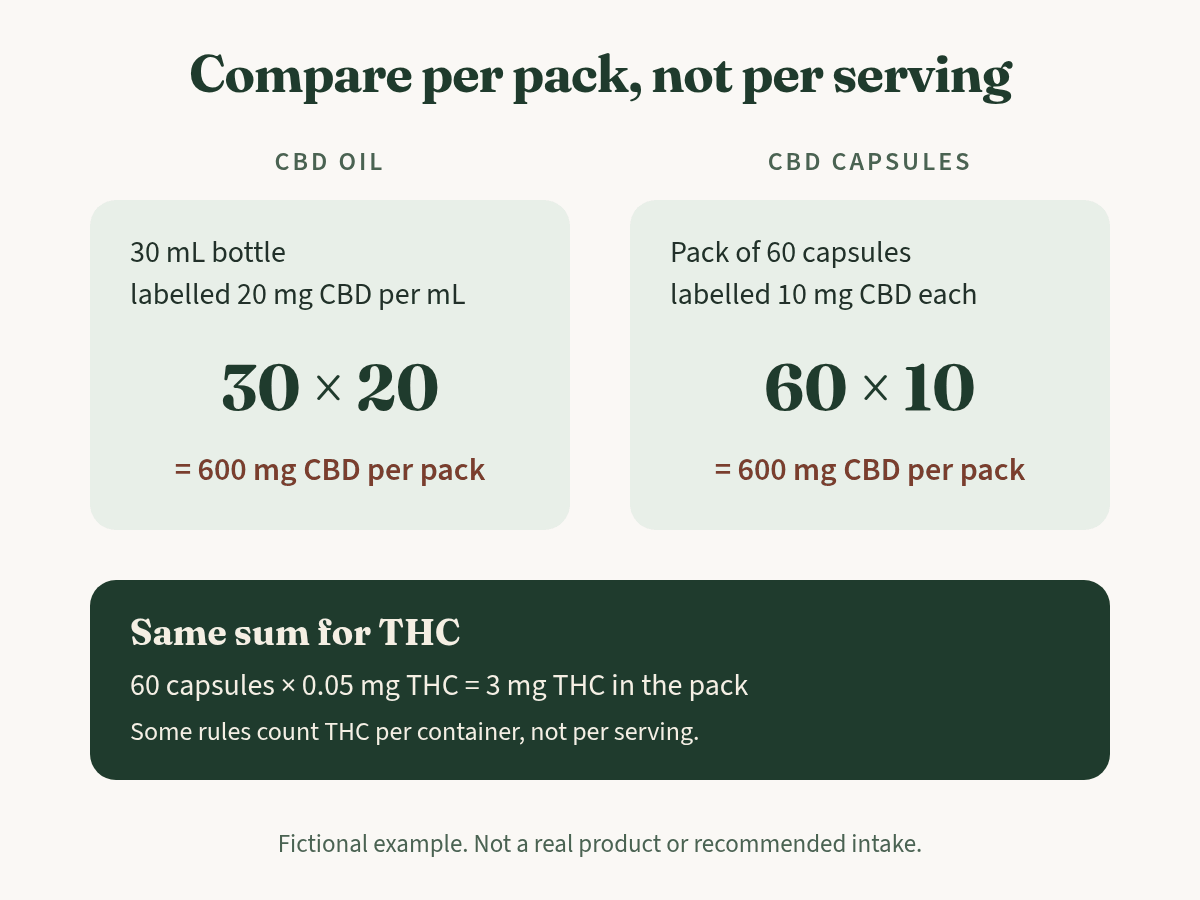
Because one is labelled per millilitre and the other per capsule, the headline numbers rarely line up. Converting both to milligrams of CBD per pack makes them comparable.
Milligrams per pack and price per milligram
Suppose an illustrative 30 mL oil states 20 mg of CBD per mL. It holds 30 × 20 = 600 mg of CBD. A pack of 60 capsules stating 10 mg each also holds 60 × 10 = 600 mg.
If the oil costs €42 and the capsules €48, the oil works out at 7 cents per mg (42 ÷ 600) and the capsules at 8 cents per mg (48 ÷ 600). This is a fictional arithmetic example, not a real product, recommended intake or authorised formulation.
THC per pack adds up
The same arithmetic applies to THC, and a pack of capsules can hide it in small numbers. A fictional pack of 60 capsules at 0.05 mg of THC each holds 60 × 0.05 = 3 mg of THC. Several rules are framed per container rather than per serving, as the rules section below explains, so the pack total is the figure to check.
What a lab report can and cannot show
A certificate of analysis (COA) reports what a laboratory measured in a sample from one batch. For capsules, check whether results are given per capsule, per gram of fill or as a percentage, and that the batch number matches the pack. Results below the limit of quantification, often shown as “<LOQ”, mean the amount was too small to measure reliably, not that it was zero.
Label accuracy is not guaranteed. A 2024 US audit sponsored by Jazz Pharmaceuticals, which makes a prescription CBD medicine, tested 202 products. Of the 100 oils (tinctures), 71 contained more than 10% above or below their labelled CBD. No capsules were included. [13] These were US products in one study, and they do not show how accurate labels are elsewhere.
CBD Capsules and Oil Under the Rules (2026)
The format barely changes the legal picture, but it can change which rules a product is presented under. What follows is a dated summary as of 27 October 2026, not legal advice.
European Union. EU food supplement law defines food supplements as products “marketed in dose form”, naming both capsules and “drop dispensing bottles”. Their labels must state the portion recommended for daily consumption, a warning not to exceed it and the amount of each substance per portion. [14] These are labelling rules, not intake advice.
The European Commission’s Novel Food Status Catalogue lists cannabinoid extracts, including CBD, as novel foods. [15] A novel food needs authorisation and inclusion in the Union list before it can be sold; whether a particular product is caught, and on what terms, depends on what it contains and how it is used. [16] As of 27 October 2026 we found no CBD on the Union list. [17]
EFSA’s February 2026 provisional safe intake applies only to CBD of at least 98% purity in food supplements, under strict conditions, and it is not a recommended intake. [5] In September 2026 EFSA published its first positive opinion on a CBD novel food, for synthetic CBD in food supplements. An EFSA opinion is not an authorisation. [18]
United Kingdom. FSA guidance, updated on 28 August 2026, classes CBD extracts and isolates as novel foods that need authorisation and states that none has yet been authorised. [19] In September 2026 the FSA Board recommended to ministers the first three CBD authorisations; as of 27 October 2026 we found no ministerial decision. [20]
Under drug law, a product containing a controlled cannabinoid such as THC can fall outside control only if it meets all three conditions of the “exempt product” definition. One is that no one component part contains more than 1 mg of the controlled drug. [21] The Home Office reads that unit as the container, such as a bottle, not a serving. [22]
United States. The FDA’s position is that CBD cannot lawfully be sold as a dietary supplement or added to food. [23] A 2025 law would exclude from the definition of hemp any final product with more than 0.4 mg of total THC and similar cannabinoids per container. [24] That limit is scheduled to apply from 11 December 2026; the date had not been reached on 27 October 2026, and Congress could still change it. [25]
Frequently Asked Questions
Do CBD capsules work faster than CBD oil?
Not in the one trial that compared them directly. With the same oil, blood CBD peaked at about four hours whether it was taken as capsules or drops. [6] Formulations designed to disperse CBD reached their peak sooner in other trials, but faster absorption is not evidence of a faster or better effect. [4]
Does food change how CBD from a capsule is absorbed?
In research, yes, often by several times. A high-fat meal raised blood CBD exposure 4.2-fold in one trial and about tenfold in another, which used capsules. [8] [9] These were research conditions, so the label and a pharmacist are the right sources for how a particular product is meant to be taken.
Are softgels the same as capsules?
They are a type of capsule with a soft shell, usually around a liquid fill. Hard-shell capsules can hold liquids too: the capsules in the 2019 Knaub trial were liquid-filled hard shells. [4] What matters more is the fill, which the ingredients list and COA describe.
Do CBD capsules contain THC?
They can, depending on the extract. Full-spectrum products usually contain small amounts of THC, and broad-spectrum and isolate products aim to contain none. The FSA warns that THC exposure is possible even from products labelled “THC-free”. [12] A batch COA showing THC per capsule, multiplied by the number in the pack, is the useful check.
Can CBD capsules affect a drug test?
Possibly, if they contain THC. Standard tests look for a THC metabolite, not CBD, so the THC in a product is what matters. The guide does CBD show up on a drug test? covers the studies. No cannabinoid product should be assumed to be drug-test safe.
The Bottom Line
CBD capsules and CBD oil usually contain the same kind of ingredient in different packaging. One small trial found no significant absorption difference between the same oil in capsules and as drops.
Larger differences came from what was inside the capsule and from food. Neither format has been shown to be more effective or safer, and higher blood levels are not, on their own, a benefit.
For either format, three questions work better than the format itself: how many milligrams of CBD and THC are in the whole pack, what the batch COA shows, and which rules apply where the product is sold. Unfamiliar terms on a label or report are defined in the CBD glossary. For one brand that sells both formats, see our Love CBD review.
Scientific and Regulatory Sources
Absorption and formulation studies
- Vásquez-Senador M., Pérez-Bermúdez I., Orellana-Palma P., Petzold G. (2026). Gummies: from confectionery to functional hydrogel-based bioactive delivery systems. Gels 12(9):841. Review. Full study.
- Regulation (EU) No 1169/2011 on the provision of food information to consumers, Articles 9, 18 and 30, Annex III point 2.4 (polyols) and Annex X point 1(d) (date exemptions), consolidated text. EUR-Lex.
- Pisak M.N., Bereket E., Erenmemisoglu A. (2025). Randomized single-dose crossover comparative bioavailability study of two novel oral cannabidiol (CBD) formulations in healthy volunteers under fed conditions, compared to a standard CBD isolate capsule. Journal of Cannabis Research 7:54. PubMed · doi.org/10.1186/s42238-025-00312-9.
- Knaub K., Sartorius T., Dharsono T., Wacker R., Wilhelm M., Schön C. (2019). A novel self-emulsifying drug delivery system (SEDDS) based on VESIsorb formulation technology improving the oral bioavailability of cannabidiol in healthy subjects. Molecules 24(16):2967. Sponsored by Vesifact AG. Full study.
- EFSA Panel on Nutrition, Novel Foods and Food Allergens (2026). Update of the statement on safety of cannabidiol as a novel food. EFSA Journal 24(2):9862 (published February 2026). Full text (Europe PMC) · EFSA Journal.
- Johnson D.A., Funnell M.P., Heaney L.M. et al. (2024; online 2023). Cannabidiol oil ingested as sublingual drops or within gelatin capsules shows similar pharmacokinetic profiles in healthy males. Cannabis and Cannabinoid Research 9(5):e1423–e1432. PubMed · doi.org/10.1089/can.2023.0117.
- Sholler D.J., Spindle T.R., Cone E.J. et al. (2022). Urinary pharmacokinetic profile of cannabidiol (CBD), Δ9-tetrahydrocannabinol (THC) and their metabolites following oral and vaporized CBD and vaporized CBD-dominant cannabis administration. Journal of Analytical Toxicology 46(5):494–503. PubMed · Full study (PMC).
- Taylor L., Gidal B., Blakey G., Tayo B., Morrison G. (2018). A phase I, randomized, double-blind, placebo-controlled, single ascending dose, multiple dose, and food effect trial of the safety, tolerability and pharmacokinetics of highly purified cannabidiol in healthy subjects. CNS Drugs 32(11):1053–1067. PubMed · Full study (PMC).
- Saals B.A.D.F., De Bie T.H., Osmanoglou E. et al. (2025). A high-fat meal significantly impacts the bioavailability and biphasic absorption of cannabidiol (CBD) from a CBD-rich extract in men and women. Scientific Reports 15:3678. PubMed · Full study (PMC).
Safety and product testing
- US Food and Drug Administration. EPIDIOLEX (cannabidiol) oral solution, prescribing information (revised May 2026), sections 1, 5, 6 and 7. Official label.
- Florian J. et al. (2025). Cannabidiol and liver enzyme level elevations in healthy adults: a randomized clinical trial. JAMA Internal Medicine. Full study.
- UK Food Standards Agency (22 June 2026). Food Fact Check: CBD safety and health claims. Official FSA blog.
- Gidal B.E., Vandrey R., Wallin C. et al. (2024). Product labeling accuracy and contamination analysis of commercially available cannabidiol product samples. Frontiers in Pharmacology 15:1335441. Funded by Jazz Pharmaceuticals. Full study.
Regulation in the EU, UK and US
- Directive 2002/46/EC of the European Parliament and of the Council of 10 June 2002 on the approximation of the laws of the Member States relating to food supplements, Articles 2(a), 6(3) and 8(2). EUR-Lex.
- European Commission. Novel Food Status Catalogue (entries “Cannabinoids” and “Cannabis sativa L.”). Official guidance.
- Regulation (EU) 2015/2283 of the European Parliament and of the Council of 25 November 2015 on novel foods, Articles 3, 6 and 10 to 12 (definition, Union list and authorisation procedure). EUR-Lex.
- European Commission. Union list of novel foods. Official list.
- EFSA Panel on Nutrition, Novel Foods and Food Allergens (2026). Safety of synthetic cannabidiol as a novel food pursuant to Regulation (EU) 2015/2283. EFSA Journal (published September 2026). doi.org/10.2903/j.efsa.2026.10154.
- UK Food Standards Agency. Cannabidiol (CBD) guidance: business guidance on CBD as a novel food (England and Wales), updated 28 August 2026. Official guidance.
- UK Food Standards Agency (September 2026 Board meeting). CBD novel food applications: recommendations to ministers on first authorisations. Official Board paper.
- The Misuse of Drugs Regulations 2001 (SI 2001/3998), regulation 2(1), definition of “exempt product”. legislation.gov.uk.
- UK Home Office. Drug licensing factsheet: cannabis, CBD and other cannabinoids (updated 3 October 2024), paragraphs 26 to 34 (exempt product definition). Official guidance.
- US Food and Drug Administration. FDA regulation of cannabis and cannabis-derived products, including cannabidiol (CBD). Official FDA information.
- Public Law 119-37 (enacted 12 November 2025), Division B, section 781 (new definition of hemp). GovInfo.
- Public Law 119-103 (enacted 2 September 2026), section 2019 (phased effective dates). GovInfo.
Scientific and regulatory material reviewed: 27 October 2026. This article provides general educational information, not medical advice, legal advice or a product-specific determination of regulatory compliance.