
This article is general information, not medical advice. Hemppy does not make CBD products; the shop lists independent brands and links to their own websites. If you buy through one of those links, Hemppy may earn a commission from the brand, and you pay the same price. See our affiliate disclosure. This article does not recommend any specific product.
Does CBD show up on a drug test? Standard drug tests are not designed to look for CBD (cannabidiol). Urine tests look for a breakdown product of THC, the intoxicating cannabinoid, and saliva tests look for THC itself.
The practical risk comes from THC inside CBD products. In controlled studies, pure CBD did not produce confirmed positive results. Daily use of CBD oils containing small amounts of THC did, in some participants, even at THC doses that caused no measurable impairment.
So the real question is what a product contains, and how a particular test works. This guide explains the science of drug testing, what human studies found, and how to read the THC lines on a lab report. It does not cover THC use itself.
On this page
- Does CBD Show Up on a Drug Test? At a Glance
- What Do Drug Tests Actually Look For?
- Why Can a CBD Product Cause a Positive Test?
- What Human Studies Have Found
- CBD and Drug Testing in Sport
- How to Read THC on a Lab Report
- Frequently Asked Questions
- The Bottom Line
Does CBD Show Up on a Drug Test? At a Glance
| Question | What the evidence shows |
|---|---|
| Do standard tests look for CBD? | No. Urine tests target THC-COOH; saliva tests target THC |
| Does CBD itself trigger a THC screen? | Not in two laboratory studies of screening kits |
| Can CBD turn into THC in the body? | Seen in artificial lab fluid; not found in human studies |
| Single doses of pure CBD | No confirmed positives in a small controlled study |
| Daily CBD oil with small amounts of THC | Positive urine tests in some participants |
| Broad-spectrum products and sport | Other prohibited cannabinoids detected in urine |
| Hemp seed foods | No positive screens in one Korean study |
No cannabinoid product, including one labelled “THC-free”, should be assumed to be drug-test safe.
What Do Drug Tests Actually Look For?
Most drug tests for cannabis look for THC or the compounds the body turns it into. CBD has a different structure and is not the target.
Urine tests
When THC is processed by the body, one of the main products is THC-COOH (11-nor-9-carboxy-Δ9-THC). It is excreted in urine and lasts longer than THC itself, which is why urine tests target it.
US federal workplace programmes use two steps. An initial screen, usually an immunoassay, flags samples at or above 50 ng/mL of THC-COOH. Those samples then go to a confirmatory test, usually mass spectrometry, with a cutoff of 15 ng/mL. [1]
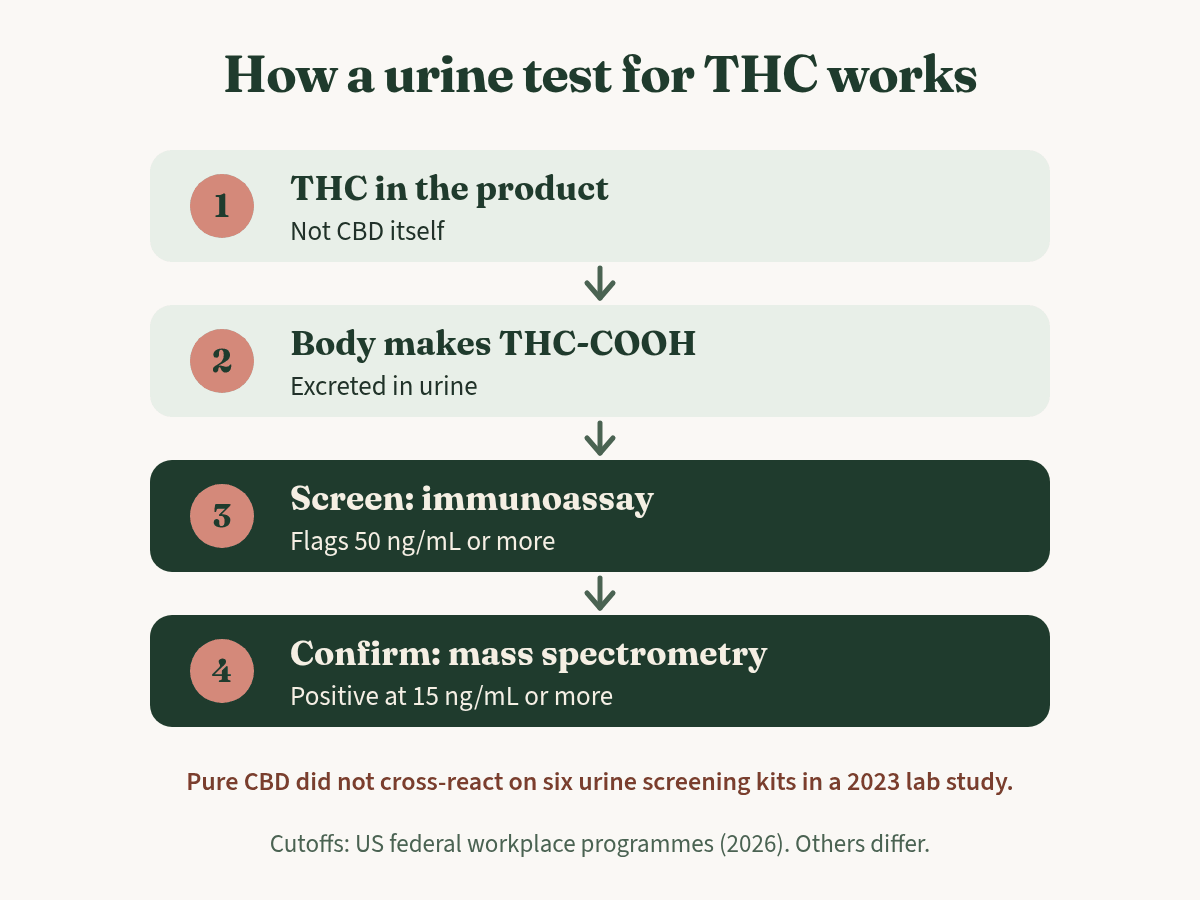
A screen is a quick test based on antibodies, so similar-shaped molecules can sometimes cross-react. Confirmation measures the specific molecule. Other programmes, employers and countries may use different cutoffs, sample types and procedures.
Saliva (oral fluid) tests
Oral fluid tests look for THC itself rather than its metabolite. The US federal panel for oral fluid sets an initial cutoff of 4 ng/mL and a confirmatory cutoff of 2 ng/mL. [1] Roadside devices used in some countries also test saliva for THC.
Does CBD itself trigger a THC screen?
Laboratory studies say it does not. A 2023 study tested six commercial urine immunoassays. CBD and its 7-COOH-CBD metabolite were not detected at concentrations up to 1,000 ng/mL, although two other CBD metabolites (6-OH-CBD and 7-OH-CBD) did on some kits at the concentrations tested. [2] A 2025 study of 53 cannabinoids and metabolites found CBD undetectable on two further THC-COOH screening kits. [3]
Spiking urine in a laboratory is not the same as testing people, and how often CBD metabolites reach those levels in real samples is unclear. Other cannabinoids behave differently: CBN, for example, cross-reacted with two urine screens in a 2020 study. [4] The CBN vs CBD guide covers that compound.
Why Can a CBD Product Cause a Positive Test?
There are three possible routes, and the evidence points mainly to the first.
THC in the product
Many CBD products contain THC. Full-spectrum extracts usually keep small amounts, and products sold as broad-spectrum or isolate do not always match their label. A 2024 US audit, sponsored by Jazz Pharmaceuticals, found THC in 3 of the 28 products labelled broad-spectrum. [5]
A 2025 US laboratory analysis of 56 CBD gummy products bought online found Δ9-THC in 39% of them, at 0.019 to 0.88 mg per gummy. [6] The UK Food Standards Agency warns that THC exposure is possible even from products labelled “THC-free”. [7] These were US samples, but the point applies more widely: a label is not proof of what a batch contains. The CBD vs THC guide explains how the two compounds differ.
Can CBD turn into THC in the stomach?
In an acidic test tube, yes, under particular conditions. Whether it happens in people is a different question.
A 2023 laboratory study incubated three THC-free CBD products in synthetic gastric fluid for three hours. Conversion to THC was below 0.0006% for an oil and up to 0.063% for a water-soluble product. Only when a detergent, sodium dodecyl sulfate, was added did conversion reach 33 to 36%. The authors, from RTI International, Johns Hopkins and SAMHSA, called conversion an unlikely cause of positive urine tests. [8]
Human data point the same way. In a 2022 Johns Hopkins study, healthy adults took 100 mg of pure CBD by mouth as a gelcap, a syrup or the prescription medicine Epidiolex, six per formulation. There was no evidence of conversion to THC with any of them. [9]
In a German study, nine people took 400 mg of CBD as a water-soluble liquid. No THC or THC metabolites appeared in blood, Two urine samples were slightly above 10 ng/mL of THC-COOH, which the authors said could reflect trace THC in the liquid itself. [10]
Reviews published in 2017 and 2026 concluded that conversion in the human stomach has not been shown. The 2017 authors called the test-tube result an artefact, and the 2026 authors, employees of formulation companies, called human conversion speculative. [11] [12]
Hemp seed foods
Hemp seed foods contain no added CBD but can carry trace THC. In a 2019 Korean study, people ate hemp seed products daily for one or twelve weeks. All 64 short-term and 480 long-term urine samples screened negative at a 25 ng/mL cutoff, although confirmatory analysis put 3 long-term samples above its cutoff. [13] The study covered three products sold in Korea. The CBD oil vs hemp seed oil guide explains the difference between the two.
What Human Studies Have Found
Controlled studies are small, but they agree on the main pattern.
Pure CBD
In a 2020 Johns Hopkins study, six healthy adults took 100 mg of oral CBD. Only 1 of 218 urine samples screened positive at the most sensitive cutoff tested, 20 ng/mL, and none exceeded the 15 ng/mL confirmation cutoff. The study was supported by SAMHSA and the US National Institute on Drug Abuse. [14]
An Australian trial looked at roadside saliva devices. Seventeen healthy adults took placebo or 15, 300 or 1,500 mg of pure CBD on separate days. Across 515 device tests, none was positive for THC, and laboratory analysis detected no THC in the samples. The work came from the University of Sydney’s philanthropically funded Lambert Initiative. [15]
CBD with small amounts of THC
The largest controlled study was published in 2026. Sixty healthy adults took 100 mg of CBD in MCT oil containing either no THC or 0.5, 1, 2, 2.8 or 3.7 mg of THC, ten per group. They took one dose in the laboratory, then the same dose twice daily for 14 days at home.
After the single dose, at least one person in each group receiving 1 mg of THC or more had a positive urine test at the federal cutoffs, and positives rose with the THC dose. During the 14 days, every group whose oil contained any THC produced at least one positive, and one sample in the CBD-only group did too. Two samples were still positive after a one-week break. [16]
Blood THC stayed very low, and no group differed from CBD alone on any measure of drug effects or performance. The authors concluded that conventional testing cannot reliably distinguish hemp product use from cannabis use. The study was funded by SAMHSA; one author works for a CBD company. [16]
An earlier open-label study pointed the same way. Fifteen adults took a full-spectrum oil with 0.02% THC three times a day for four weeks, about 0.8 mg of THC a day. Of the 14 who finished, 7 tested positive for THC-COOH. The study had no comparison group and was funded by private donations. [17]
Broad-spectrum products
In a 2025 study run by a CBD company, 20 adults took a broad-spectrum product daily for two weeks, and no THC or THC metabolites were found in their urine. [18] It tested one product, without a comparison group.
In a 2026 UK study, 31 adults took a broad-spectrum product for ten weeks and 5 took a placebo. No THC was found, but other cannabinoids prohibited in sport were. [19] The next section explains why that matters.
| Study | Product and design | Drug test result | Main limits |
|---|---|---|---|
| Spindle et al., 2020 | 100 mg pure CBD, single dose, 6 adults | No confirmed urine positives | Very small; one dose |
| McCartney et al., 2022 | Up to 1,500 mg pure CBD, 17 adults | No positive saliva device tests | Two devices only |
| Wolinsky et al., 2026 | CBD with 0 to 3.7 mg THC, 60 adults, 14 days | Positives in every THC group; one in CBD-only | 10 per group |
| Dahlgren et al., 2021 | Full-spectrum oil, about 0.8 mg THC a day, 4 weeks | 7 of 14 positive | No comparison group |
| Zvorsky et al., 2025 | Broad-spectrum, 2 weeks, 20 adults | No THC detected | Company-run; one product |
| Gillham et al., 2026 | Broad-spectrum, 10 weeks, 36 adults | No THC; CBG and CBDV detected | One product |
The most defensible conclusion is that pure CBD appears unlikely to cause a positive test on its own, while repeated use of products containing even small amounts of THC can. These studies used research doses, which are not recommendations, and their participants were healthy adults.
CBD and Drug Testing in Sport
Sport follows different rules from workplace testing. The World Anti-Doping Agency’s 2026 Prohibited List bans all natural and synthetic cannabinoids in competition, with one exception: cannabidiol itself. [20]
That leaves a gap for products with other cannabinoids. In the 2026 study above, CBG was found in 42% and cannabidivarin (CBDV) in 68% of urine samples before exercise, and more often after it. The authors advised athletes to avoid broad-spectrum products. [19] The full-spectrum vs broad-spectrum CBD guide explains how the extract types differ.
How to Read THC on a Lab Report
A certificate of analysis (COA) is the only document that shows how much THC was measured in a batch. A few lines matter most. How to read a CBD lab report covers the other lines.
- Δ9-THC and THCA. THCA turns into THC when heated. US hemp rules use “total THC”: Δ9-THC plus 0.877 × THCA. [21]
- Units. A percentage, mg per mL and mg per serving answer different questions.
- “ND” or “<LOQ”. These mean below the test’s limit of detection or quantification, not zero.
- Batch number. It should match the pack, because THC can vary between batches.
Suppose an illustrative COA for a 30 mL oil reports 0.2 mg of total THC per mL. The bottle holds about 30 × 0.2 = 6 mg of total THC. This is a fictional arithmetic example, not a real product, recommended intake or authorised formulation.
No study has identified a THC amount below which a positive test is impossible. Test results depend on the amount and frequency of use, individual metabolism, timing and the test’s cutoff. The CBD oil guide explains the rest of a COA, and lab terms are defined in the CBD glossary.
Frequently Asked Questions
Will CBD isolate make me fail a drug test?
Pure CBD is unlikely to, based on the studies so far. In controlled studies, pure CBD produced no confirmed urine positives and no positive saliva tests. [14] [15] The catch is that a product sold as isolate may still contain THC, which only a batch COA can show.
Can broad-spectrum CBD cause a positive test?
It can’t be ruled out. Broad-spectrum products aim to remove THC, but one US audit found THC in 3 of 28 such products. [5] In sport, other cannabinoids in broad-spectrum products can cause their own problem, even without THC. [19]
Does CBD show up in a saliva test?
Not in the study that tested it. Two roadside saliva devices gave no positive THC results in 17 adults after oral doses of pure CBD up to 1,500 mg. [15] Products containing THC are a different matter, because saliva tests look for THC itself. [1]
Can a drug test tell CBD use apart from cannabis use?
Conventional tests usually cannot. They detect THC or THC-COOH, whatever the source. The authors of the 2026 controlled study concluded that standard testing cannot reliably distinguish legal hemp product use from cannabis use. [16]
Can THC from a CBD product be detected days later?
In one study, yes. Two urine samples were still positive a week after the last dose of CBD oil containing low THC. [16] How long a particular person tests positive depends on many factors, so no general detection window can be given.
The Bottom Line
Drug tests look for THC and its metabolite, not CBD. In the studies so far, pure CBD did not produce confirmed positive results, and claims that it turns into THC in the stomach have not held up in human research.
The risk comes from THC in the product. Daily use of CBD oils with small amounts of THC produced positive urine tests in controlled studies, even without measurable impairment.
Three questions are more useful than the word “CBD” on a label: what does the batch COA show for THC and THCA, how much THC is in the whole pack, and which test and cutoff apply to the person being tested?
Scientific and Regulatory Sources
How drug tests work
- US Department of Health and Human Services, SAMHSA. Mandatory Guidelines for Federal Workplace Drug Testing Programs: authorized testing panels (urine and oral fluid). Federal Register 91 FR 12308 (13 March 2026). Federal Register.
- Wolf C.E., Pokhai A.A., Poklis J.L., Williams G.R. (2023). The cross-reactivity of cannabinoid analogs (delta-8-THC, delta-10-THC and CBD), their metabolites and chiral carboxy HHC metabolites in urine of six commercially available homogeneous immunoassays. Journal of Analytical Toxicology 47(8):732–736. PubMed.
- Yates T.L., Poklis J.L., Holt A.K. et al. (2025). Cross-reactivity in urine of 53 cannabinoid analogs and metabolites using a carboxylic acid enzyme-linked immunosorbent assay (ELISA) and homogenous enzyme immunoassay (HEIA) kit and Immunalysis synthetic cannabinoid HEIA kits. Journal of Analytical Toxicology 49(8):587–593. PubMed.
- Kroner G.M., Johnson-Davis K.L., Doyle K., McMillin G.A. (2020). Cannabinol (CBN) cross-reacts with two urine immunoassays designed to detect tetrahydrocannabinol (THC) metabolite. Journal of Applied Laboratory Medicine 5(3):569–574. PubMed.
Why CBD products can cause positive results
- Gidal B.E., Vandrey R., Wallin C. et al. (2024). Product labeling accuracy and contamination analysis of commercially available cannabidiol product samples. Frontiers in Pharmacology 15:1335441. Funded by Jazz Pharmaceuticals. Full study.
- Johnson E.D., Kilgore M.W., Stafford M. et al. (2025). Cannabidiol gummy products: LC-MS/MS assessment of cannabinoid concentrations. Cannabis and Cannabinoid Research 10(6):710–718. Authors from the University of Kentucky and LGC Assure. Full study · PubMed.
- UK Food Standards Agency (22 June 2026). Food Fact Check: CBD safety and health claims. Official FSA blog.
- Hart E.D., Mullen L., Vikingsson S. et al. (2023). Conversion of water-soluble CBD to Δ9-THC in synthetic gastric fluid: an unlikely cause of positive drug tests. Journal of Analytical Toxicology 47(7):632–635. PubMed.
- Sholler D.J., Spindle T.R., Cone E.J. et al. (2022). Urinary pharmacokinetic profile of cannabidiol (CBD), Δ9-tetrahydrocannabinol (THC) and their metabolites following oral and vaporized CBD and vaporized CBD-dominant cannabis administration. Journal of Analytical Toxicology 46(5):494–503. PubMed · Full study (PMC).
- Franz S., Herzog J., Skopp G., Musshoff F. (2023; online 2022). Will tetrahydrocannabinol be formed from cannabidiol in gastric fluid? An in vivo experiment. International Journal of Legal Medicine 137(1):79–87. PubMed.
- Nahler G., Grotenhermen F., Zuardi A.W., Crippa J.A.S. (2017). A conversion of oral cannabidiol to delta9-tetrahydrocannabinol seems not to occur in humans. Cannabis and Cannabinoid Research 2(1):81–86. PubMed · Full study (PMC).
- Simonsen J.B., Bruun H.Z., Hoeng J., Jensen S.S. (2026). Revisiting the literature on gastric CBD-to-THC conversion: contextualizing conflicting evidence. European Journal of Pharmaceutical Sciences 227:107632. PubMed.
- Baeck S., Kim B., Cho B., Kim E. (2019). Analysis of cannabinoids in urine samples of short-term and long-term consumers of hemp seed products. Forensic Science International 305:109997. PubMed.
Human studies and sport
- Spindle T.R., Cone E.J., Kuntz D. et al. (2020). Urinary pharmacokinetic profile of cannabinoids following administration of vaporized and oral cannabidiol and vaporized CBD-dominant cannabis. Journal of Analytical Toxicology 44(2):109–125. Supported by SAMHSA and NIDA. PubMed · Full study (PMC).
- McCartney D., Kevin R.C., Suraev A.S. et al. (2022). Orally administered cannabidiol does not produce false-positive tests for Δ9-tetrahydrocannabinol on the Securetec DrugWipe 5S or Dräger DrugTest 5000. Drug Testing and Analysis 14(1):137–143. PubMed · Full study (PMC).
- Wolinsky D., Zamarripa C.A., Spindle T.R. et al. (2026). The acute and chronic pharmacokinetics and pharmacodynamics of oral cannabidiol with and without low doses of delta-9-tetrahydrocannabinol. Journal of Analytical Toxicology 50(1):bkaf075. Funded by SAMHSA. PubMed · Full study (PMC).
- Dahlgren M.K., Sagar K.A., Lambros A.M., Smith R.T., Gruber S.A. (2021; online November 2020). Urinary tetrahydrocannabinol after 4 weeks of a full-spectrum, high-cannabidiol treatment in an open-label clinical trial. JAMA Psychiatry 78(3):335–337. Full study.
- Zvorsky I., Kulpa J., Mechtler L.L. et al. (2025; online 2024). Urinalysis and perceived effects following 2-week use of a commercial broad-spectrum cannabidiol product. Experimental and Clinical Psychopharmacology 33(1):62–67. PubMed.
- Gillham S.H., Cole P.L., Owens D.J. et al. (2026). Daily use of a broad-spectrum cannabidiol supplement produces detectable concentrations of cannabinoids in urine prohibited by the World Anti-Doping Agency: an effect amplified by exercise. Medicine & Science in Sports & Exercise 58(1):121–131. PubMed.
- World Anti-Doping Agency. The 2026 Prohibited List, section S8 Cannabinoids. Official list.
- US Department of Agriculture. 7 CFR 990.1, Domestic hemp production program: definitions (“Total THC”). eCFR.
Scientific and regulatory material reviewed: 27 October 2026. This article provides general educational information, not medical advice, legal advice or a product-specific determination of regulatory compliance.