
This article is general information, not medical advice. Hemppy does not sell products. Our shop, opening soon, will link to partner brands’ own websites, where you buy from the brand directly. If you buy through one of those links, Hemppy may earn a commission from the brand. This article does not recommend any specific product.
Short answer: most CBD you swallow is absorbed through the digestive system, and both oils and gummies usually end up swallowed. One small study in eight men found similar blood levels when the same oil was taken as drops under the tongue or swallowed in capsules. Gummies were not tested in that study, and “no significant difference” in eight people does not prove the two are equivalent. The formulation, and whether you take CBD with food, can also change how much you absorb.
The differences you can be sure of are practical ones. Oil lets you change the amount in small steps and usually lists fewer ingredients. Gummies come with a fixed labelled amount per piece, taste like sweets and are easy to carry, but they bring sugar or sweeteners and a gelling agent with them. Price per milligram varies a lot, so work it out for each product before you buy.
Below is what the evidence actually shows, how to compare two products on price, what to look for on each label, and the rules that apply in the EU, the UK and the US in 2026.
At a glance
| CBD oil | CBD gummies | |
|---|---|---|
| How it is taken | Drops under the tongue, swallowed, or mixed into food | Chewed and swallowed |
| Amount per serving | You choose it, by the drop or by the ml | Fixed labelled amount per gummy (actual content can vary) |
| Main absorption route | Marketed as under the tongue; one small study suggests most is swallowed (see below) | Digestive system |
| Time to peak blood level in studies | About 4 hours for oil drops in one small 2023 trial | No comparable data for gummies. Swallowed capsules of the same oil also peaked at about 4 hours in that trial |
| Other ingredients | A carrier oil (often MCT, hemp seed or olive oil), sometimes flavouring | Sugar or sweeteners, gelatin or pectin, acids, flavourings, sometimes colours |
| Taste | Earthy and grassy unless flavoured | Sweet and fruity |
| Portability | Glass bottle and dropper, can leak | Easy to carry, but looks like sweets |
| Price per mg of CBD | Varies. Price divided by total mg | Varies. Price divided by total mg |
CBD oil vs CBD gummies: how they compare on the label
CBD oil
- Labelled as
- mg of CBD per ml, plus total mg per bottle
- How you take it
- Drops measured by dropper or ml; under the tongue or swallowed
- Typical ingredients
- CBD extract and a carrier oil such as MCT, hemp seed or olive oil
CBD gummies
- Labelled as
- mg of CBD per gummy, plus total mg per pack
- How you take it
- Chewed and swallowed, one piece at a time
- Typical ingredients
- CBD extract, sugar or sweeteners, gelatin or pectin, flavourings
To compare cost: price ÷ total mg of CBD in the pack = price per mg
What you are actually choosing between
CBD oil
A CBD oil is a hemp extract dissolved in a carrier oil, sold in a small bottle with a dropper. The label gives a total amount of CBD (for example 1,000 mg in 10 ml) and often a percentage. Most brands tell you to place drops under the tongue and hold them for a while before swallowing. Our CBD Oil Guide explains how to read every line of the label.
CBD gummies
A CBD gummy is a chewable sweet with CBD extract mixed into the base. The label states the CBD per gummy (for example 10 mg) and the number of gummies in the pack. Everything else on the ingredient list is what makes it a gummy: a sugar or sweetener, a gelling agent and flavourings.
Both formats come in full-spectrum, broad-spectrum and isolate versions, so that choice is separate from the format. What Is CBD? covers the basics, and CBD vs THC explains why the THC line on a lab report matters.
Absorption: what the research shows
Many comparison articles say that oil held under the tongue “bypasses digestion” and works faster, while gummies take one to two hours. That sounds logical. There is very little direct evidence for it either way.
The closest test is a small randomised crossover study published in Cannabis and Cannabinoid Research. Eight healthy men took the same hemp oil (69 mg of CBD per ml), once as drops under the tongue and once swallowed inside gelatin capsules. Blood was sampled every hour for six hours and again at 24 hours. Average peak levels were 24.0 ng/ml with the drops and 28.0 ng/ml with the capsules, and both peaked at about four hours. The researchers found no statistically significant difference and suggested that the oil is swallowed before much of it can be absorbed in the mouth. [1]
Read that result for what it is. Eight men is a very small group, a single product was tested, and gummies were not part of the study. Not finding a significant difference in a trial this size is not proof that the two routes are equivalent. It does show that the confident onset claims on many sites rest on even less.
Swallowed CBD is poorly absorbed in general. A 2020 review in CNS Drugs estimated its oral bioavailability at around 6% in the fasting state, so only a small share of a swallowed dose reaches the bloodstream. [2] The product itself also plays a part: EFSA’s 2026 statement notes that CBD’s bioavailability varies with the delivery matrix and with food intake. [6] An oil and a gummy base are different matrices, so a result for one cannot simply be applied to the other.
Food changes absorption
CBD dissolves in fat. The US prescribing information for Epidiolex, a prescription CBD medicine, reports that a high-fat, high-calorie meal raised peak blood levels about 5-fold and total exposure about 4-fold compared with an empty stomach. Even a low-fat meal raised them 4-fold and 3-fold. [3] The high-fat figures come from doses of 750 or 1,500 mg, far above consumer products, so do not read them as exact numbers for a drop of oil. The direction is the useful part: whether you take CBD with a meal can make a large difference to how much you absorb, whichever format you use.
Exact onset times quoted online, such as “15 minutes for oil” or “6 to 8 hours of effects from gummies”, are not supported by head-to-head data, so we do not repeat them. Because food can change absorption this much, the conditions under which a product is taken may matter as much as the format itself.
Control over the amount: oil’s real advantage
The clearest difference between the two is how finely you can control the amount.
For oil, the number to use is mg per ml, not drops. Drop size depends on the dropper and on how you squeeze it, so “mg per drop” is only an estimate. The reliable figure is mg per ml: a 10 ml bottle labelled 1,000 mg contains 100 mg per ml. Many droppers have ml markings, so you can measure a fraction of a millilitre. Percentages need care, because some brands calculate them by weight and others by volume. The CBD Oil Guide explains how to check.
Gummies are different. The amount per piece is fixed, and often large. When ConsumerLab tested popular oral CBD products in 2023, the suggested servings ranged from 9.2 mg to 240.9 mg of CBD, and every gummy tested contained at least 25 mg per serving. [4]
“Fixed” means labelled, not guaranteed
The figure on a gummy pack is what the brand declares, not a measurement of the piece in your hand. A 2025 US laboratory study analysed 56 CBD gummy products from national brands sold online. In 70% of the gummies, the measured CBD differed by more than 10% from the amount on the packaging. When ten of the products were tested gummy by gummy, CBD content also varied between pieces from the same bottle, with coefficients of variation from 2.1% to 27.1%. [13] Cutting a gummy in half adds another layer of guesswork.
This is where the batch certificate of analysis (COA) earns its place. A COA that matches the batch number on your pack shows what a laboratory measured in that production run. It cannot vouch for every single gummy, but it is far better evidence than the front of the box.
That matters because food-safety regulators now publish intake figures far below many serving sizes:
- UK: the Food Standards Agency advises healthy adults to limit CBD to 10 mg a day. It also advises children under 18, people who are pregnant, breastfeeding or trying to conceive, and people taking medication to avoid CBD. [5]
- EU: in a statement published in February 2026, the European Food Safety Authority (EFSA) set a provisional safe intake of 0.0275 mg per kg of body weight per day, about 2 mg a day for a 70 kg adult. It applies only to food supplement formulations with CBD of at least 98% purity, without nanoparticles, made by a production process considered safe, and where genotoxicity has been ruled out. So it cannot be applied automatically to every CBD oil or gummy, for example full-spectrum extracts. It is a provisional safety value, not an authorisation of any product. EFSA also said that safety could not be established for people under 25, during pregnancy or breastfeeding, or for people taking medication. [6]
These are regulators’ safety figures, not dosage recommendations. Hemppy does not give dosage advice, so always follow the product label and ask a doctor or pharmacist if you are unsure. For comparison, though, a single 25 mg gummy is well above both figures. An oil makes it easier to measure a small amount, if that is what you want.
What else you are swallowing
An oil’s ingredient list is usually short: CBD extract plus a carrier oil such as MCT oil (a fraction of coconut or palm oil), hemp seed oil or olive oil. Flavoured versions add flavourings or sweeteners. A hemp seed oil carrier is not the same thing as CBD oil, as CBD oil vs hemp seed oil explains.
A gummy’s list is longer, and worth reading in full:
- Sugar or sweeteners. Many gummies are mostly glucose syrup and sugar. Sugar-free versions often use polyols (sugar alcohols) such as maltitol or sorbitol. In the EU, foods with more than 10% added polyols must carry the warning “excessive consumption may produce laxative effects”. [7]
- Gelling agent. Gelatin comes from animals, while pectin and agar come from plants. If you are vegan or vegetarian, this one line decides it.
- Colours and flavourings. These are worth checking if you avoid particular additives.
Gummies also look exactly like sweets. Keep them, and oils, where children cannot reach them.
Cost: compare price per milligram, not price per pack
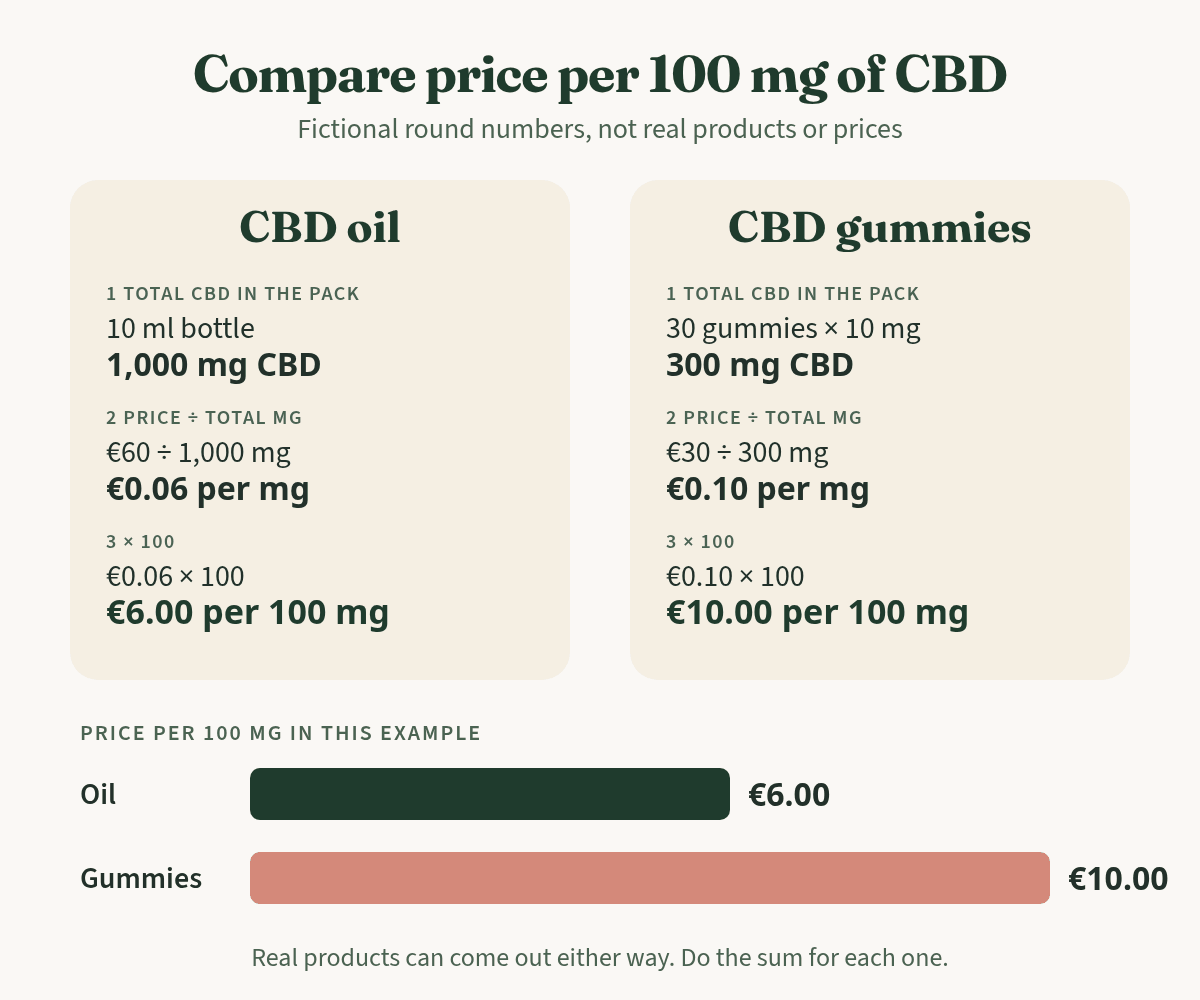
Pack prices are not comparable because the CBD content differs. Use one formula for both formats:
Price ÷ total mg of CBD in the pack = price per mg.
Here is a worked example with made-up round numbers, not real products:
| Oil | Gummies | |
|---|---|---|
| Pack | 10 ml bottle, 1,000 mg CBD | 30 gummies × 10 mg = 300 mg CBD |
| Price | €60 | €30 |
| Price per mg | €0.06 | €0.10 |
In this example the gummies cost less per pack but more per milligram. Real products can come out either way, so do the sum. Compare products of the same spectrum too, because full-spectrum, broad-spectrum and isolate extracts are not priced the same.
THC: the same question for both formats
Full-spectrum oils and gummies can contain small amounts of THC. Broad-spectrum and isolate products aim to contain none. The UK Food Standards Agency warns that you may still be exposed to THC even when a product is labelled “THC-free”, which is worth knowing if you are drug-tested. [5] In the 2025 gummy study mentioned above, 39% of the products contained Δ9-THC, at between 0.019 and 0.88 mg per gummy. [13] The THC line on the batch COA is the figure that tells you what was actually measured.
The rules where you live (2026)
- European Union. The European Commission treats CBD extracts used in food, including oils and gummies taken by mouth, as novel foods. They need EU authorisation and inclusion in the Union list before they can be sold as food or food supplements. [10] In its February 2026 statement, EFSA wrote that CBD products intended for oral consumption remain unauthorised under the Novel Food Regulation. [6] In September 2026 EFSA also published its first opinion finding one specific CBD novel food safe under its proposed conditions of use: synthetic CBD of at least 98% purity, dissolved in MCT oil, in food supplements at up to 2 mg a day for adults over 25, excluding pregnant and breastfeeding women. Safety could not be established for people taking medication. An EFSA opinion is not an authorisation: the decision rests with the European Commission and the Member States. [14] A pending application is not an authorisation either, and the list can change, so check the current Union list before relying on this. [11] How national authorities treat products already on sale differs, so check your own country’s food authority too.
- United Kingdom. CBD foods are novel foods as well. As of 22 October 2026 we found no authorised CBD food. In September 2026 an FSA Board paper recommended that ministers in England and Wales authorise the first three high-purity CBD foods; the final decision rests with ministers. [15] Meanwhile, products linked to applications under assessment appear on the FSA’s public list, and the FSA advises checking that list before buying. Health claims such as relieving pain or improving sleep are not permitted. [5]
- United States. The FDA’s position is that CBD cannot be sold as a dietary supplement or added to food sold across state lines. [12] A federal law enacted on 12 November 2025 also rewrites the definition of hemp. From 12 November 2026, it excludes products containing cannabinoids that the plant cannot produce naturally. From 11 December 2026, after a delay enacted in September 2026, the rest of the new definition applies. Among other things, it excludes naturally occurring cannabinoids that were synthesised outside the plant, and final products with more than 0.4 mg per container of total THC (including THCA) combined with any other cannabinoids with similar effects. Congress could still change these dates. [8][9] Small amounts add up: a jar of 30 gummies at 0.05 mg of THC each holds 1.5 mg. State laws vary as well.
- Elsewhere. Rules differ widely. For example, the FSA notes that Australia regulates CBD as a medicine. [5]
Format alone does not determine legal status. A product’s ingredients and overall composition, its THC content, its intended use and the product category it falls into all matter too.
Which format fits which preference?
Neither format is better in general. They differ in practical ways, and those differences line up with different preferences.
Oil tends to match a preference for:
- measuring small or adjustable amounts, using mg per ml;
- a short ingredient list without sugar, sweeteners or gelatin;
- not minding an earthy taste or a little arithmetic.
Gummies tend to match a preference for:
- a fixed labelled amount per piece, with no measuring;
- a sweet taste instead of hemp;
- something easy to carry;
- sugar or polyols being acceptable, with gelatin or pectin depending on the product.
Whichever format you look at, the same label details let you compare products fairly:
- the batch lab report, including the THC result;
- the CBD per serving and per pack;
- the full ingredient list;
- a business name and contact address on the label, which the FSA also recommends checking. [5]
The FSA advises people who take medication, are pregnant, breastfeeding or trying to conceive, or have an underlying health condition to avoid CBD unless under medical direction. EFSA says safety could not be established for people under 25, during pregnancy or breastfeeding, or for people taking medication. If any of this applies to you, speak to a doctor or pharmacist. [5][6]
FAQ
Are CBD gummies weaker than CBD oil?
Not in themselves. What matters is how many milligrams of CBD you actually take, and both formats are usually swallowed. In one small 2023 trial, oil held under the tongue did not produce higher blood levels than the same oil in swallowed capsules. Gummies were not tested. [1]
Does holding CBD oil under the tongue make a difference?
In the one small controlled comparison (eight men), it made no significant difference to blood levels or time to peak. [1] That is not proof that it never matters; the study was too small to rule out a difference.
Do gummies last longer than oil?
We found no study that compares how long CBD from gummies and from oil lasts. The specific durations quoted on many sites are not backed by head-to-head data. If you mean shelf life rather than effect, see Does CBD Oil Expire?, which covers gummies too.
Will CBD oil or gummies make me high?
CBD itself is not intoxicating. Full-spectrum products can contain traces of THC, and even products labelled “THC-free” may contain some. [5]
Can I take CBD with other medicines?
Ask a doctor or pharmacist first. The FSA does not recommend CBD for people taking medication unless under medical direction, and EFSA says safety cannot be established for this group. [5][6] The Epidiolex label lists interactions with other medicines. [3]
Whether partner shop links are shown depends on your country.
Sources
- Johnson DA, Funnell MP, Heaney LM, et al. Cannabidiol oil ingested as sublingual drops or within gelatin capsules shows similar pharmacokinetic profiles in healthy males. Cannabis and Cannabinoid Research, 2024 (online 2023). doi.org/10.1089/can.2023.0117 · PubMed 37733294
- Perucca E, Bialer M. Critical aspects affecting cannabidiol oral bioavailability and metabolic elimination, and related clinical implications. CNS Drugs, 2020. doi.org/10.1007/s40263-020-00741-5
- US FDA. EPIDIOLEX (cannabidiol) oral solution, prescribing information, section 12.3 (Effect of Food) and section 7 (Drug Interactions). accessdata.fda.gov
- ConsumerLab.com. Tests of CBD oils, softgels, gummies and topical products (news release, 23 August 2023). consumerlab.com
- UK Food Standards Agency. Food Fact Check: CBD safety and health claims (22 June 2026). food.blog.gov.uk
- EFSA NDA Panel. Update of the statement on safety of cannabidiol as a novel food. EFSA Journal, 2026 (EFSA news release 9 February 2026). doi.org/10.2903/j.efsa.2026.9862 · EFSA news
- Regulation (EU) No 1169/2011 on food information to consumers, Annex III, point 2. eur-lex.europa.eu
- Public Law 119-37 (approved 12 November 2025), Division B, section 781 (new definition of hemp, effective 365 days after enactment). govinfo.gov · Congressional Research Service, IF13136 (updated 28 September 2026). congress.gov
- Public Law 119-103, Continuing Appropriations and Extensions Act, 2027 (H.R. 6500, approved 2 September 2026), section 2019 “Section 781 extension”. govinfo.gov
- European Commission. Novel Food Status Catalogue (entries “Cannabinoids” and “Cannabis sativa L.”). food.ec.europa.eu · Regulation (EU) 2015/2283 on novel foods. eur-lex.europa.eu
- European Commission. Union list of novel foods. food.ec.europa.eu
- US FDA. FDA Regulation of Cannabis and Cannabis-Derived Products, Including Cannabidiol (CBD): Questions and Answers. fda.gov
- Johnson ED, Kilgore MW, Stafford M, Randolph M, Glover M, Babalonis S. Cannabidiol gummy products: LC-MS/MS assessment of cannabinoid concentrations. Cannabis and Cannabinoid Research, 2025;10(6):710-718. doi.org/10.1089/can.2024.0167 · PubMed 40454463
- EFSA NDA Panel. Safety of synthetic cannabidiol as a novel food pursuant to Regulation (EU) 2015/2283. EFSA Journal, 2026 (published 18 September 2026). doi.org/10.2903/j.efsa.2026.10154
- UK Food Standards Agency. CBD novel food applications: recommendations to ministers on first authorisations (Board paper, September 2026 Board meeting; page updated 19 October 2026). gov.uk
Last checked: 22 October 2026. Rules in this area change often. We will update this page when they do.