
This article is general information, not medical advice. Hemppy does not make CBD products; the shop lists independent brands and links to their own websites. If you buy through one of those links, Hemppy may earn a commission from the brand, and you pay the same price. See our affiliate disclosure. This guide explains label arithmetic and does not recommend any amount to take.
In CBD oil 10% vs 5%, the difference is concentration: a 5% oil holds 50 mg of CBD in every milliliter and a 10% oil holds 100 mg. In a 10 ml bottle that is 500 mg against 1,000 mg in total, or about 2.5 mg against 5 mg per drop if a drop is 0.05 ml. The 10% oil is twice as concentrated, not twice as good.
This guide shows how to turn a percentage into milligrams, how to estimate CBD per drop, how to compare price per 100 mg, and how to check two bottles against each other. It uses real Love CBD oils as worked examples and does not recommend how much to take.
On this page
- CBD Oil 10% vs 5% at a Glance
- What the Percentage on a CBD Oil Means
- From Percent to Milligrams: The Formula
- How Much CBD Is in One Drop?
- What Actually Differs Between 5% and 10%
- Price per 100 mg: Why Concentration and Value Differ
- Real Examples: Love CBD Oils in Percent
- How to Choose Between 5% and 10%
- When the Label and the Bottle Disagree
- CBD Oil Strength and the Rules (2026)
- Frequently Asked Questions
- The Bottom Line
CBD Oil 10% vs 5% at a Glance
| Measure | 5% CBD oil | 10% CBD oil |
|---|---|---|
| CBD per ml | 50 mg | 100 mg |
| Total in a 10 ml bottle | 500 mg | 1,000 mg |
| Total in a 30 ml bottle | 1,500 mg | 3,000 mg |
| CBD per drop at 20 drops per ml | 2.5 mg | 5 mg |
| CBD per drop at 25 drops per ml | 2 mg | 4 mg |
| Drops in a 10 ml bottle at 20 per ml | 200 | 200 |
| CBD in a full 1 ml dropper | 50 mg | 100 mg |
The percentage is a concentration, so it does not change with bottle size. The total changes with both: 5% in a 30 ml bottle holds three times the CBD of 5% in a 10 ml bottle. Drop counts are estimates, because dropper size varies.
What the Percentage on a CBD Oil Means
The percentage says how much of the oil is CBD. One percentage point is 10 mg of CBD in every milliliter of oil, so 5% is 50 mg per ml and 10% is 100 mg per ml.
There is one catch. A percentage can be calculated by volume (w/v: grams of CBD per 100 ml of oil) or by weight (w/w: grams of CBD per 100 g of oil). They match only if a milliliter of the oil weighs exactly one gram. Oils are lighter than that, so a 5% w/w oil holds slightly less than 50 mg per ml. When two brands both print “5%”, compare their mg per ml or total mg instead. The CBD oil guide works through this difference.
Many brands print only the total milligrams, for example “1,000 mg”. That is the CBD in the whole bottle, and it says nothing about strength until you divide by the bottle’s volume.
From Percent to Milligrams: The Formula
Two lines cover every case:
- percentage × 10 = mg of CBD per ml
- mg per ml × bottle volume in ml = total mg
Worked examples with fictional bottles:
- 5% in 10 ml: 5 × 10 = 50 mg per ml, then 50 × 10 = 500 mg.
- 10% in 10 ml: 10 × 10 = 100 mg per ml, then 100 × 10 = 1,000 mg.
- 10% in 30 ml: 100 mg per ml × 30 = 3,000 mg.
To go the other way, divide the total by the volume, then by 10. A label of 1,500 mg in a 30 ml bottle is 1,500 ÷ 30 = 50 mg per ml, which is 5%. The same 1,500 mg in a 10 ml bottle is 150 mg per ml, or 15%.
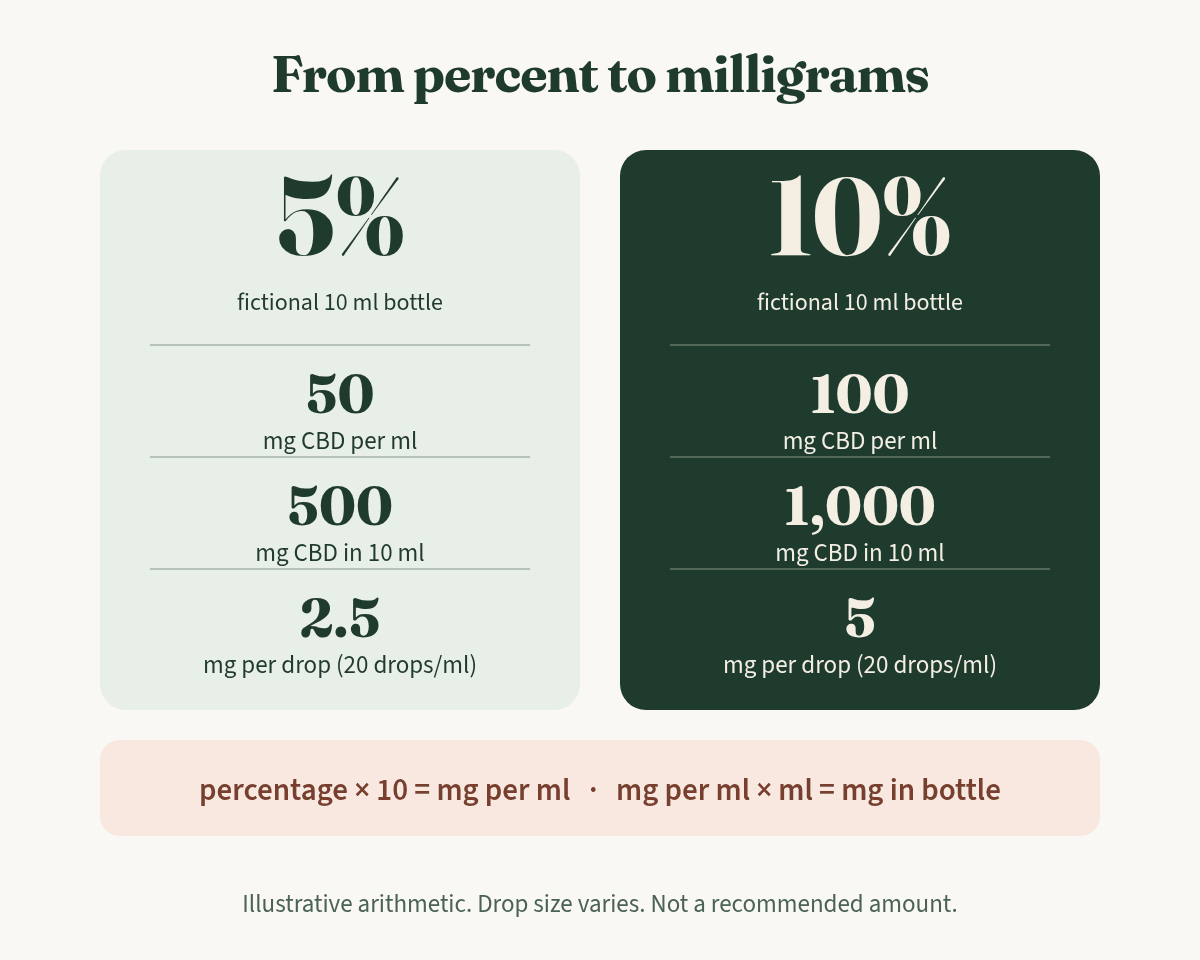
This is fictional arithmetic, not a real product or a suggested amount. The point is the unit: a percentage tells you about the oil, and a milligram total tells you about the bottle.
How Much CBD Is in One Drop?
CBD per drop is mg per ml divided by drops per ml. Drops are not a fixed unit. Estimates of 20 drops per ml (0.05 ml each) are common, and some droppers give 25 or 30.
| Strength | CBD per ml | 20 drops per ml | 25 drops per ml | 30 drops per ml |
|---|---|---|---|---|
| 5% | 50 mg | 2.5 mg | 2 mg | 1.7 mg |
| 10% | 100 mg | 5 mg | 4 mg | 3.3 mg |
These are estimates, not label values. A dropper with milliliter marks is a firmer basis: 0.2 ml of a 5% oil holds 10 mg of CBD whatever the drop size, and 0.1 ml of a 10% oil holds the same.
Sprays work differently. Love CBD states CBD per spray for each oil. Those figures imply about 0.12 ml per spray, roughly 170 sprays in a 20 ml bottle, which is our arithmetic from its labeled numbers. [1] [2] [3]
What Actually Differs Between 5% and 10%
At the same bottle size, only a few things change.
- CBD per ml and per drop: the 10% oil has twice as much of each.
- Total CBD in the bottle: twice as much, so a 10% bottle contains twice the milligrams of a 5% bottle of the same volume.
- How long a bottle lasts: at the same amount taken, a 10% oil needs half the volume, so the bottle lasts about twice as long.
- Price per 100 mg: often lower for the higher strength, but not always (see below).
What does not follow from the percentage is quality, extract type, carrier oil, taste, or what any amount does. Nothing in the label arithmetic shows that 10% works “twice as well” as 5%. The amount of CBD you take is what the milligram figure measures, and the bottle’s percentage only decides how many drops that takes.
Who the product is for, and how much to take, are questions for a doctor or pharmacist, especially for anyone pregnant, breastfeeding, taking medication or under 18. The FSA advises people in those groups not to use CBD food products unless under medical direction. [4]
Price per 100 mg: Why Concentration and Value Differ
Price per 100 mg is the price divided by the total mg in the bottle, times 100. It makes bottles of different sizes comparable.
A fictional example: a 10 ml bottle of 5% oil costs €25 and a 10 ml bottle of 10% oil costs €40. The 5% oil costs 25 ÷ 500 × 100 = €5.00 per 100 mg and the 10% oil 40 ÷ 1,000 × 100 = €4.00. The 10% bottle costs more but gives more CBD per euro. That is common, though brands set their own prices and it is not a rule.
Two bottles with the same percentage can also differ: a 10 ml and a 30 ml bottle of 10% oil have the same mg per ml, but the larger holds three times the CBD and usually costs less per 100 mg. Price per 100 mg compares cost only. It says nothing about the extract, the carrier, or how a batch tested.
Real Examples: Love CBD Oils in Percent
Love CBD prints strength in milligrams per 20 ml bottle, not as a percentage. The table converts its nine oils to w/v percentages using our arithmetic (mg ÷ 20 ml ÷ 10). Prices are the brand’s regular GBP prices on 3 November 2026. [1] [2] [3]
| Oil (20 ml) | CBD per bottle | Equivalent % (w/v) | CBD per spray (brand) | Price | Per 100 mg |
|---|---|---|---|---|---|
| Dutch 150 mg | 150 mg | 0.75% | 0.87 mg | £9.99 | £6.66 |
| Gold 250 mg | 250 mg | 1.25% | 1.5 mg | £12.99 | £5.20 |
| Dutch 300 mg | 300 mg | 1.5% | 1.74 mg | £18.99 | £6.33 |
| Dutch 500 mg | 500 mg | 2.5% | 2.9 mg | £28.99 | £5.80 |
| Gold 500 mg | 500 mg | 2.5% | 3 mg | £22.99 | £4.60 |
| Entourage 800 mg | 800 mg | 4% | 4.65 mg | £48.99 | £6.12 |
| Gold 1000 mg | 1,000 mg | 5% | 6 mg | £39.99 | £4.00 |
| Entourage 1400 mg | 1,400 mg | 7% | 8.13 mg | £79.99 | £5.71 |
| Entourage 2000 mg | 2,000 mg | 10% | 11.62 mg | £99.99 | £5.00 |
Two of these sit exactly on the 5% and 10% in this article: Gold 1000 mg is 5% and Entourage 2000 mg is 10%. The 10% oil costs £99.99 against £39.99, and its price per 100 mg is higher (£5.00 against £4.00), the opposite of the fictional example above. The two also differ in extract (full-spectrum against broad-spectrum), carrier (olive oil against MCT oil) and brand range, so this is not a clean test of percentage alone.
Within a single range, the pattern does hold: Entourage falls from £6.12 per 100 mg at 4% to £5.00 at 10%. All nine oils are on the Love CBD brand page, and our Love CBD review covers its lab reports and delivery terms.
How to Choose Between 5% and 10%
The percentage is a convenience, so choose by what the label lets you do with it.
- Start from the label, not the percentage. Read the total mg, the volume and the amount the label says per serving. The FSA’s provisional advice is a maximum of 10 mg CBD a day for healthy adults. [4] A full 1 ml dropper of 10% oil holds 100 mg, ten times that figure, and of 5% oil 50 mg.
- Smaller steps or fewer drops. A lower percentage allows smaller changes between labeled amounts. A higher one needs fewer drops or sprays for the same mg. Neither is better in itself.
- Counting drops. If a label amount takes ten or more drops of a 5% oil, a 10% oil would need about half as many. If one drop of 10% oil is already more than you want, the 5% oil gives finer steps.
- Bottle size and price. Compare price per 100 mg across sizes, not price per bottle.
- What else is in the bottle. Spectrum, carrier and a batch certificate matter as much as the percentage. See full-spectrum vs broad-spectrum CBD.
If you take any medication or have a health condition, ask a doctor or pharmacist before using CBD. This article does not tell anyone how much to take.
When the Label and the Bottle Disagree
A percentage on the front is a claim. In a 2017 US study, researchers bought 84 CBD products online and had them analysed. Only 31% were within 10% of the labeled CBD, and among the 40 oils 18 (45%) were. [5] A 2018 study of 14 European CBD oils found nine whose CBD concentration differed notably from the declared amount. [6]
In a UK study of 29 products, the mean advertised CBD content was 4.5% but the mean measured content was 3.2%, and only 11 products were within 10% of the label. [7] These studies are small and a few years old. They cannot say how accurate any brand is today, but they explain why two bottles that both say “10%” should be compared through their lab reports.
A certificate usually reports mg/g or %, not mg per ml. Converting needs the oil’s density, which the report rarely states, so check the units. Our guide to reading a CBD lab report shows how to match a certificate to a label, and the CBD glossary defines the terms.
CBD Oil Strength and the Rules (2026)
This article explains arithmetic. It does not say that any CBD oil may be sold or bought where you live. This is a dated summary as of 3 November 2026, not legal advice.
In the UK, FSA guidance updated on 28 August 2026 classes CBD extracts and isolates as novel foods that need authorization and states that none has yet been authorized. [4] In the EU, the Novel Food Status Catalogue lists cannabinoid extracts as novel foods, which need authorization and entry on the Union list before sale. [8] [9] As of 3 November 2026 we found no CBD on the Union list. [10] National rules differ and are not mapped here.
Frequently Asked Questions
How many mg is 5% CBD oil?
A 5% oil holds 50 mg of CBD per ml, so 500 mg in 10 ml and 1,500 mg in 30 ml. This assumes the percentage is w/v, which is worth checking on the label.
How many mg is 10% CBD oil?
A 10% oil holds 100 mg per ml: 1,000 mg in 10 ml and 3,000 mg in 30 ml.
Is 10% CBD oil strong?
It is a high concentration for a retail oil, but “strong” depends on the amount taken, not the bottle. A full 1 ml dropper of 10% oil holds 100 mg, which is ten times the FSA’s provisional 10 mg daily figure for healthy adults. [4]
Is 10% CBD oil twice as good as 5%?
It holds twice as much CBD per ml and per drop. Nothing about the percentage shows it works twice as well, and quality depends on the extract, the carrier and the batch certificate.
How many drops are in 1 ml of CBD oil?
It depends on the dropper and the oil. 20 drops per ml is a common estimate, and some droppers give 25 or 30. Use milliliter marks if you need a firm figure.
How do I convert mg to a percentage?
Divide the total mg by the volume in ml, then divide by 10. For example 1,000 mg in 10 ml is 100 mg per ml, which is 10%.
Does the carrier oil change the percentage?
Only if the percentage is by weight. Carrier oils weigh different amounts per ml, so a w/w percentage and a w/v percentage drift apart. Compare mg per ml or total mg.
The Bottom Line
Percent to milligrams is one multiplication: percentage × 10 gives mg per ml, and times the volume gives the bottle total. A 5% oil has 50 mg per ml and a 10% oil 100 mg per ml.
The higher percentage means fewer drops for the same milligrams and often a lower price per 100 mg, but not always, as the Love CBD examples show. It does not mean better quality or a better result.
Compare two bottles by total mg, volume, price per 100 mg and a certificate whose batch matches the pack. For amounts, rely on the label and a doctor or pharmacist, not on the percentage.
Scientific and Regulatory Sources
Label arithmetic and examples
- Love CBD. CBD Oils, Dutch CBD Range (product page: 20 ml bottle, 150, 300 and 500 mg strengths, CBD per spray, variation prices). Checked 3 November 2026. Love CBD.
- Love CBD. CBD Oils, Entourage Range (product page: 20 ml bottle, 2000 mg strength, CBD per spray, variation price). Checked 3 November 2026. Love CBD.
- Love CBD. CBD Oils, Gold Range (product page: 20 ml bottle, 250, 500 and 1000 mg strengths, CBD per spray, variation prices). Checked 3 November 2026. Love CBD.
- UK Food Standards Agency. Cannabidiol (CBD) guidance: business guidance on CBD as a novel food (England and Wales), updated 28 August 2026. Official guidance.
Accuracy and testing
- Bonn-Miller M.O., Loflin M.J.E., Thomas B.F., Marcu J.P., Hyke T., Vandrey R. (2017). Labeling accuracy of cannabidiol extracts sold online. JAMA 318(17):1708–1709. Full study.
- Pavlovic R., Nenna G., Calvi L. et al. (2018). Quality traits of “cannabidiol oils”: cannabinoids content, terpene fingerprint and oxidation stability of European commercially available preparations. Molecules 23(5):1230. Full study.
- Liebling J.P., Clarkson N.J., Gibbs B.W., Yates A.S., O’Sullivan S.E. (2022). An analysis of over-the-counter cannabidiol products in the United Kingdom. Cannabis and Cannabinoid Research 7(2):207–213. Full study.
Rules
- European Commission. Novel Food Status Catalogue (entries “Cannabinoids” and “Cannabis sativa L.”). Official guidance.
- Regulation (EU) 2015/2283 of the European Parliament and of the Council of 25 November 2015 on novel foods, Articles 3, 6 and 10 to 12 (definition, Union list and authorisation procedure). EUR-Lex.
- European Commission. Union list of novel foods. Official list.
Facts and prices checked: 3 November 2026 (Europe/Riga). Worked examples marked fictional are not real products. This article provides general educational information, not medical advice, legal advice or a product-specific determination of regulatory compliance.