
This article is general information, not medical advice. Hemppy does not sell products. Our shop, opening soon, will link to partner brands’ own websites, where you buy from the brand directly. If you buy through one of those links, Hemppy may earn a commission from the brand. This article does not recommend any specific product.
The CBG vs CBD question is really about a precursor and a product. CBG (cannabigerol) and CBD (cannabidiol) are both non-intoxicating hemp cannabinoids, but CBG’s acid form is the plant’s starting material for CBD, THC and CBC.
That difference in position shapes almost everything else. CBG is usually present only in small amounts, has a slightly different formula, and acts on some different receptors in laboratory studies. It has also been studied in people far less than CBD.
The practical gaps are just as important: no CBG medicine exists, the human evidence comes from a handful of small trials, and the rules differ. CBG is prohibited in competitive sport, CBD is not. This guide compares the two on chemistry, research, safety, lab reports and law.
On this page
- CBG and CBD at a Glance
- What Is CBG and How Does It Relate to CBD?
- How Do CBG and CBD Act in the Body?
- Does CBG Get You High?
- CBG vs CBD in Human Research
- Is CBG Safe? What Is Known and Unknown
- How to Read CBG on a Lab Report
- CBG, CBD and Drug Testing in Sport
- CBG and CBD Under the Law: EU, UK and US
- Frequently Asked Questions About CBG and CBD
- The Bottom Line
CBG and CBD at a Glance
| CBG (cannabigerol) | CBD (cannabidiol) | |
|---|---|---|
| Place in the plant | Its acid, CBGA, is the shared precursor | Made from CBGA via CBDA |
| Formula | C21H32O2 | C21H30O2 |
| Intoxicating? | No “high” reported in small trials | No “high” in controlled studies |
| Human trials | A few small, short trials | Many, including medicine trials |
| Approved medicine | None found | Epidiolex / Epidyolex |
| Sport (WADA 2026) | Prohibited in competition | Exempt |
| EU food status | Novel food; 2024 CBG applications ended | Novel food; none authorised |
CBG is not a stronger or newer version of CBD. It is a different molecule with much less human data behind it, so most questions about CBG do not yet have firm answers.
What Is CBG and How Does It Relate to CBD?
CBGA: the branch point
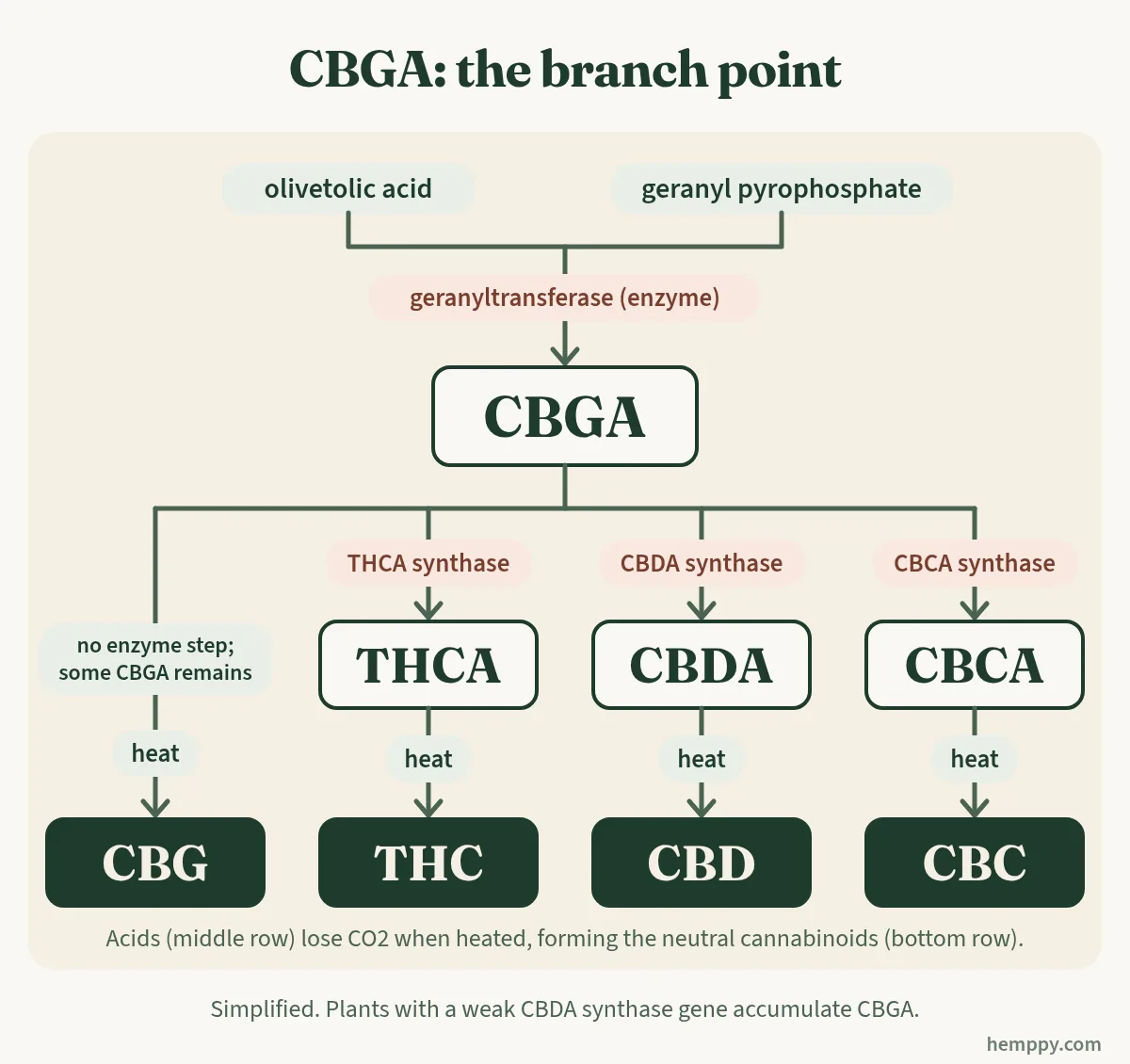
The plant builds cannabinoids in steps. First, an enzyme joins two smaller molecules, olivetolic acid and geranyl pyrophosphate, to form cannabigerolic acid (CBGA). [1] CBGA then reaches a fork. THCA synthase turns it into THCA, the acid form of THC. [2] CBDA synthase turns it into CBDA, the acid form of CBD. [3] A third enzyme makes CBCA, the acid form of cannabichromene (CBC). [4]
Each acid becomes its familiar neutral form when it loses carbon dioxide, a reaction called decarboxylation that heat speeds up. CBGA becomes CBG, CBDA becomes CBD, and THCA becomes THC. [4] The CBD vs THC guide explains how the THC and CBD branches differ.
Why most hemp contains little CBG
Because CBGA is used up as it is converted into other acids, most plants contain only a small amount of it. Breeding studies found CBG-predominant plants in fibre hemp, caused by an inherited version of the CBD synthase gene that barely works, so CBGA builds up instead of being converted. [5]
Same family, different formula
CBG has the formula C21H32O2 and a molecular weight of about 316.5. CBD is C21H30O2, about 314.5. [6] The two extra hydrogen atoms reflect CBG’s open, unfolded chain. The ring closures made by the synthase enzymes are absent, and that structural difference is one reason the two molecules act differently in laboratory tests.
How Do CBG and CBD Act in the Body?
Almost everything known here comes from cell and animal studies, which show how a molecule can behave, not what it will do in a person.
A 2021 review by Nachnani and colleagues at Penn State concluded that CBG’s affinity and activity at the cannabinoid receptors lie between those of THC and CBD. It also found CBG unusual in its interactions with α2-adrenoceptors and the serotonin 5-HT1A receptor. The authors stressed that, unlike CBD, little research has been done on what they called an unregulated molecule. They reported no conflicts of interest. [7]
A 2024 review by Li and colleagues described CBG as a partial agonist at the CB2 receptor with minimal direct activation of CB1. It also reported that CBG was a weaker inhibitor than CBD of FAAH, an enzyme that breaks down one of the body’s own cannabinoids. [8]
CBD’s own receptor profile is different again, and is covered in the CBD basics guide. Different receptor profiles do not, on their own, show that either compound is useful for anything.
Does CBG Get You High?
The available evidence says no. Reviews describe CBG as non-intoxicating, unlike THC. [8] In a 2024 trial, 34 healthy adults who already used cannabis took 20 mg of CBG or placebo at home, supervised over video call, in random order. They reported no subjective drug effects, and an impairment app showed no difference from placebo. [9]
In a 2026 laboratory study, 12 healthy adults took single doses of 25, 50, 100 and 200 mg of CBG, with placebo inserted at random. Subjective effects were minimal, and the authors described few psychoactive effects. [10] Both studies measured short-term effects only.
CBG vs CBD in Human Research
CBD has been tested in large randomised trials, including those that led to a prescription medicine. CBG’s human evidence, by contrast, can be listed in full in a few paragraphs.
Controlled trials of CBG
Wolinsky and colleagues (2026) gave 12 healthy adults ascending single doses of CBG isolate in MCT oil at Johns Hopkins. No drug-related adverse events occurred. A few ratings changed at particular doses: lower “jittery” and “active” ratings at 50 mg, lower “calm” at 100 mg and higher appetite at 200 mg. Blood levels rose with dose but varied widely between people. Liver tests stayed within normal limits after the two highest doses.
The authors called for studies of repeated dosing. One author was affiliated with Charlotte’s Web Inc. [10]
Cuttler and colleagues (2024) ran the crossover trial described above. Compared with placebo, CBG was linked with lower overall anxiety ratings, lower stress about 20 minutes after dosing and better scores on a verbal memory test.
The authors listed several limits: one modest dose, measurements only in the first hour, a sample of existing cannabis users and no correction for multiple comparisons. CReDO Science, a company that works with CBG, funded the study, and its founder was a co-author; the funder had no role in the analysis. [9]
Story and colleagues (2024) studied how food changes CBG absorption. Nineteen adults completed a pilot study taking 25 mg of CBG in gummies, either as isolate or emulsified, alongside low-fat or high-fat meals. A high-fat meal raised peak blood levels of CBG from the isolate gummy roughly ninefold, a bigger effect than the emulsion. No adverse effects were reported.
The work was funded by a US Department of Agriculture Hatch grant and the University of Massachusetts, with CBG donated by a supplier. [11]
Products that combine CBG and CBD
One randomised pilot tested a drink powder containing 35 mg of CBD and 50 mg of CBG, plus beta-caryophyllene, amino acids and magnesium, in 40 exercise-trained adults with induced muscle soreness. The primary result, soreness ratings at 72 hours, favoured the product, but it was reported with an 85% confidence interval rather than the usual 95%. Objective recovery measures showed no difference.
Because the product mixed several ingredients, the trial cannot separate CBG’s role from CBD’s. Most authors were employees of Canopy Growth, a cannabis company. [12]
Surveys of CBG users
Two online surveys asked people who already use CBG what they use it for. One, of 127 US adults using CBG-predominant cannabis, found anxiety, chronic pain, depression and sleep the most common reasons, and most rated their products highly. [13] A 2026 survey of 239 CBG and CBGA users reported a typical dose of 10 to 12 mg. [14]
People who choose to answer a survey about a product they use are likely to view it favourably. The authors of both surveys include the founder of CReDO Science, a company that works with CBG. Surveys describe use patterns; they cannot show that CBG causes any effect.
How the evidence compares
| CBG | CBD | |
|---|---|---|
| Largest controlled human studies found | 34 people for CBG alone; 40 for a mixed product | Hundreds, including medicine trials |
| Longest controlled exposure found | Single doses; 3.5 days in a mixed product | Weeks to months |
| Head-to-head CBG vs CBD trial | None found | None found |
| Regulator-reviewed safety data | None found | Prescription medicine label |
We found no published trial that compares CBG and CBD directly for anxiety, sleep, pain or any other outcome.
Is CBG Safe? What Is Known and Unknown
For CBD, the picture is detailed. The prescription medicine’s label lists sleepiness, decreased appetite, diarrhoea, raised liver enzymes, fatigue, rash, sleep problems and infections as common adverse reactions, and it warns about liver injury and interactions with other medicines. [15]
In a 2025 FDA-funded trial of 201 healthy adults, some took 5 mg/kg of CBD a day for 28 days. Liver enzymes rose above three times the upper limit of normal in 8 of 151 people on CBD and in none of 50 on placebo. [16]
For CBG, the human safety record is short. The small trials above found no drug-related adverse events and normal liver tests after single doses. [10] No study we found has tracked people taking CBG on its own every day for weeks, tested its interactions with medicines, or studied pregnancy, children or older adults. That is an absence of data, not evidence of safety or harm.
How to Read CBG on a Lab Report
A certificate of analysis (COA) may list CBG and CBGA separately. Some labs add a “total CBG” figure, which converts CBGA to the CBG it would become after decarboxylation. Based on the molecular weights, 316.5 ÷ 360.5, that factor works out at about 0.878. [6] This is our arithmetic, not a regulatory formula.
Here is a fictional worked example. A COA for a 30 ml oil reports 1.50% CBG and 0.20% CBGA by weight.
- Total CBG = 1.50% + (0.878 × 0.20%) = 1.68% (rounded).
- Treating 30 ml as roughly 30 g, an approximation since oil density varies, that is about 500 mg of total CBG in the bottle.
- If the label claims 500 mg of CBG, the figures roughly match. If it claims 1,000 mg, they do not.
Hemp extracts of any kind can carry THC. A study of 56 CBD gummy products found Δ9-THC in 39% of them, a reminder that the THC lines on the same report matter just as much. [17] Check that the batch number on the COA matches the product. The CBD oil guide explains the rest of a lab report.
CBG, CBD and Drug Testing in Sport
This is one of the clearest differences between the two. The World Anti-Doping Agency’s 2026 list prohibits all natural and synthetic cannabinoids in competition, with a single exception: cannabidiol. CBG is not exempt. [18]
The issue can affect CBD users too. In a 2026 study, 31 people took a broad-spectrum CBD product with trace amounts of CBG for ten weeks. CBG was found in 42% of urine samples before exercise and 74% after it, and the authors concluded that athletes should avoid broad-spectrum CBD products. No THC was detected. [19]
CBG and CBD Under the Law: EU, UK and US
Rules on minor cannabinoids are less developed than those on CBD and change often. The summary below reflects the position as of 22 October 2026 and is general information, not legal advice.
European Union
The European Commission’s Novel Food Status Catalogue treats extracts of Cannabis sativa L. and products containing cannabinoids as novel foods. [20] In 2024 the Commission ended the novel food procedures for synthetic CBG (NF 2022/6330), CBG from Cannabis sativa L. (NF 2022/6332) and a combined CBD and CBG application (NF 2020/1603). [21] We found no authorised CBG or CBD novel food on the Union list. [22] A novel food needs an EU authorisation before it is placed on the market. [23]
Hemp grown under the EU farm payment rules must contain no more than 0.3% THC. [24] National drug and food rules also apply and vary. The CBD oil vs gummies guide covers EU and UK food rules for CBD.
United Kingdom
The Home Office treats pure CBD as not controlled, but THC and several other cannabinoids are Class B drugs, and it advises that CBD products are highly likely to contain traces of them. [25] Its factsheet does not mention CBG by name, and we found no Home Office guidance specific to CBG. A CBG product that contains THC raises the same questions as a CBD product. The FSA treats CBD in food as a novel food that needs authorisation. [26]
United States
Federal law defines hemp by its Δ9-THC content, no more than 0.3% on a dry-weight basis, and does not set a separate limit for CBG. [27]
A 2025 law changes the definition to count total THC, including THCA. It also excludes final products with more than 0.4 mg per container of total THC and cannabinoids with similar effects, and products with cannabinoids synthesised or made outside the plant. [28] Those changes are being phased in on 12 November and 11 December 2026. [29] How the new wording applies to any particular CBG product is a question for a lawyer. State rules also differ.
Frequently Asked Questions About CBG and CBD
Is CBG the same as CBD?
No. They are related but separate cannabinoids. CBG’s acid form is the precursor the plant uses to make CBD’s acid form, and the two differ in structure, receptor activity and the amount of research behind them. A related comparison covers CBN vs CBD.
Is CBG better than CBD for sleep, anxiety or pain?
There is no evidence either way. We found no trial comparing the two directly. CBG’s human data come from a few small, short studies and user surveys. CBD’s only approved medical uses are three rare seizure conditions. [15]
Is CBG stronger than CBD?
“Stronger” has no clear meaning here. The two act on different receptors with different potency in lab tests, and neither produces a high. Milligram amounts on labels say how much is present, not how strong the effect will be.
Can CBG and CBD be taken together?
Many products combine them, but only one small, industry-funded trial has tested a CBG and CBD combination, alongside other ingredients. [12] We found no study of how the two interact in the body. Anyone taking prescription medicines should ask a doctor or pharmacist first, because CBD is known to interact with some. [15]
What is CBGA?
CBGA (cannabigerolic acid) is the acid form of CBG and the precursor the plant uses to make THCA, CBDA and CBCA. Heat converts CBGA into CBG. [4]
The Bottom Line
CBG and CBD are close relatives. CBG’s acid form is the plant’s starting point, and CBD is one of the compounds made from it.
Neither causes a high. In lab studies they act on partly different targets, but no trial has compared them directly in people.
CBD has a prescription medicine and a detailed safety record, including known liver and drug-interaction risks. CBG has a few small, short trials and no long-term safety data.
Many practical differences are regulatory. CBG is prohibited in competition, and the 2024 EU applications for CBG as a food ended. A lab report showing both cannabinoids and THC tells more than the name on the label.
Scientific and Regulatory Sources
Plant chemistry and pharmacology
- Fellermeier M., Zenk M.H. (1998). Prenylation of olivetolate by a hemp transferase yields cannabigerolic acid, the precursor of tetrahydrocannabinol. FEBS Letters. PubMed.
- Sirikantaramas S. et al. (2004). The gene controlling marijuana psychoactivity: molecular cloning and heterologous expression of Δ1-tetrahydrocannabinolic acid synthase from Cannabis sativa L. Journal of Biological Chemistry. PubMed.
- Taura F., Morimoto S., Shoyama Y. (1996). Purification and characterization of cannabidiolic-acid synthase from Cannabis sativa L. Journal of Biological Chemistry. PubMed.
- Tahir M.N. et al. (2021). The biosynthesis of the cannabinoids. Journal of Cannabis Research. Full study.
- de Meijer E.P.M., Hammond K.M. (2005). The inheritance of chemical phenotype in Cannabis sativa L. (II): cannabigerol predominant plants. Euphytica. Publisher abstract.
- National Library of Medicine. PubChem compound records: cannabigerol (CID 5315659), cannabigerolic acid (CID 6449999) and cannabidiol (CID 644019). PubChem CBG · PubChem CBGA · PubChem CBD.
- Nachnani R., Raup-Konsavage W.M., Vrana K.E. (2021). The pharmacological case for cannabigerol. Journal of Pharmacology and Experimental Therapeutics. PubMed.
- Li S. et al. (2024). Cannabigerol (CBG): a comprehensive review of its molecular mechanisms and therapeutic potential. Molecules. Full study.
Human studies, medicines and testing
- Cuttler C., Stueber A., Cooper Z.D., Russo E. (2024). Acute effects of cannabigerol on anxiety, stress, and mood: a double-blind, placebo-controlled, crossover, field trial. Scientific Reports. Full study.
- Wolinsky D. et al. (2026). Safety, pharmacodynamics, and pharmacokinetics of oral cannabigerol in healthy adults. Journal of Pharmacology and Experimental Therapeutics. PubMed.
- Story G. et al. (2024). Impact of dietary fat and oral delivery system on cannabigerol pharmacokinetics in adults. Cannabis and Cannabinoid Research. Full study.
- Peters E.N. et al. (2023). A randomized, double-blind, placebo-controlled, repeated-dose pilot study of the safety, tolerability, and preliminary effects of a cannabidiol (CBD)- and cannabigerol (CBG)-based beverage powder to support recovery from delayed onset muscle soreness (DOMS). Journal of the International Society of Sports Nutrition. Full study.
- Russo E.B. et al. (2022). Survey of patients employing cannabigerol-predominant cannabis preparations: perceived medical effects, adverse events, and withdrawal symptoms. Cannabis and Cannabinoid Research. Full study.
- Lutz E.T.H. et al. (2026). A survey of cannabigerol users’ patterns of use, perceived efficacy and satisfaction. Journal of Psychoactive Drugs. PubMed.
- US Food and Drug Administration. EPIDIOLEX (cannabidiol) oral solution, prescribing information (revised May 2026), sections 1, 5, 6 and 7. Official label.
- Florian J. et al. (2025). Cannabidiol and liver enzyme level elevations in healthy adults: a randomized clinical trial. JAMA Internal Medicine. Full study.
- Johnson E.D. et al. (2025). Cannabidiol gummy products: LC-MS/MS assessment of cannabinoid concentrations. Cannabis and Cannabinoid Research. PubMed.
- World Anti-Doping Agency. The 2026 Prohibited List, section S8 Cannabinoids. Official list.
- Gillham S.H. et al. (2026). Daily use of a broad-spectrum cannabidiol supplement produces detectable concentrations of cannabinoids in urine prohibited by the World Anti-Doping Agency: an effect amplified by exercise. Medicine & Science in Sports & Exercise. PubMed.
Laws and regulators
- European Commission. Novel Food Status Catalogue (entries for cannabinoids and Cannabis sativa L.). Official guidance.
- European Commission. Decisions terminating the novel food authorisation procedure (2024: NF 2022/6330, NF 2022/6332 and NF 2020/1603). Official decisions.
- European Commission. Union list of novel foods. Official list.
- Regulation (EU) 2015/2283 on novel foods. EUR-Lex.
- European Commission. Hemp: rules for cultivation and EU support (Regulation (EU) 2021/2115). Official information.
- UK Home Office. Drug licensing factsheet: cannabis, CBD and other cannabinoids (updated 3 October 2024). Official guidance.
- UK Food Standards Agency. Food Fact Check: CBD safety and health claims (22 June 2026). Official guidance.
- United States Code, 7 U.S.C. §1639o (definition of hemp, as in force on 22 October 2026). GovInfo.
- Public Law 119-37 (enacted 12 November 2025), Division B, section 781 (new definition of hemp). GovInfo.
- Public Law 119-103 (enacted 2 September 2026), section 2019 (phased application of section 781). GovInfo.
Scientific and regulatory material reviewed: 22 October 2026. This article provides general educational information, not medical advice, legal advice or a product-specific determination of regulatory compliance.